


























Views
Downloads

Printable Conflict Resolution Worksheet | Grade 6-9
Paste this activity's link or code into your existing LMS (Google Classroom, Canvas, Teams, Schoology, Moodle, etc.).
Students can open and work on the activity right away, with no student login required.
You'll still be able to track student progress and results from your teacher account.
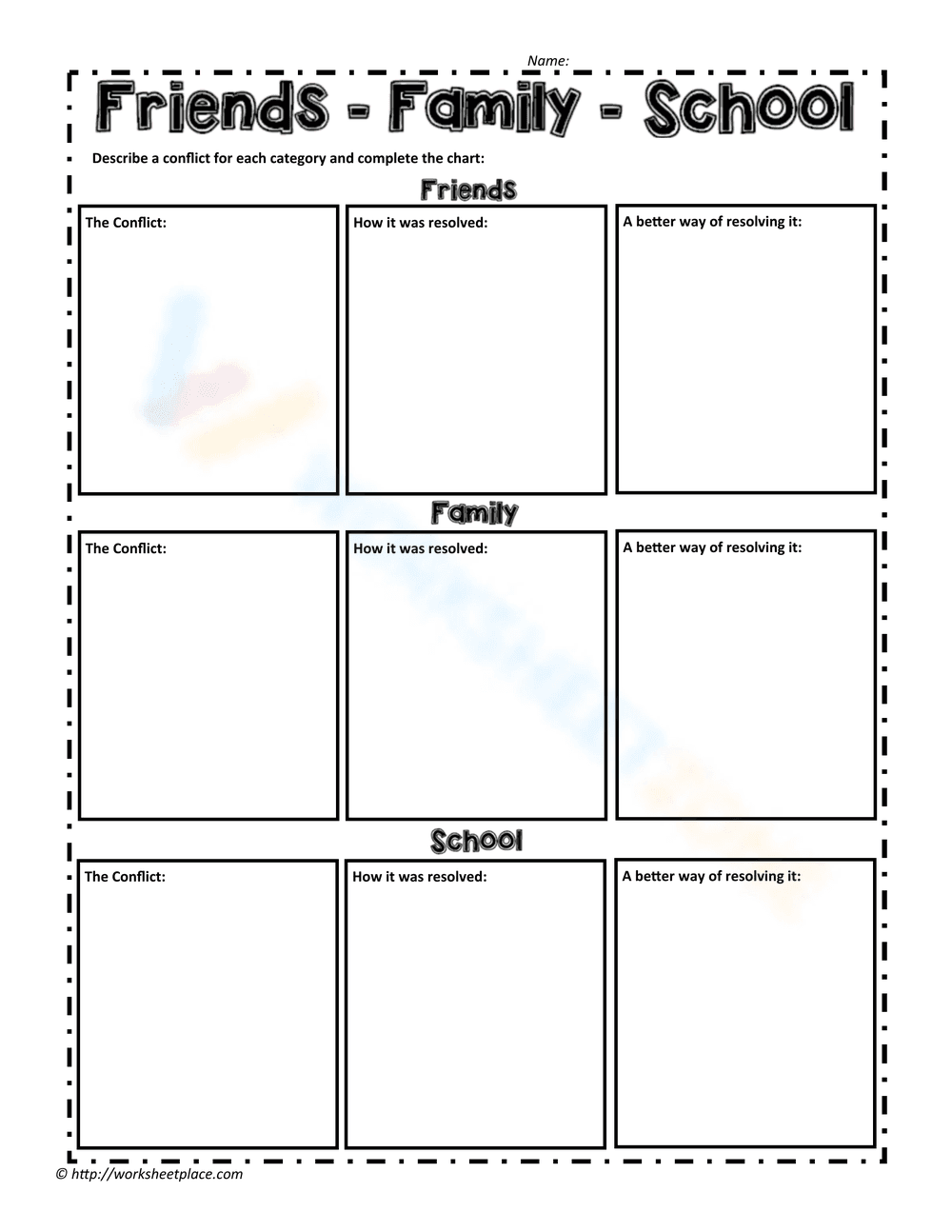
This conflict resolution worksheet helps middle school students identify and evaluate interpersonal challenges across different areas of their lives. By reflecting on specific situations with friends, family, and school, students develop critical social-emotional skills and practice articulating better ways to handle future disagreements.
At a Glance
- Grade: 6-9 · Subject: English
- Standard:
CCSS.ELA-LITERACY.W.6.4— Produce clear and coherent writing appropriate to the task.- Skill Focus: Conflict Resolution
- Format: 1 page · 3 problems · Answer key included · PDF
- Best For: Independent reflection and SEL
- Time: 15–20 minutes
Inside this single-page resource, students will find a structured graphic organizer divided into three distinct categories: Friends, Family, and School. For each category, learners describe a specific conflict they experienced. They then explain how the situation was resolved and brainstorm a constructive alternative. The boxed layout provides ample space for writing. A sample answer key is included to guide discussions.
This resource is designed for immediate classroom implementation with a streamlined zero-prep workflow.
- Print (1 minute): Download the PDF and print a class set. The design is ink-friendly and requires no special formatting.
- Distribute (1 minute): Hand out during an advisory period, SEL block, or English class.
- Review (3 minutes): Briefly explain the categories and model one constructive resolution.
With total teacher prep time under two minutes, this activity is perfect for morning meetings or as a reliable emergency sub plan.
This activity aligns with CCSS.ELA-LITERACY.W.6.4: "Produce clear and coherent writing in which the development, organization, and style are appropriate to task, purpose, and audience." By requiring students to articulate their experiences and formulate alternative solutions, the exercise reinforces essential expressive writing skills. Both standard codes can be copied directly into lesson plans, IEP goals, or district curriculum mapping tools.
Teachers can integrate this worksheet as an independent reflection activity after a lesson on interpersonal communication. Alternatively, use it as a restorative practice tool when students navigate real-time disagreements. As a formative assessment observation tip, look for students' ability to shift from blaming language to proactive, solution-oriented language in the final box. Expected completion time ranges from 15 to 20 minutes.
This resource is primarily designed for middle school students in grades 6 through 9 who are developing their social-emotional competencies. The structured format provides natural differentiation for students who struggle with open-ended journaling, as the specific prompts break the task into manageable steps. It pairs perfectly with a direct instruction lesson on "I" statements or a classroom anchor chart detailing healthy communication strategies.
Integrating structured reflection tools into middle school routines significantly impacts student behavior and academic readiness. According to a comprehensive EdReports 2024 analysis of social-emotional learning materials, students who regularly practice articulating their interpersonal challenges demonstrate a marked improvement in self-regulation and peer collaboration. This worksheet directly supports these findings by asking learners to evaluate past behaviors and formulate constructive alternatives. Aligned with CCSS.ELA-LITERACY.W.6.4, the activity requires students to produce clear and coherent writing appropriate to the task, bridging the gap between emotional intelligence and core literacy skills. By systematically addressing conflicts across family, friends, and school contexts, educators can foster a more supportive classroom environment while meeting rigorous academic standards. This dual-purpose approach ensures that essential communication skills are practiced consistently and meaningfully.


