


























Views
Downloads
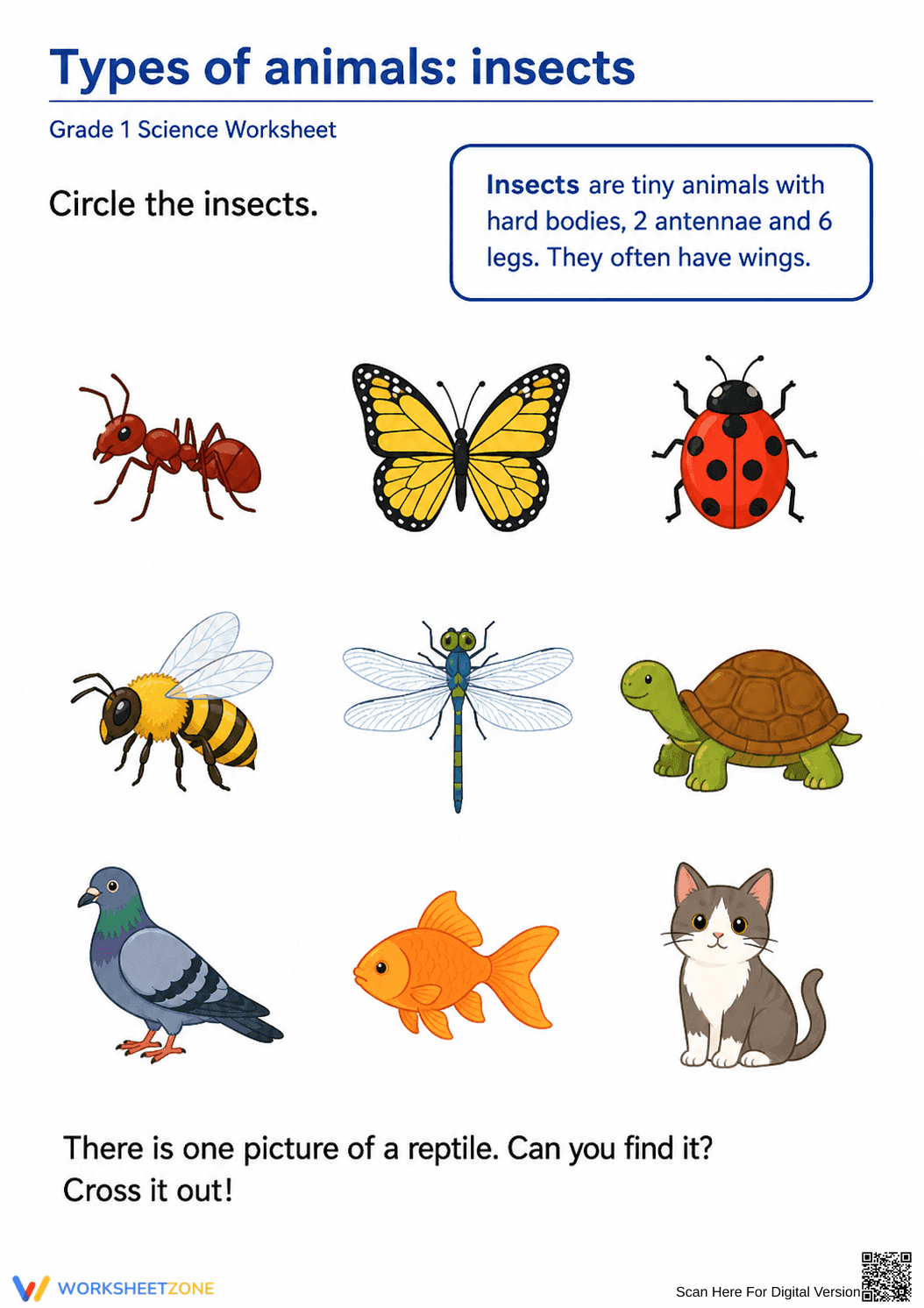

Grade 1 Insects — Printable No-Prep Worksheet
Paste this activity's link or code into your existing LMS (Google Classroom, Canvas, Teams, Schoology, Moodle, etc.).
Students can open and work on the activity right away, with no student login required.
You'll still be able to track student progress and results from your teacher account.
Mastering animal classification starts with observable physical traits. This Grade 1 Science worksheet focuses on insects, helping students distinguish these six-legged creatures from other animals like birds, fish, and reptiles. By applying a specific definition to various examples, learners build the foundational sorting skills required for biological sciences and environmental awareness.
At a Glance
- Grade: 1 · Subject: Science
- Standard:
1-LS1-1— Use external parts to identify and classify living organisms- Skill Focus: Insect and Reptile Identification
- Format: 1 page · 10 problems · Answer key included · PDF
- Best For: Introduction to animal types and classification
- Time: 10–15 minutes
This single-page PDF includes a student-friendly definition of insects, highlighting their hard bodies, antennae, and six legs. The main task features nine animal illustrations, including an ant, butterfly, and ladybug. A bonus challenge asks students to locate and cross out a single reptile. A full answer key is included for quick verification.
Zero-Prep Workflow
- Print (30 seconds): Download the PDF and print for your class. The layout ensures high-quality reproduction on any printer.
- Distribute (30 seconds): Hand out the sheets with zero additional teacher setup required.
- Review (1 minute): Use the included answer key to check work or project it for a whole-class review. Total prep time is under two minutes.
Standards Alignment
This worksheet is aligned with 1-LS1-1. By identifying external parts like legs and antennae, students gain the observational skills necessary to meet this standard. This standard code can be copied directly into lesson plans, IEP goals, or district curriculum mapping tools.
How to Use It
Introduce this after a lesson on animal body parts. It serves as a formative-assessment tool; observe if students correctly count legs before circling. Expect completion within 15 minutes, allowing for a quick transition to other science activities.
Who It's For
Designed for first-grade students, this resource is also suitable for second-grade review. It provides scaffolds through visual cues and a definition box, making it accessible for English Language Learners. Pair this with a classification anchor chart to deepen the conceptual connection.
This science resource utilizes evidence-based classification strategies to build biological literacy in early elementary students. According to the RAND AIRS 2024 report, providing students with explicit definitions—such as the "6 legs and 2 antennae" rule for insects—before asking them to perform sorting tasks significantly improves retention and category accuracy. By focusing on observable external parts, the worksheet directly supports the 1-LS1-1 standard, moving learners from simple identification to evidence-based scientific reasoning. The inclusion of non-examples like pigeons and fish forces students to move beyond surface-level visual matching, a key component of the gradual release of responsibility model advocated by Fisher & Frey (2014). This approach ensures that learners are not just memorizing names but are understanding the underlying structural differences that define animal classes in the natural world.


