


























Views
Downloads

Essential Fish Characteristics Worksheet | Grade 1 Ready
Paste this activity's link or code into your existing LMS (Google Classroom, Canvas, Teams, Schoology, Moodle, etc.).
Students can open and work on the activity right away, with no student login required.
You'll still be able to track student progress and results from your teacher account.
This Grade 1 science worksheet helps students master animal classification by identifying specific fish traits. Learners observe colorful illustrations to determine which animals belong to the fish family based on physical characteristics like fins, gills, and scales. By the end of this activity, students will confidently distinguish fish from mammals, reptiles, and insects.
At a Glance
- Grade: 1 · Subject: Science
- Standard:
1-LS1-1— Identify how animals use their external parts to survive in their environment- Skill Focus: Animal Classification: Fish
- Format: 2 pages · 10 problems · Answer key included · PDF
- Best For: Independent practice or quick science check
- Time: 10–15 minutes
What's Inside
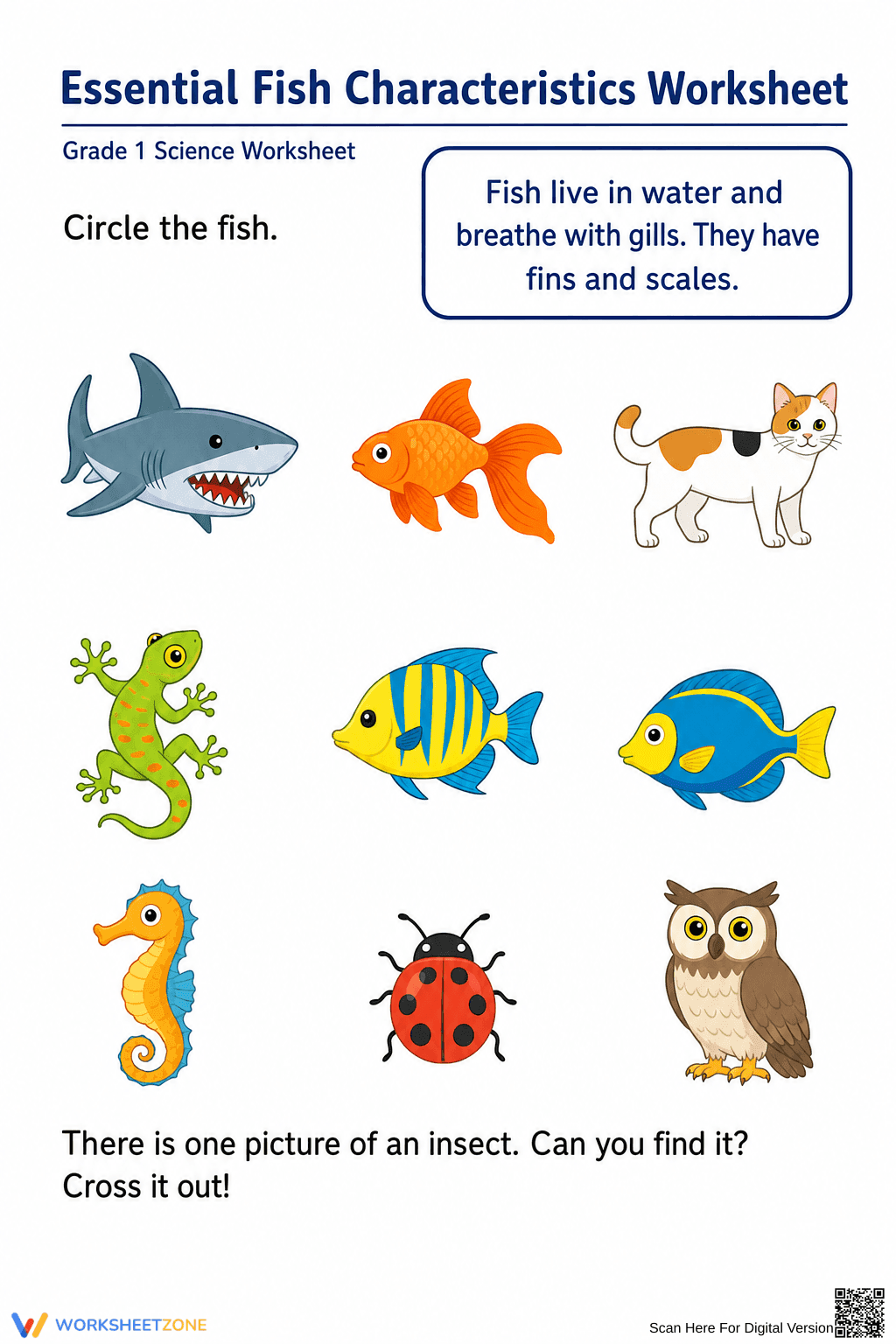
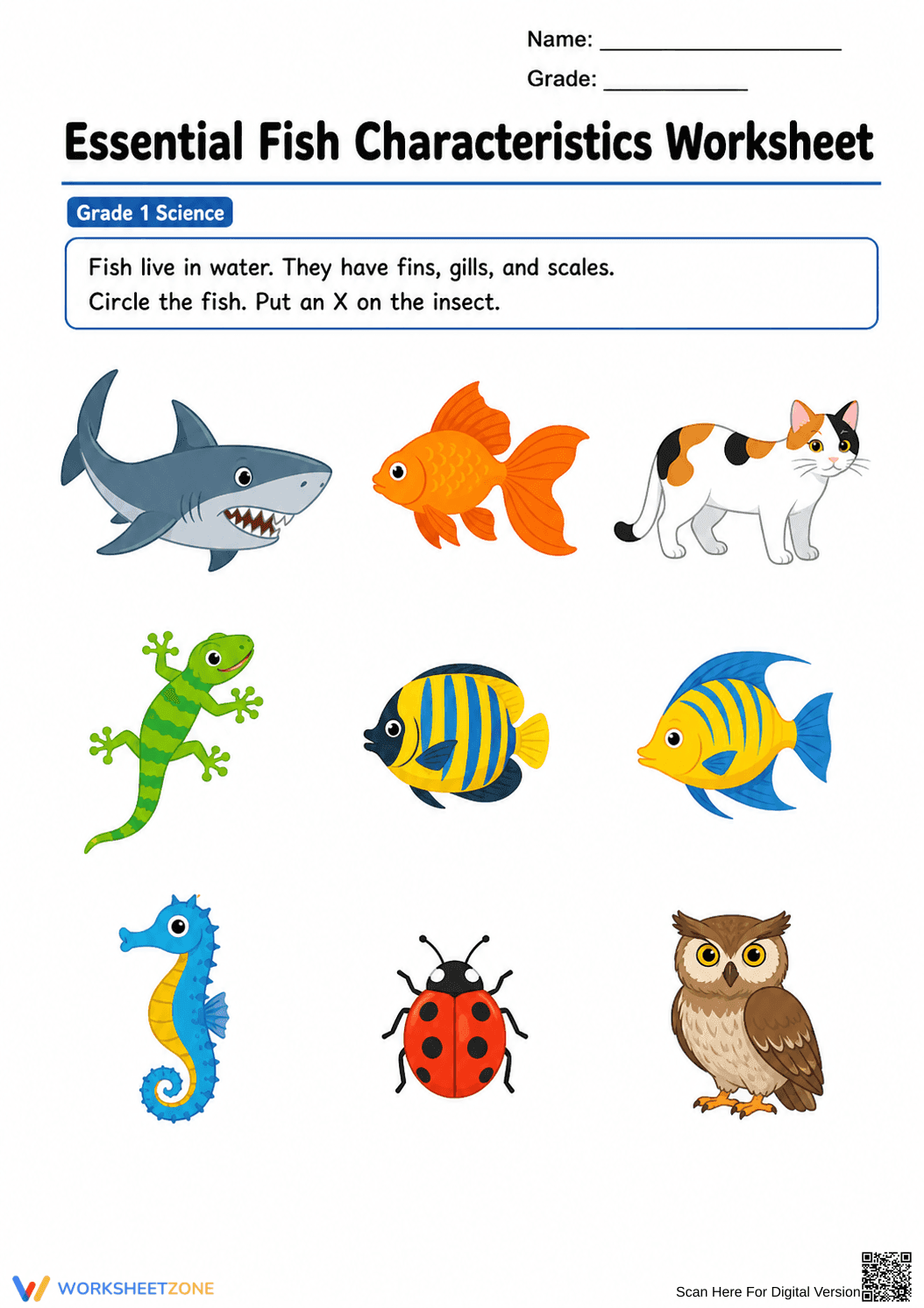
The worksheet features a clear instructional text box defining fish traits: aquatic habitats, gills, and scales. Students evaluate nine high-quality illustrations including a shark, goldfish, cat, gecko, and seahorse. A secondary task challenges students to locate and cross out an insect, providing a critical cross-category comparison. A full-page answer key is included for immediate feedback.
Zero-Prep Workflow
Implementing this worksheet is a simple three-step process. First, print the single-page activity (1 minute). Next, distribute the sheets and read the definition box together to establish the criteria for classification (2 minutes). Finally, review the answers using the included key, allowing students to discuss why the cat or owl were excluded (2 minutes). Total teacher prep time is under 5 minutes.
Standards Alignment
This activity is aligned to 1-LS1-1, requiring students to identify how animals use external parts to survive. By identifying fins and gills as survival structures, students build a foundation for biological diversity and functional anatomy. This standard code can be copied directly into lesson plans, IEP goals, or district curriculum mapping tools.
How to Use It
Use this worksheet as a formative assessment after a lesson on animal groups. Observe if students correctly identify the seahorse, which is a common misconception for young learners. This activity works best during independent practice or as a quick exit ticket. Expect students to complete the identification and the bonus insect challenge within 10 to 15 minutes.
Who It's For
This resource is designed for first-grade students but also works for kindergarten enrichment or second-grade review. It supports visual learners with high-quality illustrations and emerging readers with a concise definition box. Pair this with an anchor chart on vertebrate groups or a short video on aquatic life for a comprehensive learning experience.
According to the RAND AIRS 2024 report on elementary science literacy, early exposure to structured classification tasks significantly improves a student's ability to process biological hierarchies in later grades. This worksheet aligns with the 1-LS1-1 standard by focusing on observable physical traits such as gills and fins, which are critical for aquatic survival. Fisher & Frey (2014) emphasize that such check-for-understanding tasks provide vital feedback loops for teachers during the gradual release of responsibility. By requiring students to distinguish fish from mammals or insects, the activity reinforces the concept of specific traits belonging to distinct animal classes. This evidence-based approach ensures that learners are not merely memorizing names but are analyzing functional anatomy as a basis for scientific inquiry. The included answer key supports this process by allowing for immediate error correction and academic discourse, bridging the gap between observation and classification mastery.


