


























Views
Downloads
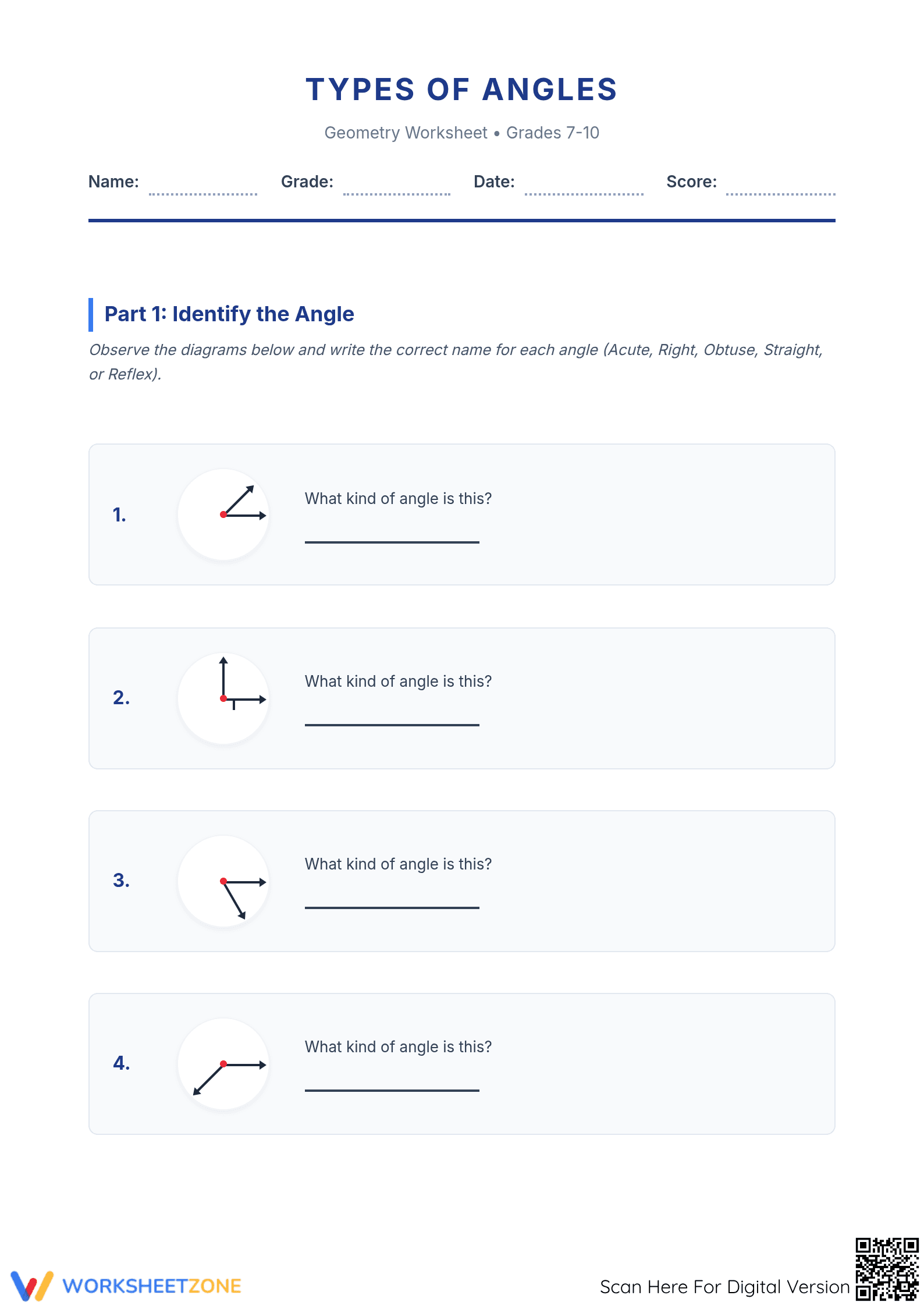
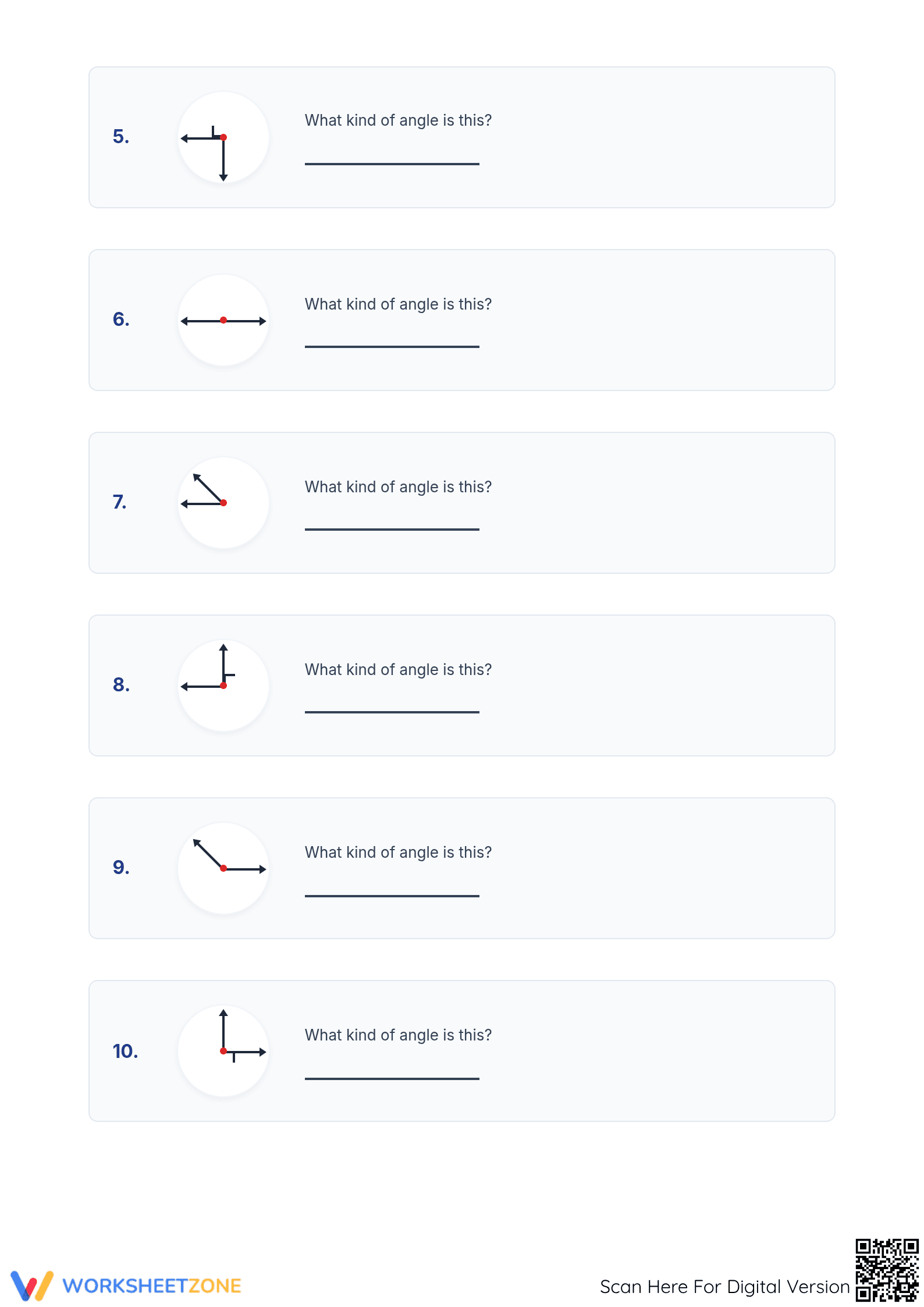
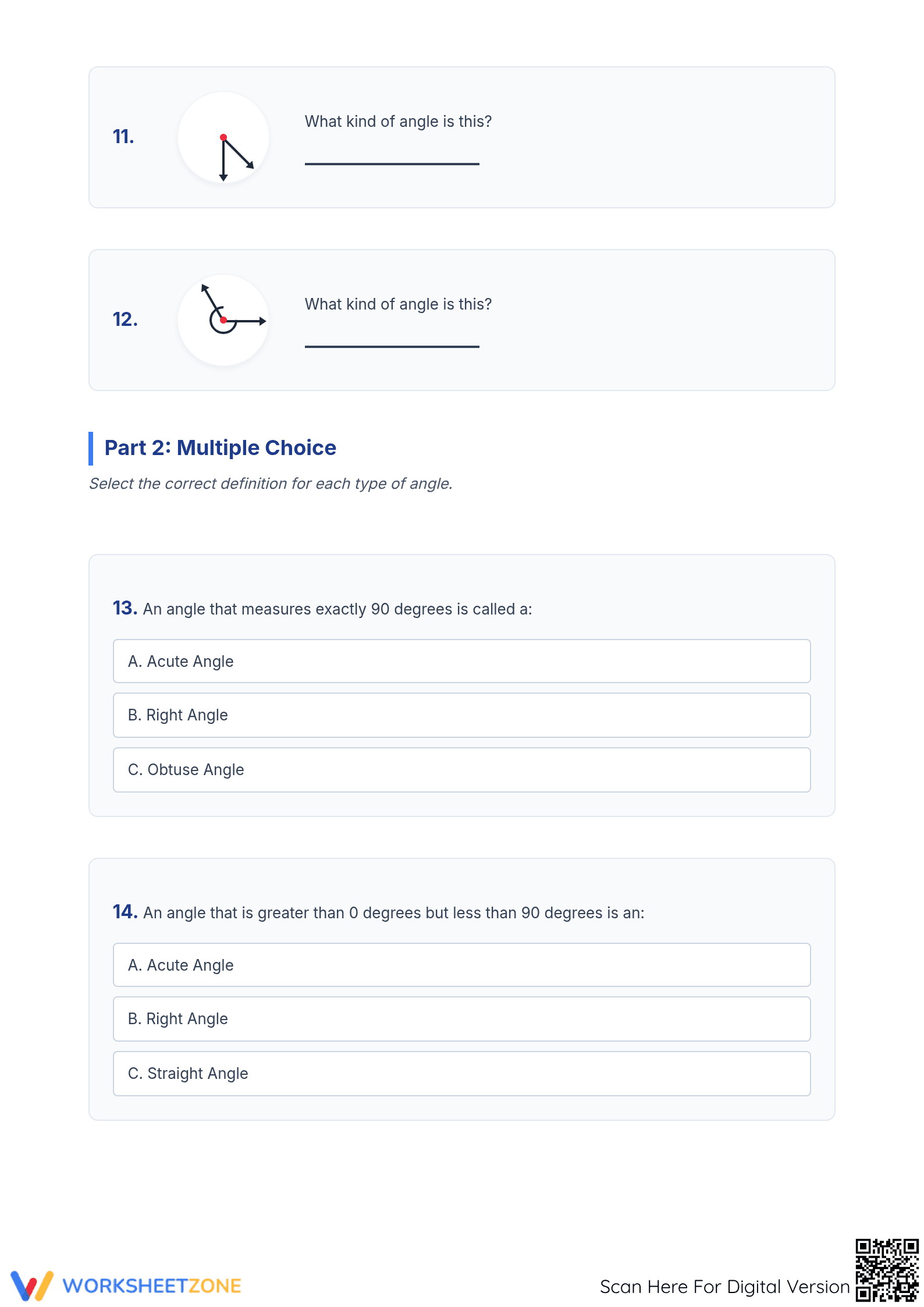

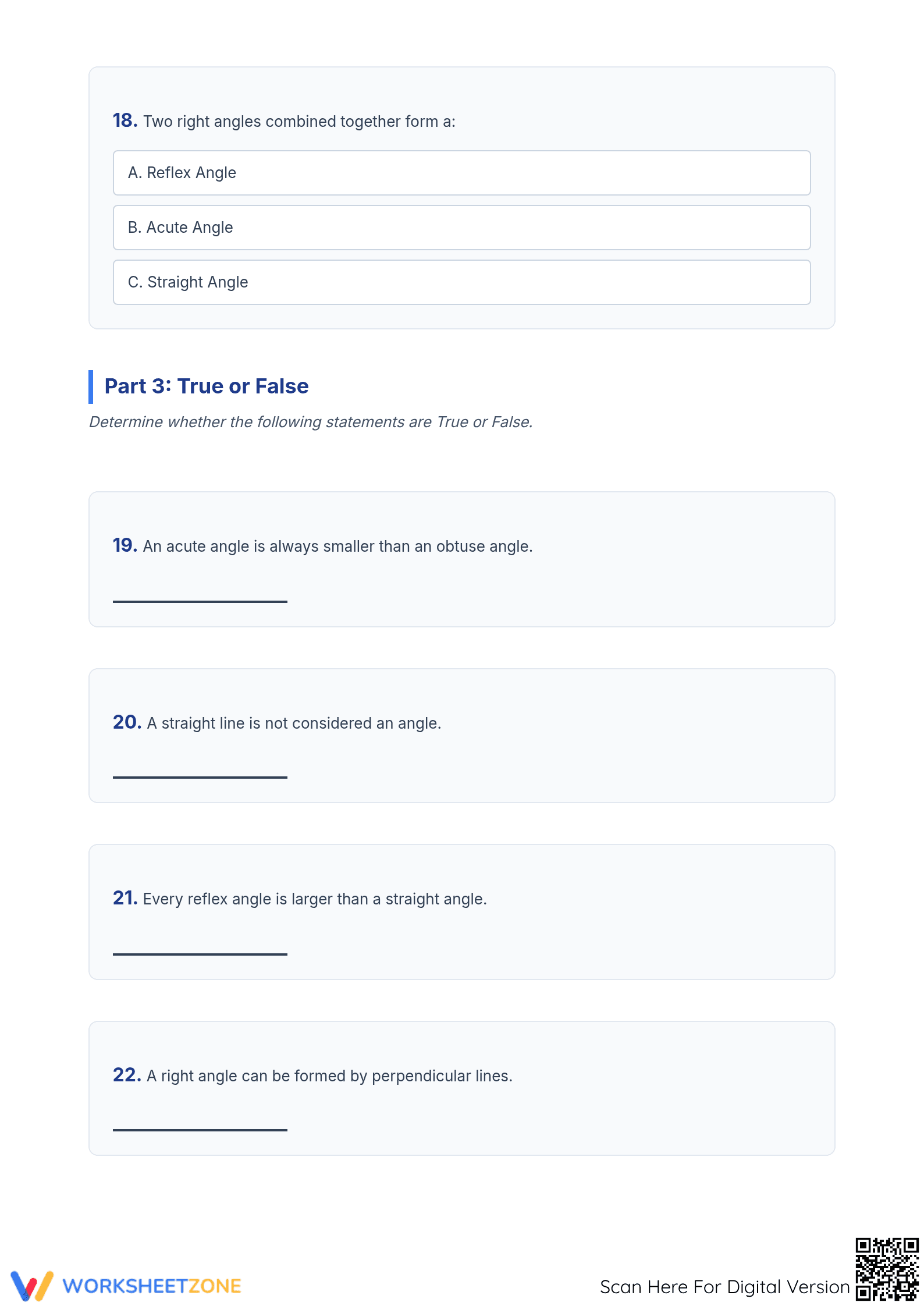

Essential Types of Angles Worksheet | Grades 7-10 Math
Paste this activity's link or code into your existing LMS (Google Classroom, Canvas, Teams, Schoology, Moodle, etc.).
Students can open and work on the activity right away, with no student login required.
You'll still be able to track student progress and results from your teacher account.
Master geometric foundations with this printable resource. This worksheet guides students through identifying and defining five key angle types: acute, right, obtuse, straight, and reflex. By engaging with visual diagrams, learners build the spatial reasoning necessary for advanced trigonometry. Students achieve accuracy in naming angles based on measurements.
At a Glance
- Grade: 7–10 · Subject: Math (Geometry)
- Standard:
CCSS.MATH.CONTENT.7.G.B.5— Use geometric facts about angles to solve for unknown properties in figures- Skill Focus: Angle Classification and Identification
- Format: 5 pages · 22 problems · Answer key included · PDF
- Best For: Geometry review or no-prep sub plans
- Time: 25–35 minutes
This 5-page workbook provides a structured approach to geometry. Part 1 features 12 visual identification tasks analyzing diagrams to name angle types. Part 2 shifts to 6 multiple-choice questions reinforcing degree-range definitions. Part 3 offers 4 true-or-false statements to challenge misconceptions. A full answer key is provided for immediate feedback and streamlined grading, ensuring this resource is highly effective for classroom use.
Zero-Prep Workflow
This resource is designed for immediate classroom implementation. First, print the 5-page PDF or assign the interactive version in under 30 seconds. Next, distribute the materials as a bell-ringer or independent practice, allowing 30 minutes for completion. Finally, use the included answer key for rapid peer-review or grading, requiring less than 2 minutes of teacher prep time. It is an ideal emergency sub plan.
Standards Alignment
The primary alignment is CCSS.MATH.CONTENT.7.G.B.5. This standard requires using facts about angles to solve problems. Identifying basic angle types is a prerequisite for this competency. Students must distinguish obtuse and reflex angles before solving complex equations. Both standard codes can be copied directly into lesson plans, IEP goals, or district curriculum mapping tools.
How to Use It
Use this as a formative assessment before a unit on transversals. Observing how students identify a reflex angle helps determine readiness for rotations. Alternatively, assign the multiple-choice section as an exit ticket to verify internalization of degree thresholds. Total completion time ranges from 25 to 35 minutes depending on the student's prior exposure to geometry terminology and basic math facts.
Who It's For
This resource is tailored for students in Grades 7 through 10 requiring a refresher on geometric definitions. It is effective for English Language Learners as visual diagrams provide context for academic terms. This worksheet pairs naturally with a standard geometry passage or anchor chart detailing angle ranges, providing the scaffold for students before moving into proof-writing or coordinate geometry.
Angle classification is a critical precursor to success in higher-order mathematics, building prerequisite knowledge for CCSS.MATH.CONTENT.7.G.B.5. Research from RAND AIRS 2024 emphasizes that students who struggle with fundamental geometric definitions, like the distinction between straight and reflex angles, are less likely to achieve mastery in multi-step algebraic solving. This worksheet addresses that gap with 22 targeted tasks moving from visual identification to conceptual validation. The 5 pages of structured practice align with recommendations that scaffolded repetition is essential for retention of technical vocabulary. Educators can integrate this tool into their curriculum, knowing it supports the NAEP framework for geometry prioritizing the ability to classify figures based on properties. This direct alignment ensures students are prepared for standardized assessments and future engineering coursework.


