




























Views
Downloads

True or False Equations Worksheet | Grade 1 Printable

Paste this activity's link or code into your existing LMS (Google Classroom, Canvas, Teams, Schoology, Moodle, etc.).
Students can open and work on the activity right away, with no student login required.
You'll still be able to track student progress and results from your teacher account.
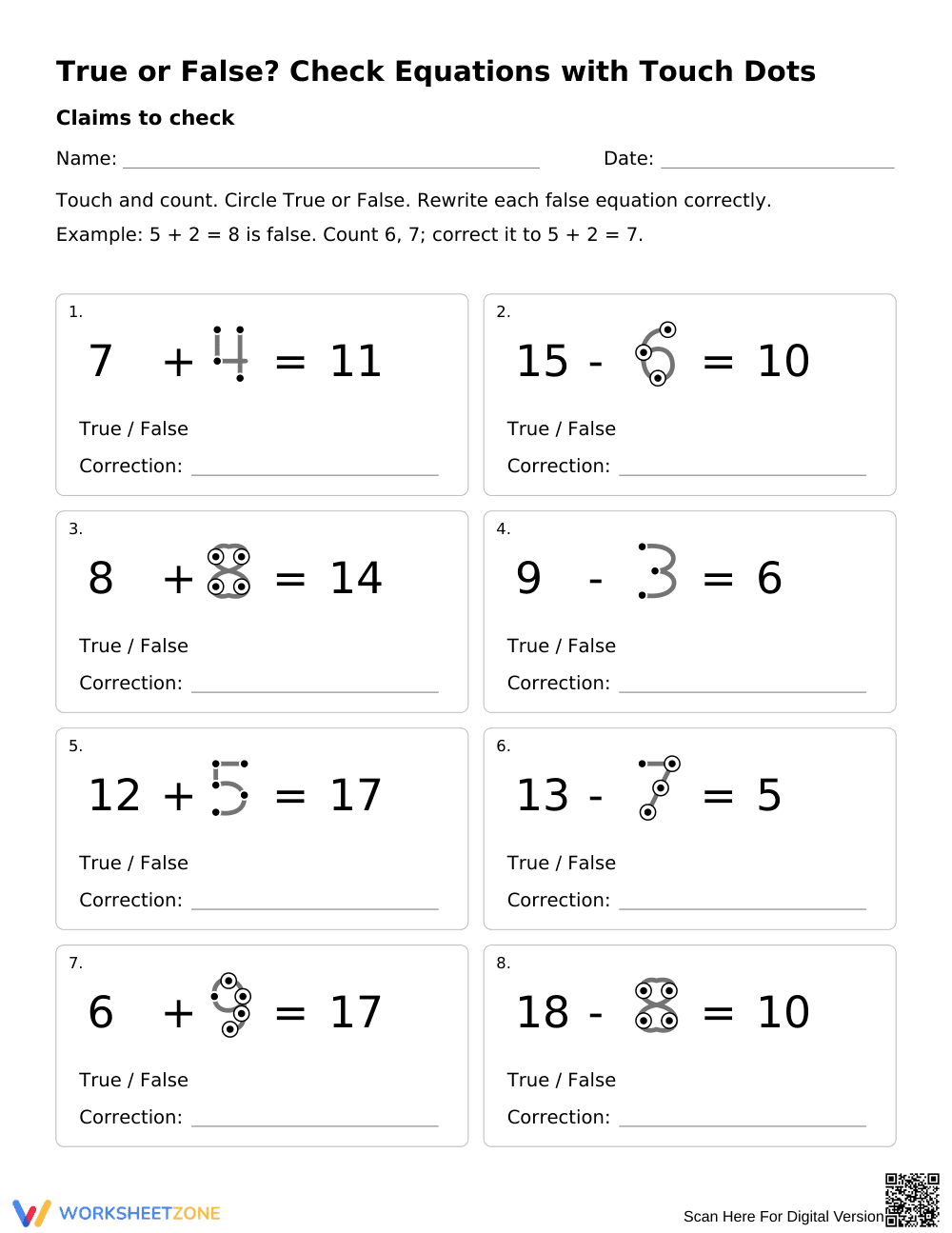
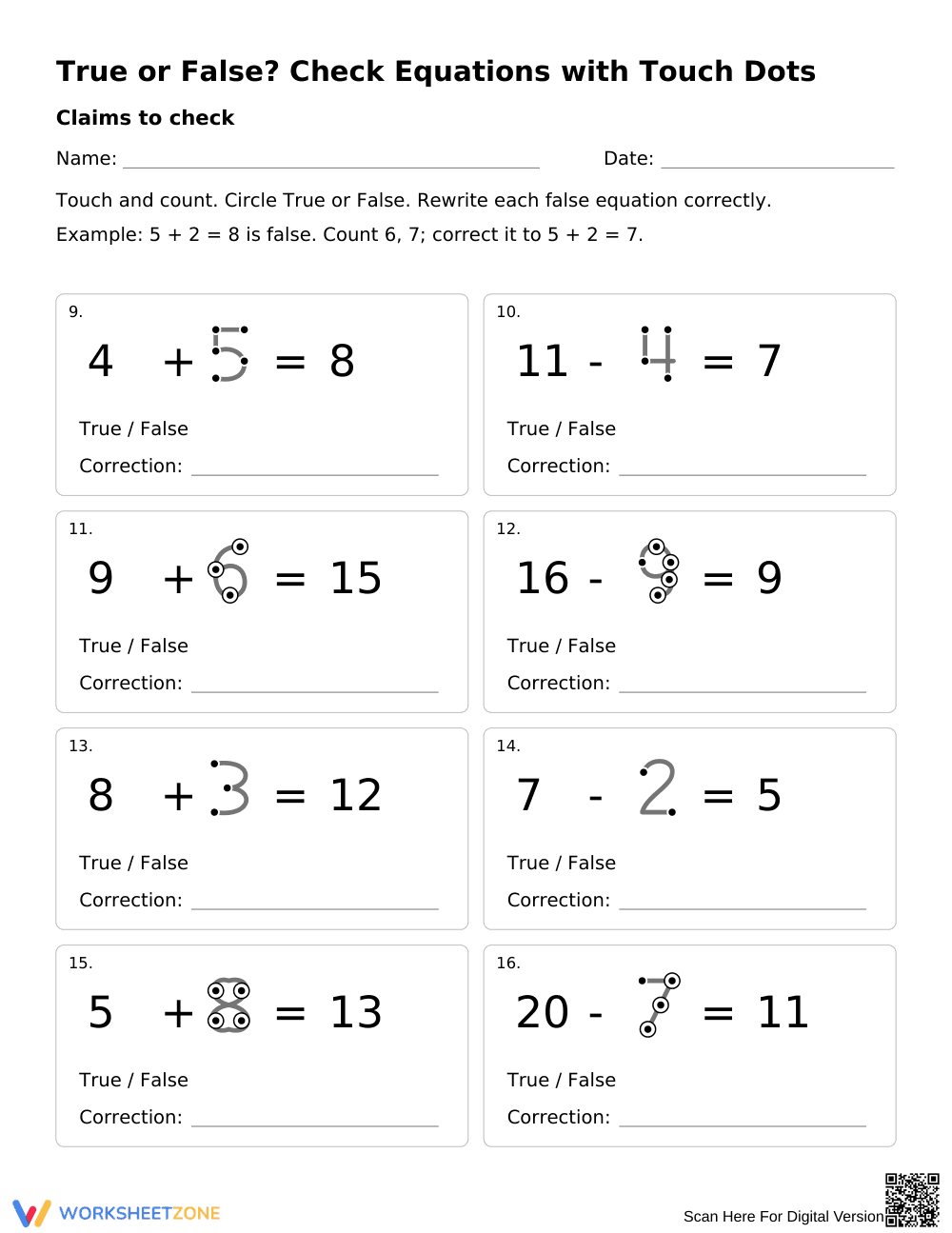
This Grade 1 math worksheet develops equation sense and equal sign comprehension through 16 addition and subtraction claims within 20. First-grade learners use multisensory touch dots to calculate values, evaluate equation accuracy, and rewrite incorrect statements correctly, establishing a strong foundation for algebraic thinking and arithmetic fluency.
At a Glance
- Grade: 1 · Subject: Math
- Standard:
CCSS.MATH.CONTENT.1.OA.D.7— Understand equal sign meaning and determine whether addition and subtraction equations are true or false- Skill Focus: True or false equation analysis using touch-point counting
- Format: 2 pages · 16 problems · Answer key included · PDF
- Best For: Independent math practice and targeted intervention
- Time: 15–20 minutes
What's Inside
Across 2 student practice pages, learners encounter 16 balanced equation verification problems with built-in touch points on the second term. Every item provides dedicated checkboxes for True and False classifications alongside an explicit correction line for rewriting false equations. A full 1-page answer key provides clear solutions for rapid grading or student self-checking.
Skill Progression
- Guided practice (Problems 1–4): A top-of-page worked example models counting touch points and rewriting false equations before students tackle foundational single-digit operations.
- Supported practice (Problems 5–10): Learners apply multisensory dots across mixed teen addition and subtraction equations, evaluating operational accuracy with visual scaffolding.
- Independent practice (Problems 11–16): Students independently verify complex combinations approaching 20, identifying subtle arithmetic errors and generating accurate corrections without teacher prompts.
This structured progression reflects the gradual release of responsibility model, shifting students from guided sensory counting to confident independent evaluation.
Standards Alignment
The primary focus aligns to `CCSS.MATH.CONTENT.1.OA.D.7`: Understand the meaning of the equal sign, and determine if equations involving addition and subtraction are true or false. Supporting practice connects with `CCSS.MATH.CONTENT.1.OA.C.6` by promoting addition and subtraction strategies within 20. Both standard codes can be copied directly into lesson plans, IEP goals, or district curriculum mapping tools.
How to Use It
Assign this resource during small-group instruction or as independent seatwork following direct instruction on the meaning of the equal sign. For a sharp formative assessment observation, monitor whether students count on or count back accurately from the first addend or minuend when tapping touch dots. The full 16-problem sequence typically takes students 15 to 20 minutes to complete.
Who It's For
This worksheet serves general Grade 1 math classrooms, Tier 2 intervention groups, and special education students who benefit from tactile touch-point supports. Pair this activity with an equal sign balance scale demonstration or an anchor chart showing that the equal sign means "the same as."
According to foundational research by Fisher & Frey (2014) on guided instruction, structured scaffolding like touch-point counting anchors student focus, allowing early elementary learners to allocate working memory toward higher-order conceptual reasoning. This Grade 1 mathematics resource targets CCSS.MATH.CONTENT.1.OA.D.7 by requiring students to understand the equal sign as a balance of equivalence rather than a prompt to calculate. Across 16 systematic true-or-false evaluation items, learners determine whether addition and subtraction equations within 20 are mathematically valid. By pairing tactile counting dots with explicit error-correction tasks, students transition from passive computation to active mathematical evaluation. Empirical findings in primary mathematics instruction demonstrate that identifying and rectifying incorrect equations deepens conceptual understanding of relational equality, building essential readiness for subsequent algebraic thinking and multi-digit operations across elementary school curricula.


