


























Views
Plays
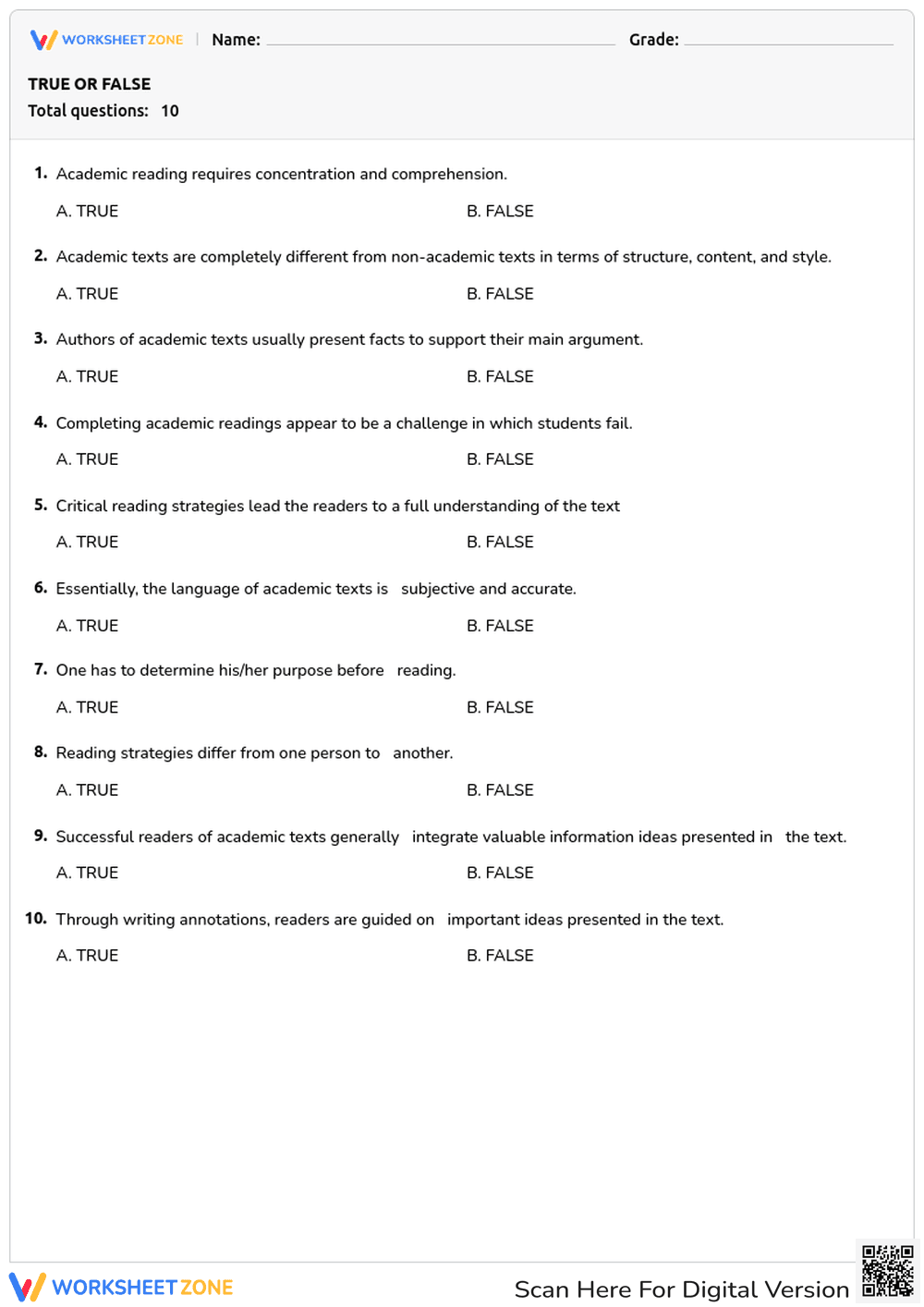

Grade 8 Academic Reading — Printable No-Prep Worksheet
Paste this activity's link or code into your existing LMS (Google Classroom, Canvas, Teams, Schoology, Moodle, etc.).
Students can open and work on the activity right away, with no student login required.
You'll still be able to track student progress and results from your teacher account.
This printable academic reading strategies worksheet helps students identify the core characteristics of scholarly texts and effective comprehension techniques. By evaluating ten true-or-false statements, learners clarify misconceptions about academic writing, text structure, and annotation, building the metacognitive skills necessary for high school and college readiness.
At a Glance
- Grade: 8 · Subject: ELA
- Standard:
CCSS.ELA-LITERACY.RI.8.6— Determine an author's purpose and analyze text structure.- Skill Focus: Academic Reading Strategies
- Format: 1 page · 10 problems · Answer key included · PDF
- Best For: Formative assessment or bell ringer
- Time: 10–15 minutes
What's Inside
This single-page resource features a ten-question true-or-false quiz focused on academic literacy. The statements cover essential concepts such as the necessity of concentration, the objective nature of academic language, the role of factual evidence in supporting arguments, and the utility of writing annotations. A complete answer key is provided to ensure quick and accurate grading, making it an ideal tool for immediate feedback.
Zero-Prep Workflow
Enjoy a simple three-step workflow:
- Print (1 minute): Download the PDF and print copies for your class. The design ensures fast reproduction.
- Distribute (1 minute): Hand out the single-page quiz as students enter the room. The instructions are completely self-explanatory, requiring zero teacher setup.
- Review (5 minutes): Use the included answer key to grade the quizzes rapidly, or project the answers for a whole-class peer-review session.
With under two minutes of total teacher prep time, this worksheet is an excellent addition to any emergency sub plan or last-minute lesson adjustment.
Standards Alignment
This worksheet aligns with CCSS.ELA-LITERACY.RI.8.6, requiring students to determine an author's point of view or purpose in a text and analyze how the author acknowledges and responds to conflicting evidence or viewpoints. By understanding the objective, fact-based nature of academic texts, students are better equipped to analyze complex informational writing. These codes can be copied directly into lesson plans, IEP goals, or curriculum mapping tools.
How to Use It
Use this worksheet as a pre-assessment before a research unit to gauge baseline understanding of academic texts. Alternatively, use it as a quick bell-ringer activity to activate prior knowledge before introducing a complex informational article. While students work, circulate to observe which concepts—like annotation purposes or academic objectivity—cause hesitation. Expect students to complete the task within a 10 to 15-minute timeframe.
Who It's For
This resource is primarily designed for eighth-grade ELA students, though it serves as an excellent review for high schoolers refining their study skills. The true-or-false format provides built-in scaffolding for students who might struggle with open-ended responses. Pair this quiz with a direct instruction lesson on active reading strategies or a guided practice session using a short, grade-level academic passage.
Mastering the conventions of scholarly writing is a critical step in developing advanced literacy skills across all content areas. Aligned with CCSS.ELA-LITERACY.RI.8.6, this resource helps students determine an author's purpose and analyze text structure by explicitly teaching the foundational characteristics of academic texts. According to a comprehensive study by Fisher & Frey (2014), explicit instruction in metacognitive reading strategies significantly improves students' ability to comprehend complex, discipline-specific informational texts. When learners understand that academic authors rely on objective facts rather than subjective opinions to build arguments, they become much more critical consumers of information. This targeted practice ensures students recognize the immense value of active reading techniques, such as annotating and summarizing, ultimately fostering the academic independence required for secondary and post-secondary success.


