


























Views
Downloads
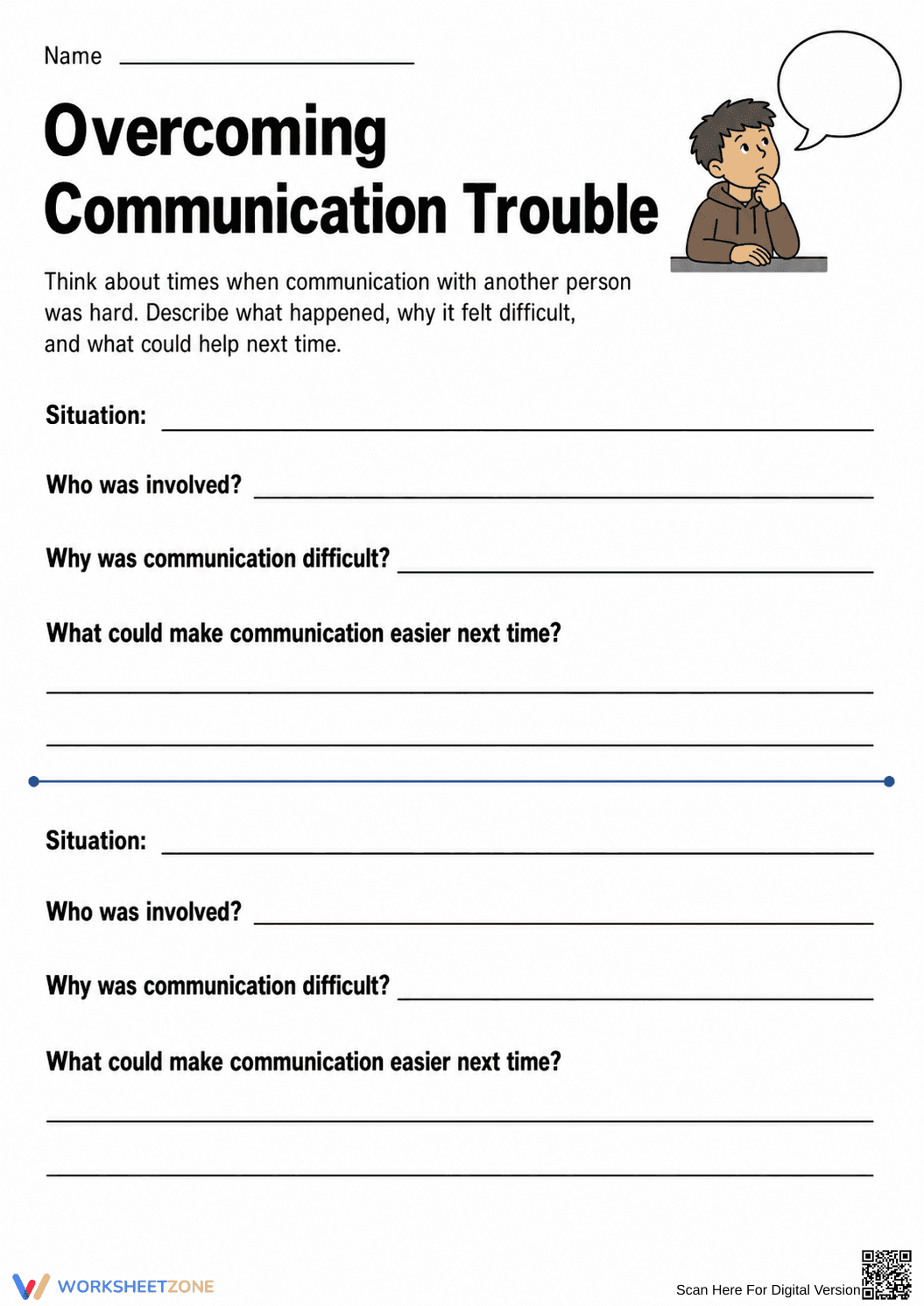

Printable Communication Reflection Worksheet | Grade 4
Paste this activity's link or code into your existing LMS (Google Classroom, Canvas, Teams, Schoology, Moodle, etc.).
Students can open and work on the activity right away, with no student login required.
You'll still be able to track student progress and results from your teacher account.
This communication reflection worksheet helps students identify and resolve interpersonal conflicts by analyzing past conversations. By breaking down specific situations, students practice self-awareness and develop actionable strategies for clearer dialogue. This targeted exercise builds essential social-emotional skills while improving overall classroom dynamics and peer relationships.
At a Glance
- Grade: 4 · Subject: Social Skills
- Standard:
CCSS.ELA-LITERACY.SL.4.1— Engage effectively in collaborative discussions and express ideas clearly.- Skill Focus: Conflict Resolution
- Format: 1 page · 2 problems · No answer key · PDF
- Best For: Independent reflection
- Time: 15–20 minutes
This single-page resource features two structured reflection scenarios. Each section prompts students to describe a specific communication breakdown, identify the individuals involved, explain the root cause of the difficulty, and brainstorm future solutions. The open-ended format provides ample writing space, allowing students to articulate their thoughts without the constraints of a rigid answer key.
Designed for immediate classroom implementation, this resource requires zero teacher setup. Print (1 minute): Generate enough copies for the class directly from the PDF. Distribute (1 minute): Hand out the sheets during morning meeting or after a recess conflict. Review (3 minutes): Briefly explain the four prompt questions. With under two minutes of total prep time, this worksheet serves as an excellent emergency sub plan or a quick intervention tool for school counselors.
This activity aligns with CCSS.ELA-LITERACY.SL.4.1, requiring students to engage effectively in a range of collaborative discussions with diverse partners, building on others' ideas and expressing their own clearly. By analyzing where communication fails, students learn the mechanics of successful peer interaction. Both standard codes can be copied directly into lesson plans, IEP goals, or district curriculum mapping tools.
Teachers can deploy this worksheet as a restorative practice tool following a peer disagreement. Have students complete the reflection independently before mediating a conversation between them. Alternatively, use it as a proactive morning work assignment where students recall a past difficulty at home or school. During completion, observe whether students can accurately pinpoint the cause of the breakdown rather than simply blaming the other party. Expect students to finish the two scenarios in roughly fifteen to twenty minutes.
This resource is ideal for upper elementary students developing their social-emotional competencies. It works exceptionally well for students who struggle with impulse control or peer conflicts, offering a structured way to process emotions. For differentiation, teachers can allow students to dictate their responses or draw the scenario instead of writing. Pair this worksheet with a direct instruction lesson on "I" statements or active listening strategies to maximize its impact.
Explicit instruction in social-emotional competencies directly impacts academic achievement and classroom climate. According to a comprehensive review by EdReports 2024, integrating structured reflection tools into daily routines significantly reduces behavioral referrals and increases student engagement. This resource targets CCSS.ELA-LITERACY.SL.4.1 by asking students to engage effectively in collaborative discussions and express ideas clearly. When students systematically analyze their communication breakdowns, they transition from reactive behaviors to proactive problem-solving. The ability to identify the root causes of interpersonal friction is a foundational skill that supports both literacy development and lifelong relationship building. By providing a consistent framework for evaluating these interactions, educators equip learners with the vocabulary needed to navigate complex social environments successfully. Regular practice with these reflective exercises ensures that students internalize these strategies, leading to more resilient and empathetic classroom communities.


