


























Views
Downloads
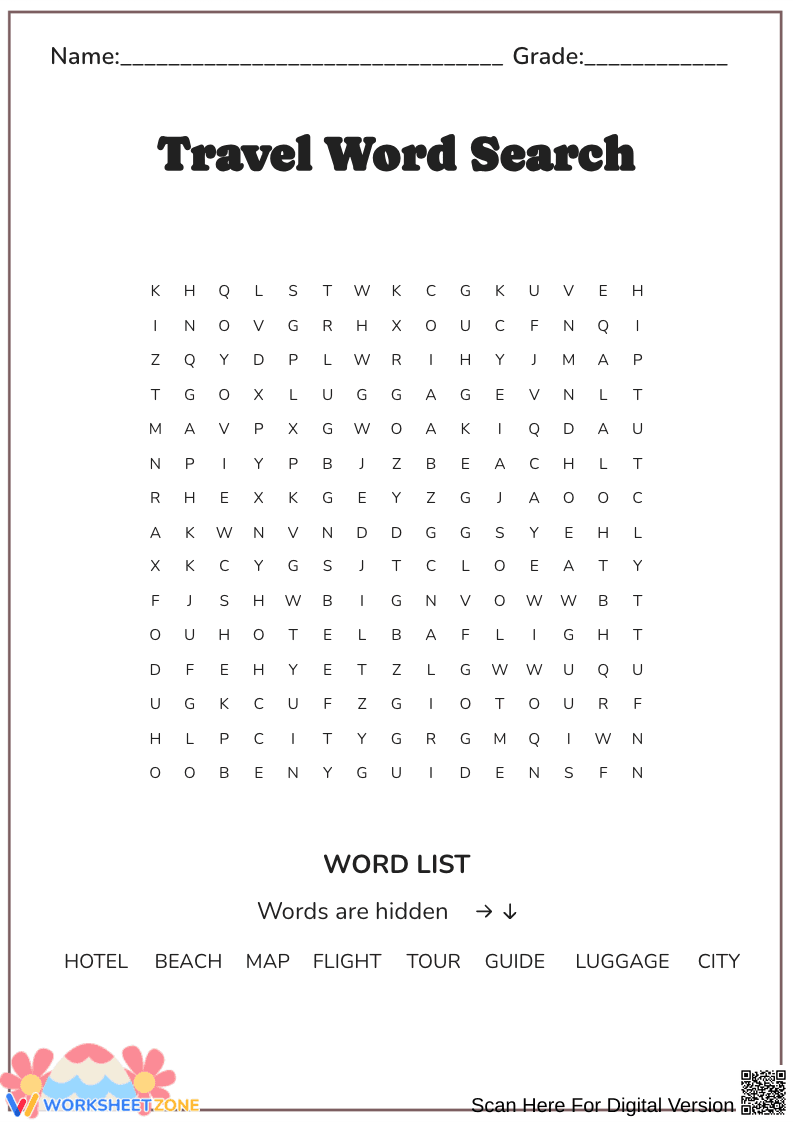

Printable Travel Word Search Worksheet for Grades 6-7
Paste this activity's link or code into your existing LMS (Google Classroom, Canvas, Teams, Schoology, Moodle, etc.).
Students can open and work on the activity right away, with no student login required.
You'll still be able to track student progress and results from your teacher account.
This printable travel word search worksheet helps middle school students build vocabulary and spelling skills. Students locate eight travel-themed terms hidden horizontally and vertically within the grid. This activity reinforces word recognition and contextual association for language arts or social studies classes.
At a Glance
- Grade: Grades 6–7 · Subject: ELA & Vocabulary
- Standard:
CCSS.ELA-LITERACY.L.6.6— Acquire and use grade-appropriate general academic words- Skill Focus: Travel vocabulary and word recognition
- Format: 1 page · 8 problems · Answer key not included · PDF
- Best For: Fast finishers and sub plans
- Time: 10–15 minutes
What's Inside
The worksheet features a clean, single-page layout containing a letter grid and a clear word list at the bottom. Students search for eight specific travel terms: hotel, beach, map, flight, tour, guide, luggage, and city. The words are hidden in forward horizontal and downward vertical directions, making it accessible yet engaging for middle schoolers.
Zero-Prep Workflow
This resource requires minimal teacher preparation. First, print the single-page PDF document, which takes less than one minute. Next, distribute the sheets directly to students at the start of class or during transitions, requiring about thirty seconds. Finally, review the completed puzzles individually or display the solved grid on a projector for a quick two-minute visual check. The entire setup takes under two minutes, making this puzzle an ideal choice for emergency substitute lesson plans, morning work, or quiet transitions between core academic blocks.
Standards Alignment
This activity aligns directly with CCSS.ELA-LITERACY.L.6.6, which requires students to acquire and use grade-appropriate general academic and domain-specific words. By identifying terms like luggage and flight, students reinforce spelling patterns and lexical familiarity. Both standard codes can be copied directly into lesson plans, IEP goals, or district curriculum mapping tools.
How to Use It
Use this worksheet as a warm-up activity at the beginning of a geography or creative writing unit. Alternatively, assign it as a quiet task for students who finish tests early. For a formative assessment, observe how quickly students locate the words to gauge visual scanning speed and spelling familiarity. The activity typically takes ten to fifteen minutes to complete.
Who It's For
This worksheet is designed for sixth and seventh-grade students, including English language learners who benefit from visual word reinforcement. It pairs naturally with a travel-themed reading passage, a creative writing prompt about a dream vacation, or an introductory geography lesson on maps and transportation.
According to the ScienceDirect TpT Analysis (2024), word puzzles like searches and crosswords serve as effective vocabulary reinforcement tools in middle school classrooms. These activities support orthographic mapping by forcing students to focus on letter sequences and spelling patterns. By aligning this puzzle with CCSS.ELA-LITERACY.L.6.6, educators target essential word-acquisition skills through active engagement. Research indicates that incorporating structured, low-stakes vocabulary tasks helps students transition terms from short-term recognition to long-term memory. This one-page worksheet provides a practical, evidence-based approach to spelling practice, helping teachers maximize instructional time without adding to their grading workload. It offers a reliable method for reinforcing key terms in both English language arts and social studies contexts.


