


























Views
Downloads
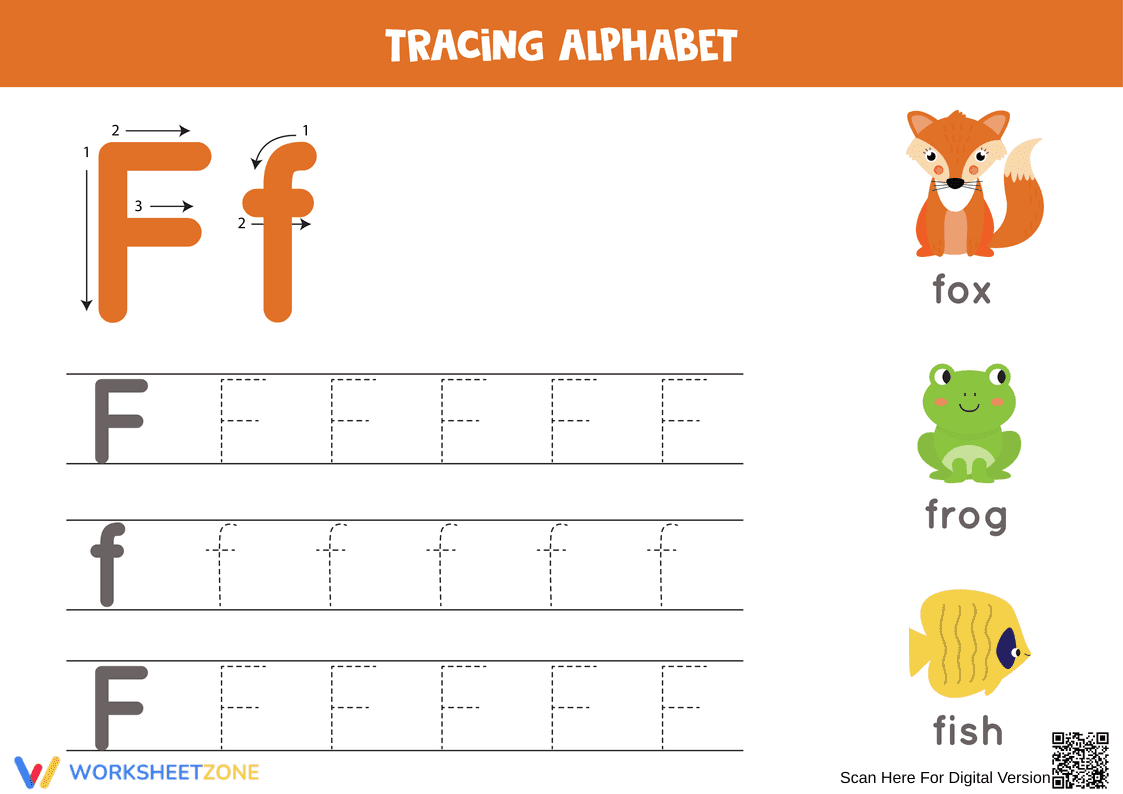

Letter F Tracing Worksheet | Essential Grade K Practice
Paste this activity's link or code into your existing LMS (Google Classroom, Canvas, Teams, Schoology, Moodle, etc.).
Students can open and work on the activity right away, with no student login required.
You'll still be able to track student progress and results from your teacher account.
This essential Letter F tracing worksheet provides young learners with a structured path to mastering alphabet formation. By combining visual stroke guides with repetitive practice, students develop the fine motor control necessary for neat handwriting. The inclusion of phonics-based illustrations helps bridge the gap between letter recognition and initial sound awareness for early readers.
At a Glance
- Grade: Kindergarten · Subject: Handwriting
- Standard:
CCSS.ELA-LITERACY.L.K.1.A— Print many upper- and lowercase letters correctly- Skill Focus: Letter F formation
- Format: 1 page · 18 tasks · No answer key required · PDF
- Best For: Morning work or literacy centers
- Time: 10–15 minutes
Inside this single-page PDF, you will find a comprehensive layout featuring large-scale stroke order diagrams for both uppercase 'F' and lowercase 'f'. The worksheet includes three dedicated rows of tracing practice, providing 18 individual opportunities for students to refine their grip and stroke precision. Colorful illustrations of a fox, frog, and fish reinforce the /f/ sound while keeping students engaged.
The zero-prep workflow for this resource is designed for maximum efficiency in busy classrooms. First, print the single-page PDF (30 seconds). Second, distribute the sheets to students with pencils or crayons (1 minute). Third, provide a quick verbal model of the stroke order shown at the top of the page (30 seconds). Total teacher preparation time is under two minutes, making it an ideal choice for emergency sub plans.
This resource aligns with `CCSS.ELA-LITERACY.L.K.1.A`, which requires students to print many upper- and lowercase letters. It specifically targets the motor planning required for vertical and horizontal strokes. This standard code can be copied directly into lesson plans, IEP goals, or district curriculum mapping tools to ensure compliance with state and national literacy frameworks.
Use this worksheet during the independent practice phase of a gradual release lesson on the alphabet. It serves as an excellent formative assessment tool; observe students as they trace to identify those struggling with top-to-bottom stroke direction. Expect students to complete the page in approximately 12 minutes during independent center time or as a quiet morning arrival activity.
This worksheet is ideal for preschool and kindergarten students beginning their handwriting journey. It is particularly helpful for learners requiring visual cues for letter orientation and those working on pencil pressure. Pair this resource with a tactile sand tray activity or a large-format anchor chart featuring the letter F to reinforce multi-sensory learning throughout the school day.
According to the Fisher & Frey (2014) framework for gradual release of responsibility, structured practice like this Letter F tracing worksheet is vital for moving students from guided instruction to independent mastery. The worksheet directly addresses CCSS.ELA-LITERACY.L.K.1.A by providing 18 specific tracing tasks that reinforce the physical mechanics of printing upper- and lowercase letters. Research from the NAEP highlights that early fluency in letter formation is a significant predictor of later writing success, as it reduces the cognitive load on young writers. By integrating phonics-based visuals like a fox and frog, the resource supports dual-coding theory, helping students link the visual shape of the letter to its auditory phoneme. This printable PDF is a high-utility tool for developing the fine motor precision required for neat handwriting in early childhood settings, ensuring students meet foundational literacy benchmarks efficiently and with confidence.


