


























Views
Downloads

Trace The Rhythm Apple Tree | Essential Music Worksheet
Paste this activity's link or code into your existing LMS (Google Classroom, Canvas, Teams, Schoology, Moodle, etc.).
Students can open and work on the activity right away, with no student login required.
You'll still be able to track student progress and results from your teacher account.
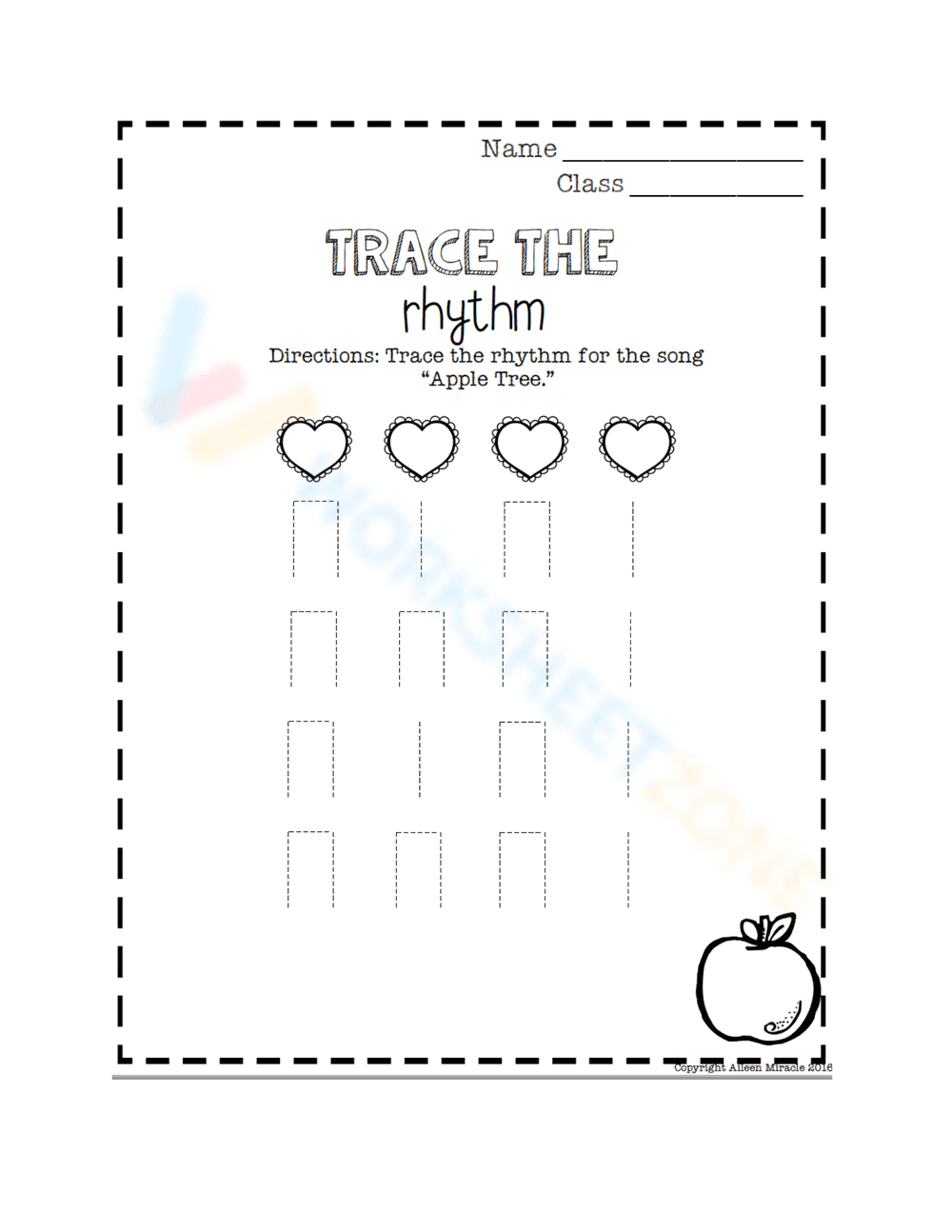
This Grade K-2 music rhythm worksheet helps students master basic notation through tactile tracing. By following the dashed lines for the song Apple Tree, learners connect physical movement with rhythmic patterns. This activity strengthens fine motor control while reinforcing the visual representation of quarter and eighth notes in a familiar musical context.
At a Glance
- Grade: K-2 · Subject: Music/Rhythm
- Standard:
CCSS.ELA-LITERACY.L.K.1.A— Print many upper- and lowercase letters and develop fine motor tracing skills- Skill Focus: Rhythm tracing and notation
- Format: 1 page · 16 tasks · No answer key needed · PDF
- Best For: Early elementary music or sub plans
- Time: 10–15 minutes
The worksheet features a clean, student-friendly layout centered on the folk song Apple Tree. It contains 16 individual rhythm symbols organized into four clear lines. Students trace eighth note pairs and quarter notes positioned under heart icons representing the steady beat. The single-page PDF format ensures high-contrast printing for young learners.
This resource is designed for immediate classroom implementation with a total teacher prep time of under 2 minutes. First, print the single-page PDF for your class. Second, distribute the sheets alongside pencils or crayons. Third, review the tracing as a group or use it as a quiet independent center activity while you work with small groups. It is an ideal solution for emergency sub plans.
Primary alignment is `CCSS.ELA-LITERACY.L.K.1.A`, which focuses on the foundational motor skills required for writing and symbol production. While musically focused, the task requires students to follow precise paths to recreate symbols. This standard code can be copied directly into lesson plans, IEP goals, or district curriculum mapping tools.
Use this worksheet during the practice phase of a music lesson after singing Apple Tree and keeping the steady beat. It serves as an excellent formative assessment to observe pencil grip and symbol recognition. Expect students to complete the tracing in 10 to 15 minutes depending on their fine motor development and familiarity with the song.
This is ideal for Kindergarten through 2nd-grade students, particularly those in the early stages of music literacy. It provides necessary scaffolding for learners who struggle with free-hand drawing of musical notes. Pair this with a recording of the song or a physical apple-themed steady beat chart to create a comprehensive lesson experience.
According to the RAND AIRS 2024 report, tactile engagement with symbolic notation significantly improves retention in early childhood education. This worksheet utilizes the Apple Tree rhythm to bridge the gap between auditory perception and visual representation. By tracing 16 specific rhythmic figures, students reinforce the muscle memory required for later independent music composition and literacy. The integration of fine motor practice with rhythmic patterns aligns with multi-sensory learning frameworks, ensuring that students with varying developmental needs can access the curriculum. Research from Fisher & Frey (2014) suggests that guided tracing acts as a crucial scaffold in the gradual release of responsibility model. This resource provides that structured support, allowing teachers to monitor progress effectively. The standard CCSS.ELA-LITERACY.L.K.1.A is met through the precise motor control required to trace the eighth and quarter note stems and beams accurately.


