


























Views
Downloads
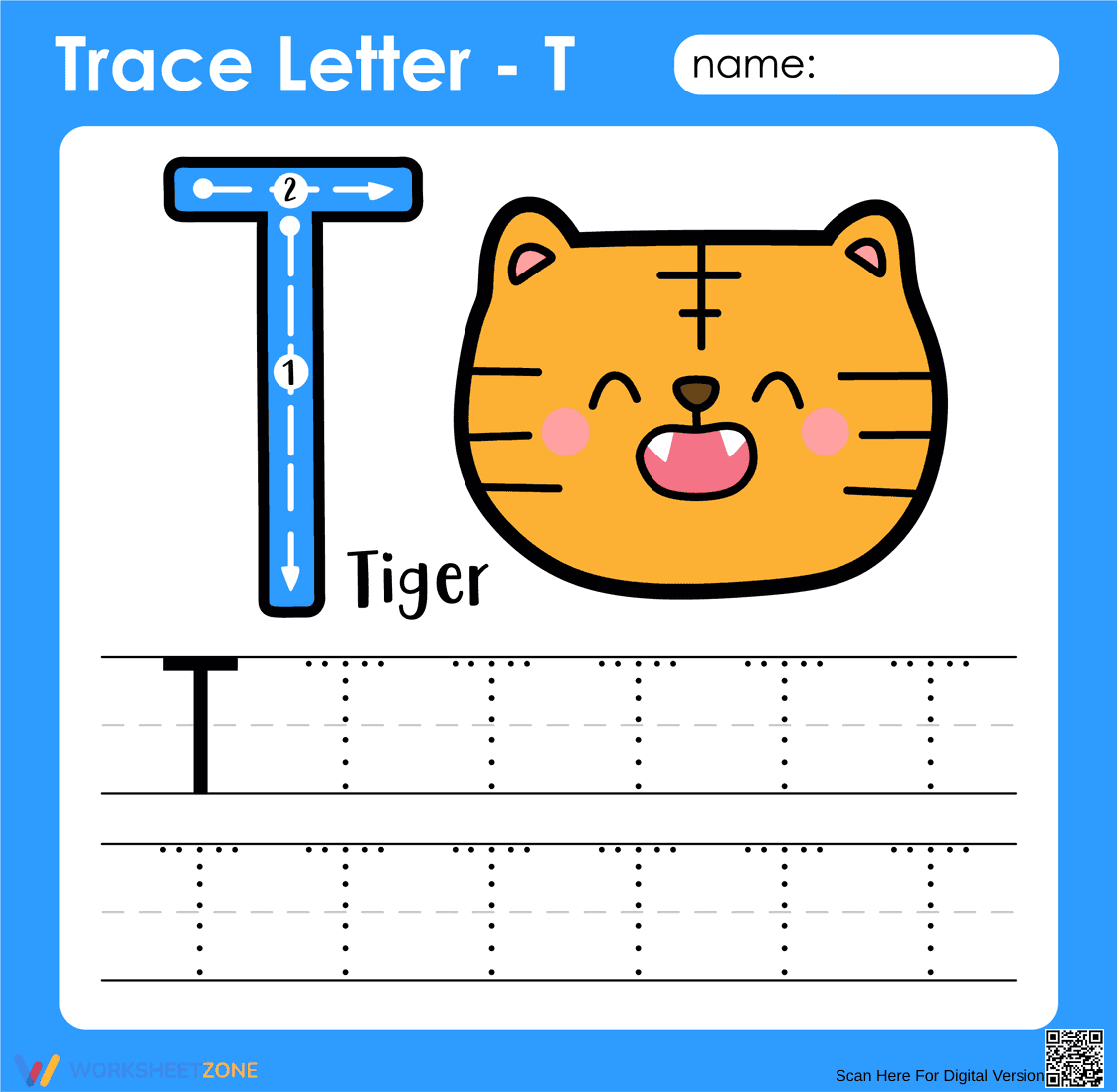

Letter T Tracing Worksheet | Preschool Printable
Paste this activity's link or code into your existing LMS (Google Classroom, Canvas, Teams, Schoology, Moodle, etc.).
Students can open and work on the activity right away, with no student login required.
You'll still be able to track student progress and results from your teacher account.
This printable letter T tracing worksheet helps preschool students develop foundational handwriting skills and fine motor control. By practicing proper stroke order and tracing uppercase letters along guided dashed lines, early learners build the muscle memory required for confident alphabet formation and future writing success.
At a Glance
- Grade: Preschool · Subject: English
- Standard:
CCSS.ELA-LITERACY.L.K.1.A— Print upper- and lowercase letters- Skill Focus: Letter T Tracing
- Format: 1 page · 10 problems · No answer key · PDF
- Best For: Morning work and centers
- Time: 5–10 minutes
Inside this single-page resource, educators will find a clear layout designed for early childhood learners. The page features a large, numbered stroke-order guide for the uppercase letter T, accompanied by a friendly tiger illustration to reinforce phonetic association. Below the visual guide, students receive two rows containing ten dotted tracing letters set on standard primary handwriting lines, offering ample repetition without causing fatigue.
Zero-Prep Workflow
This resource is designed for immediate classroom implementation with absolutely no teacher preparation required. Follow these three simple steps:
- Print (1 minute): Download the PDF and print the required number of copies. The high-contrast black-and-white tracing lines ensure crisp reproduction.
- Distribute (1 minute): Hand out the pages along with thick pencils or crayons suitable for preschool grips.
- Review (3 minutes): Briefly model the top-to-bottom and left-to-right stroke order shown on the large example before letting students work independently.
With prep time under two minutes, this activity is excellent for sub plans.
Standards Alignment
This handwriting practice aligns directly with CCSS.ELA-LITERACY.L.K.1.A, which requires students to print many upper- and lowercase letters. While targeted at preschool readiness, it builds the exact foundational skills expected in early kindergarten assessments. The standard code can be copied directly into lesson plans, IEP goals, or district curriculum mapping tools.
How to Use It
This worksheet serves as an ideal morning work activity as students transition into the classroom, taking approximately 5 to 10 minutes to complete. It also functions perfectly within a small-group literacy center focused on the Letter of the Week. As a formative assessment tip, observe students while they trace to ensure they are starting their vertical line from the top down, correcting pencil grip and stroke direction in real-time before bad habits form.
Who It's For
This resource is crafted for preschool and pre-k students who are just beginning their handwriting journey. It provides necessary visual scaffolds for children developing fine motor skills and hand-eye coordination. For differentiation, students who finish early can color the tiger illustration, while those needing extra support can trace the letters with a highlighter first. Pair this worksheet with a read-aloud book featuring words starting with the letter T to reinforce phonics connections.
Early childhood literacy research emphasizes the critical link between physical handwriting practice and letter recognition. According to a comprehensive EdReports 2024 analysis on foundational skills, explicit instruction in letter formation, such as printing upper- and lowercase letters, significantly improves subsequent reading fluency and phonetic decoding. When students engage in targeted tracing activities aligned with CCSS.ELA-LITERACY.L.K.1.A, they activate motor pathways in the brain that solidify their understanding of alphabet characters. This specific worksheet provides the exact type of structured, repetitive motor practice recommended by educational researchers for preschool and kindergarten readiness. By combining visual stroke-order cues with guided tracing lines, educators can effectively bridge the gap between visual letter recognition and independent writing capabilities, ensuring young learners build the necessary muscle memory for long-term academic success.


