


























Views
Downloads
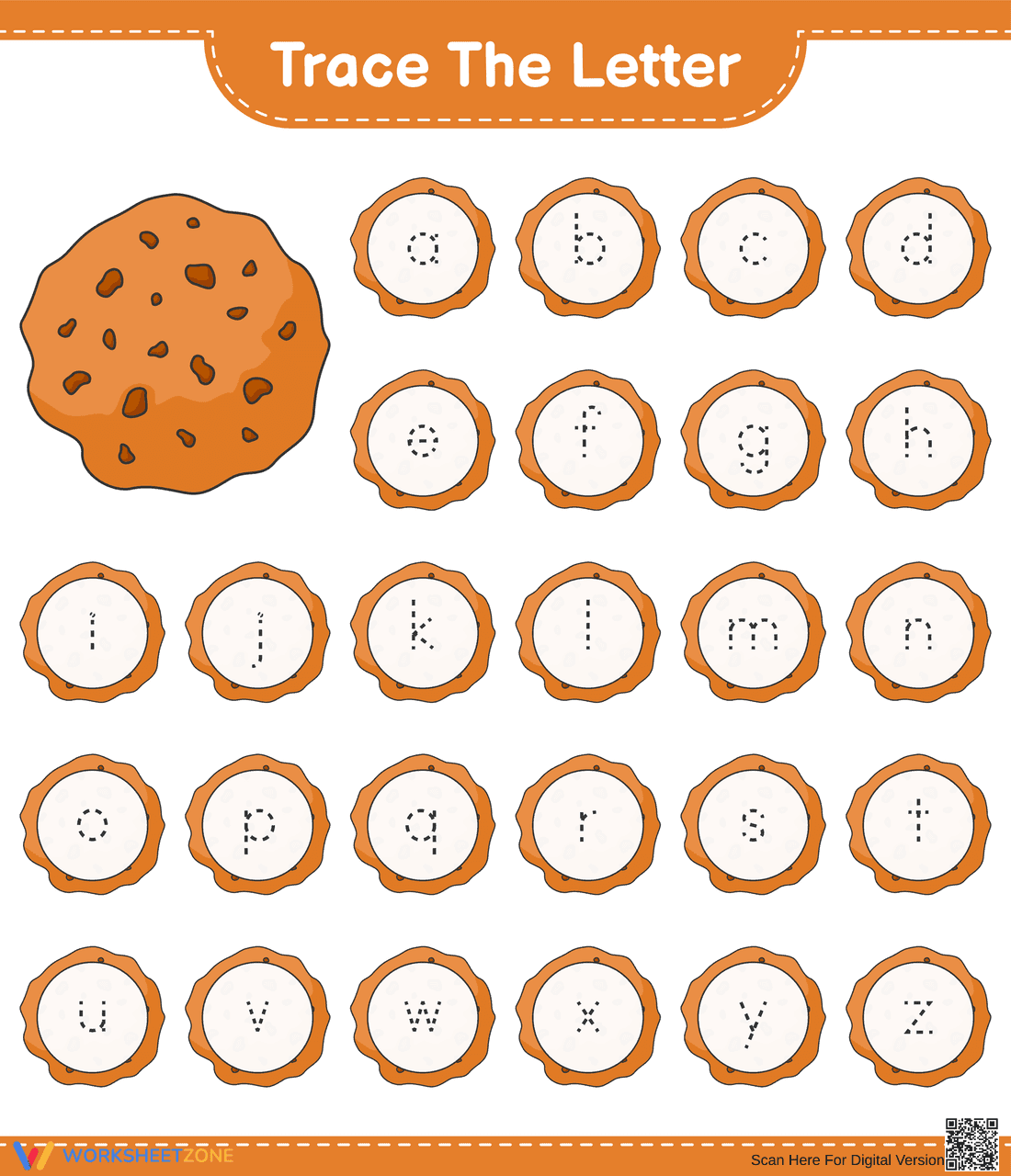

Printable Alphabet Tracing Worksheet | Grade K ELA
Paste this activity's link or code into your existing LMS (Google Classroom, Canvas, Teams, Schoology, Moodle, etc.).
Students can open and work on the activity right away, with no student login required.
You'll still be able to track student progress and results from your teacher account.
This Grade K English Language Arts worksheet provides focused practice on lowercase letter formation. Students trace all twenty-six letters of the alphabet within a fun cookie theme, building essential fine motor skills and letter recognition. This resource ensures early learners develop the foundational handwriting abilities required for future writing success.
At a Glance
- Grade: K · Subject: ELA
- Standard:
CCSS.ELA-LITERACY.L.K.1.A— Print many upper- and lowercase letters- Skill Focus: Lowercase letter tracing
- Format: 1 page · 26 problems · No answer key · PDF
- Best For: Independent practice centers
- Time: 10–15 minutes
This single-page resource features twenty-six lowercase letters presented in a clear, dotted font for easy tracing. Each letter is housed inside a cookie graphic, providing a visually engaging boundary that helps young students focus on their pencil control. The straightforward layout requires no additional materials other than a pencil or crayon, making it an ideal tool for early childhood classrooms.
Zero-Prep Workflow
- Print (1 minute): Simply download the PDF and print the required number of copies. The black-and-white friendly design ensures minimal ink usage.
- Distribute (1 minute): Hand out the worksheets along with pencils or markers. The intuitive cookie theme and dotted letters make the task immediately obvious to young learners.
- Review (1 minute): Quickly scan student work to ensure proper stroke order and letter formation. Total teacher preparation time is under two minutes, making this an excellent option for emergency sub plans or morning work.
Standards Alignment
This worksheet is directly aligned with CCSS.ELA-LITERACY.L.K.1.A, which requires students to print many upper- and lowercase letters. By tracing the complete lowercase alphabet, students practice the precise motor movements necessary to meet this standard. Both standard codes can be copied directly into lesson plans, IEP goals, or district curriculum mapping tools.
How to Use It
Deploy this worksheet during morning arrival as a calm, focused activity before direct instruction begins. It also functions perfectly as an independent literacy center station while the teacher conducts small reading groups. While students work, observe their pencil grip and stroke direction to provide immediate, formative feedback on their handwriting technique. Most kindergarten students will complete this activity within ten to fifteen minutes.
Who It's For
This resource is designed for preschool, kindergarten, and first-grade students who are developing their basic handwriting skills. It serves as an excellent intervention tool for students struggling with fine motor control or letter memory. Pair this tracing sheet with an alphabet anchor chart or a direct instruction lesson on letter sounds to reinforce the connection between the written symbol and its corresponding phoneme.
Mastering letter formation is a critical step in early literacy development and foundational for future academic success. According to Fisher & Frey (2014), explicit handwriting instruction combined with guided, repetitive practice significantly improves both writing fluency and reading comprehension in early elementary students. This worksheet directly supports that research by providing targeted, structured repetition of all twenty-six lowercase letters. Aligned specifically with CCSS.ELA-LITERACY.L.K.1.A, it ensures students actively print many upper- and lowercase letters to build essential muscle memory and fine motor control. The clear tracing format reduces cognitive load, allowing young learners to focus entirely on their motor skills, pencil grip, and correct stroke sequence. By integrating this foundational practice into daily classroom routines, educators can effectively bridge the gap between visual letter recognition and independent writing production, setting a strong stage for long-term literacy achievement.


