


























Views
Downloads
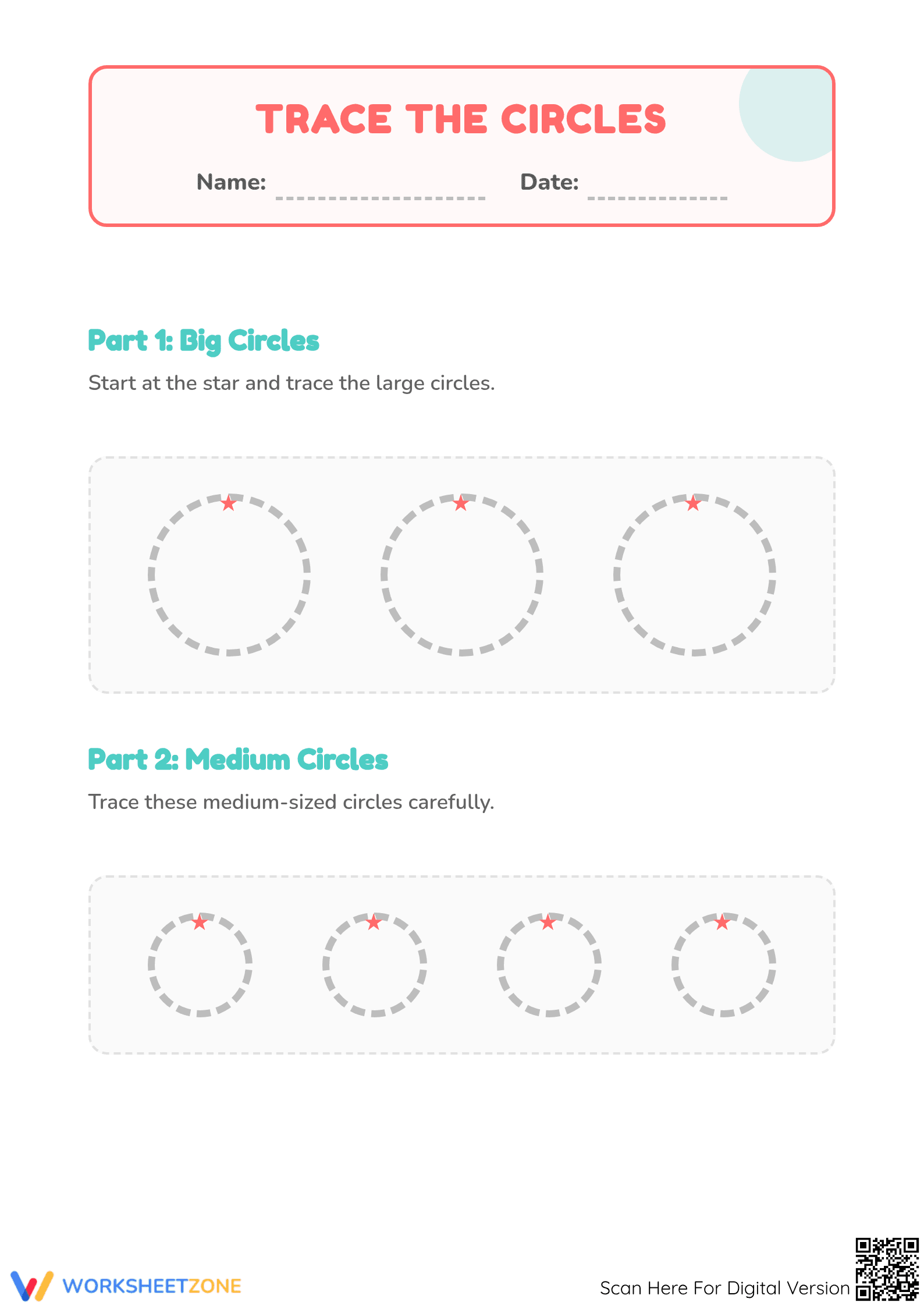


Preschool Trace the Circles — Printable No-Prep Worksheet
Paste this activity's link or code into your existing LMS (Google Classroom, Canvas, Teams, Schoology, Moodle, etc.).
Students can open and work on the activity right away, with no student login required.
You'll still be able to track student progress and results from your teacher account.
Foundational Tracing Practice
This Trace the Circles worksheet provides preschool learners with essential fine motor practice through structured shape identification. By following guided paths of varying sizes, students build the muscular control necessary for future handwriting while solidifying their understanding of geometric properties. It is a foundational tool for early math success.
At a Glance
- Grade: Preschool · Subject: Math
- Standard:
K.G.2— Identify and describe circles regardless of their size- Skill Focus: Circle Tracing & Fine Motor
- Format: 2 pages · 20 problems · Answer key included · PDF
- Best For: Morning work or math centers
- Time: 10–15 minutes
What's Inside
Inside this two-page PDF, teachers will find four distinct sections tailored to developmental progression. Part one features three large circles, while part two offers four medium-sized shapes. The second page introduces six small circles and seven integrated shape tasks to challenge precision. A full answer key and visual cues are included.
Zero-Prep Workflow
The zero-prep workflow for this resource is designed for maximum efficiency. First, print the two-page document in under one minute. Second, distribute to students with crayons during morning arrival. Finally, review student precision in less than thirty seconds per page to identify who needs motor support. This process ensures high-quality instruction without a heavy teacher load.
Standards Alignment
This resource aligns with `CCSS.MATH.CONTENT.K.G.A.2`, which requires students to name shapes regardless of size. While designed for preschool, it meets prerequisite skills for kindergarten geometry. This standard code can be copied directly into lesson plans or district mapping tools for consistent tracking. It provides a clear bridge to primary math expectations.
How to Use It
Use this worksheet as a morning work activity to settle the class during arrival. Alternatively, it serves as a formative assessment tool during a small-group center. Observe if students can maintain the curve of the circle without lifting their writing utensil, which indicates advancing development. This data informs grouping for future activities.
Who It's For
This worksheet is specifically designed for preschool students beginning to master pencil grip. It is ideal for occupational therapy or students needing extra support in spatial awareness. Pair this resource with a physical circle scavenger hunt or a tactile sand-tracing activity for a multi-sensory experience. It effectively supports diverse learners in the inclusive classroom.
According to the Gradual Release of Responsibility model by Fisher & Frey (2014), providing students with structured scaffolds like tracing stars and dashed lines is critical for developing cognitive independence. This preschool tracing circles worksheet utilizes these proven instructional design principles to transition learners from assisted movement to independent geometric reproduction. The inclusion of twenty distinct tracing tasks allows for the repetitive practice required to move spatial information into long-term memory. Research suggests that early mastery of geometric shapes is a strong predictor of later success in both advanced mathematics and reading comprehension, as it develops the visual discrimination skills needed to recognize letters and numbers. By focusing on the K.G.2 standard, educators ensure that students are not merely copying lines but are actively engaging with the defining attributes of a circle. This systematic approach supports early intervention goals and provides clear evidence of progress for parent-teacher conferences.


