


























Views
Downloads
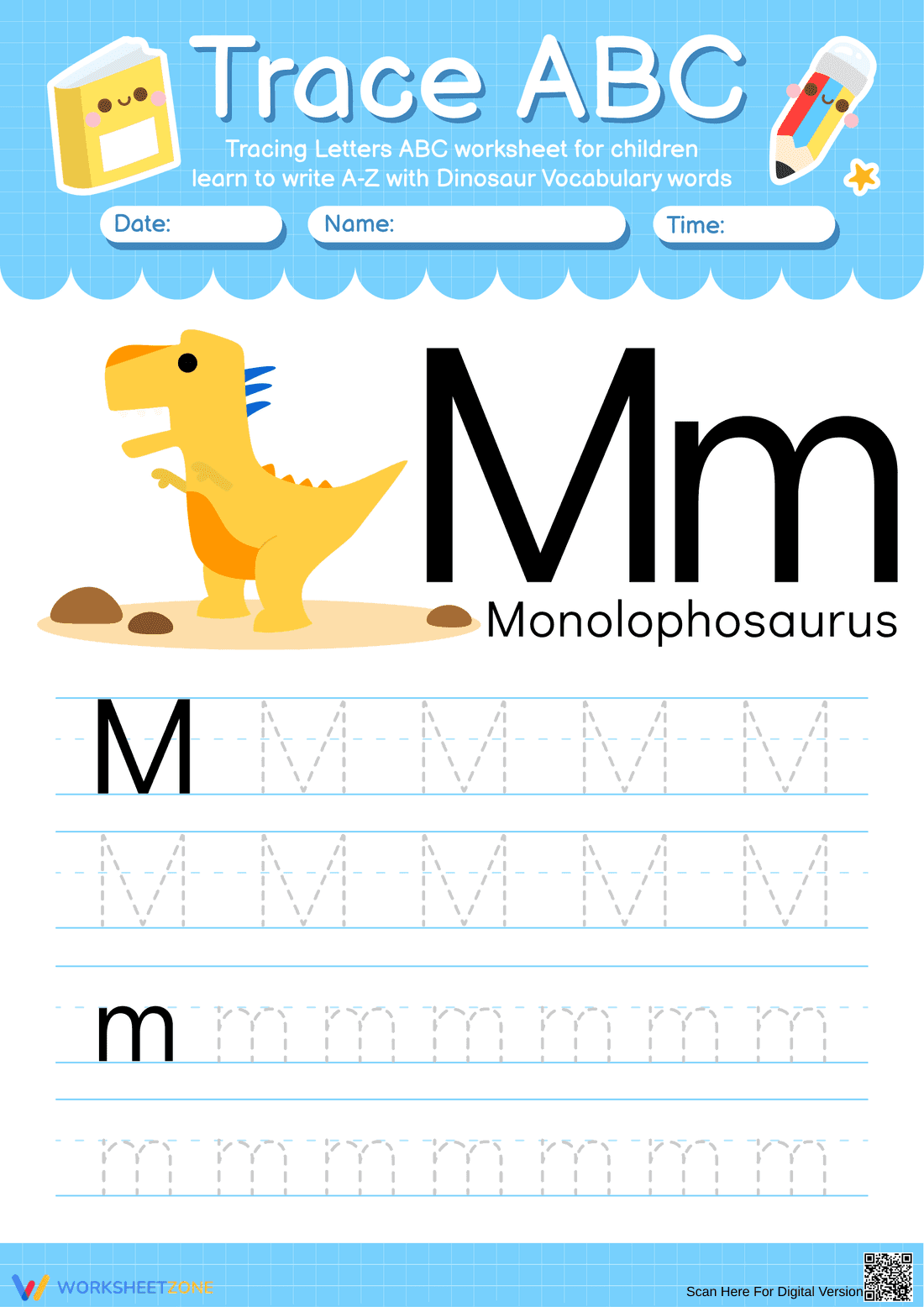

Printable Letter M Tracing Worksheet | Kindergarten ELA
Paste this activity's link or code into your existing LMS (Google Classroom, Canvas, Teams, Schoology, Moodle, etc.).
Students can open and work on the activity right away, with no student login required.
You'll still be able to track student progress and results from your teacher account.
This dinosaur-themed letter M tracing worksheet provides early learners with focused handwriting practice. Students develop fine motor skills and letter recognition by tracing both uppercase and lowercase forms of the letter M. The engaging Monolophosaurus illustration captures student interest while reinforcing foundational alphabet knowledge and proper letter formation techniques.
At a Glance
- Grade: Kindergarten · Subject: English
- Standard:
CCSS.ELA-LITERACY.L.K.1.A— Print many upper- and lowercase letters- Skill Focus: Letter M formation
- Format: 1 page · 24 problems · No answer key required · PDF
- Best For: Independent handwriting practice
- Time: 10–15 minutes
Inside this single-page resource, educators will find four structured rows of tracing exercises. The first two rows are dedicated to the uppercase letter M, while the bottom two rows focus on the lowercase letter m. Each row features dashed guidelines to support proper stroke order and sizing. A colorful Monolophosaurus graphic at the top introduces a unique vocabulary word, connecting the target letter to an engaging visual cue.
This resource is designed for immediate classroom implementation with a highly efficient zero-prep workflow:
- Print (1 minute): Simply download the PDF and print the required number of copies. The high-contrast dashed lines ensure clear visibility even in black and white.
- Distribute (1 minute): Hand out the sheets along with pencils or crayons. The intuitive layout means students immediately understand the task.
- Review (0 minutes): Tracing activities require no formal grading key, allowing teachers to visually assess progress on the spot.
Total teacher preparation time is under two minutes, making this an ideal activity for morning work, literacy centers, or emergency substitute plans.
This worksheet is strictly aligned to CCSS.ELA-LITERACY.L.K.1.A: Print many upper- and lowercase letters. By repeatedly tracing the letter M within standard handwriting lines, students build the muscle memory required to meet this foundational literacy benchmark. Both standard codes can be copied directly into lesson plans, IEP goals, or district curriculum mapping tools.
Teachers can utilize this worksheet during morning arrival as a calm, focused bell-ringer activity. It also serves perfectly as an independent station during literacy block rotations. While students work, teachers can conduct formative assessments by observing pencil grip and stroke direction, gently correcting any bottom-to-top tracing habits. Expected completion time ranges from 10 to 15 minutes, depending on the child's fine motor development.
This resource is primarily designed for Kindergarten students mastering the alphabet, though it is equally effective for Preschoolers showing early writing readiness or first graders needing handwriting intervention. The clear visual boundaries provide excellent scaffolding for students developing fine motor control. Pair this worksheet with a read-aloud book featuring dinosaurs or words starting with the letter M to reinforce phonetic connections.
Developing automaticity in letter formation is a critical stepping stone for early literacy success. This resource targets CCSS.ELA-LITERACY.L.K.1.A, helping students print many upper- and lowercase letters with confidence. According to a 2024 report by EdReports, explicit and repeated handwriting practice significantly reduces the cognitive load required for basic transcription, allowing young writers to eventually focus on idea generation and sentence structure. By isolating the letter M and providing guided tracing paths, this worksheet ensures students build accurate muscle memory before attempting independent writing. The integration of thematic elements, such as the dinosaur vocabulary, further supports engagement during repetitive motor skill tasks. Consistent practice with structured guidelines remains one of the most effective methods for transitioning early learners from tracing to independent letter production.


