


























Views
Downloads

Town Coordinate Plane Worksheet | Printable Grade 6 Math
Paste this activity's link or code into your existing LMS (Google Classroom, Canvas, Teams, Schoology, Moodle, etc.).
Students can open and work on the activity right away, with no student login required.
You'll still be able to track student progress and results from your teacher account.
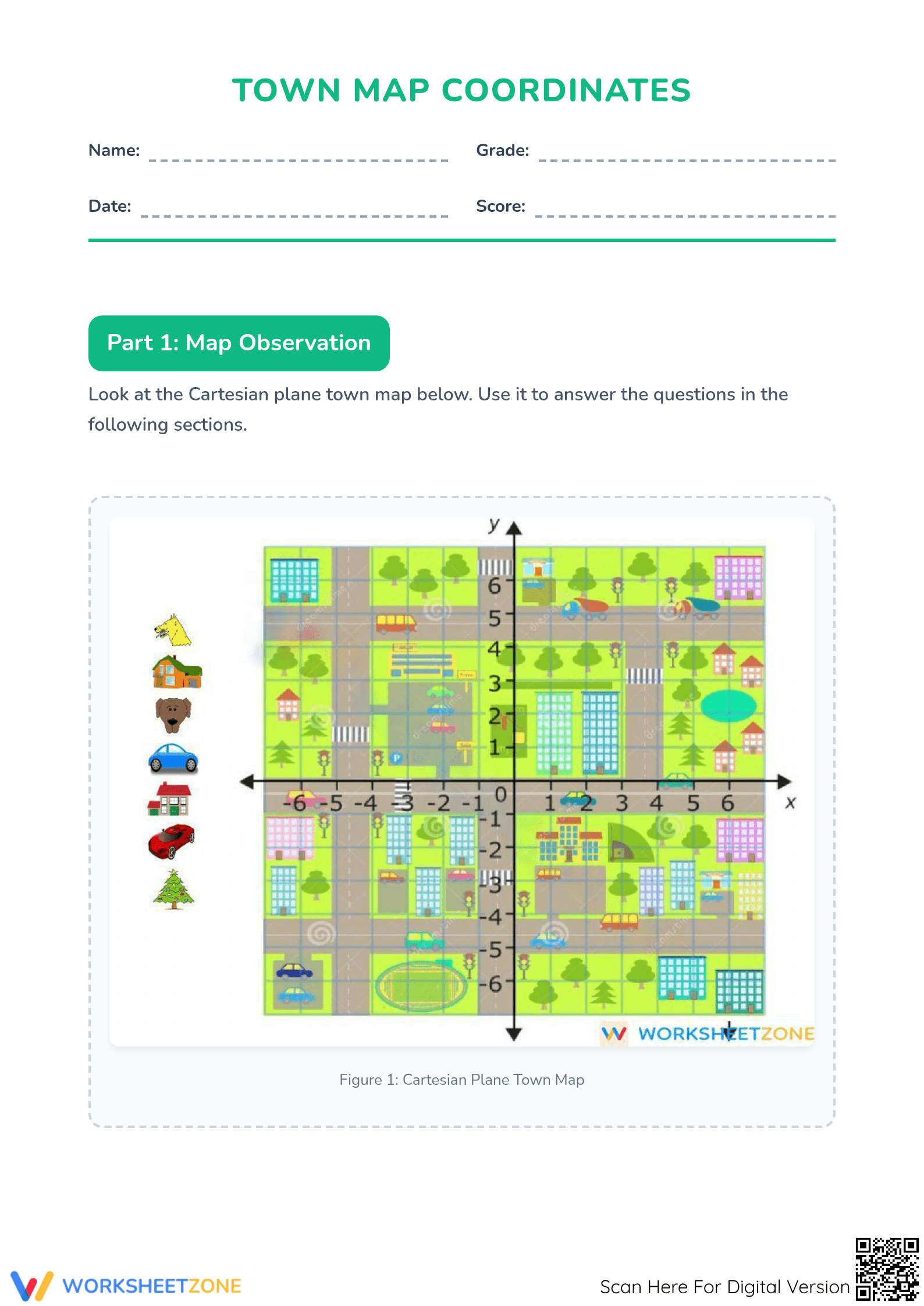
Mastering the Cartesian plane is a fundamental milestone in middle school mathematics. This Town Map Coordinates worksheet provides students with a visually engaging context to practice identifying and plotting points across all four quadrants. By locating specific town landmarks and identifying objects based on given coordinates, learners build the spatial reasoning and accuracy required for advanced algebra and geometry.
At a Glance
- Grade: 6 · Subject: Math
- Standard:
CCSS.MATH.CONTENT.6.NS.C.6.C— Find and position pairs of integers on a coordinate plane- Skill Focus: Four-Quadrant Coordinate Graphing
- Format: 4 pages · 20 problems · Answer key included · PDF
- Best For: Interactive classroom practice or homework assignment
- Time: 20–30 minutes
What's Inside
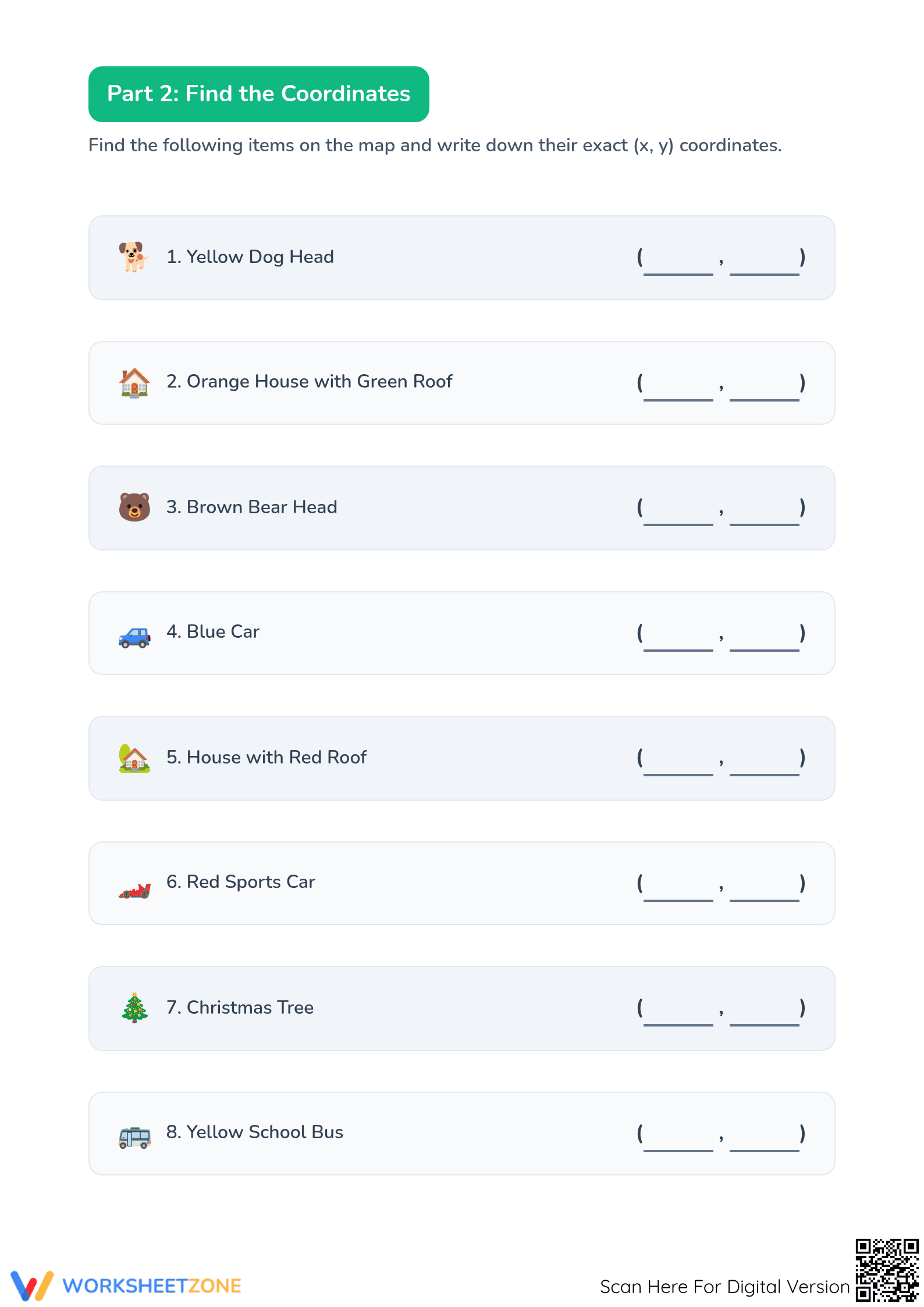
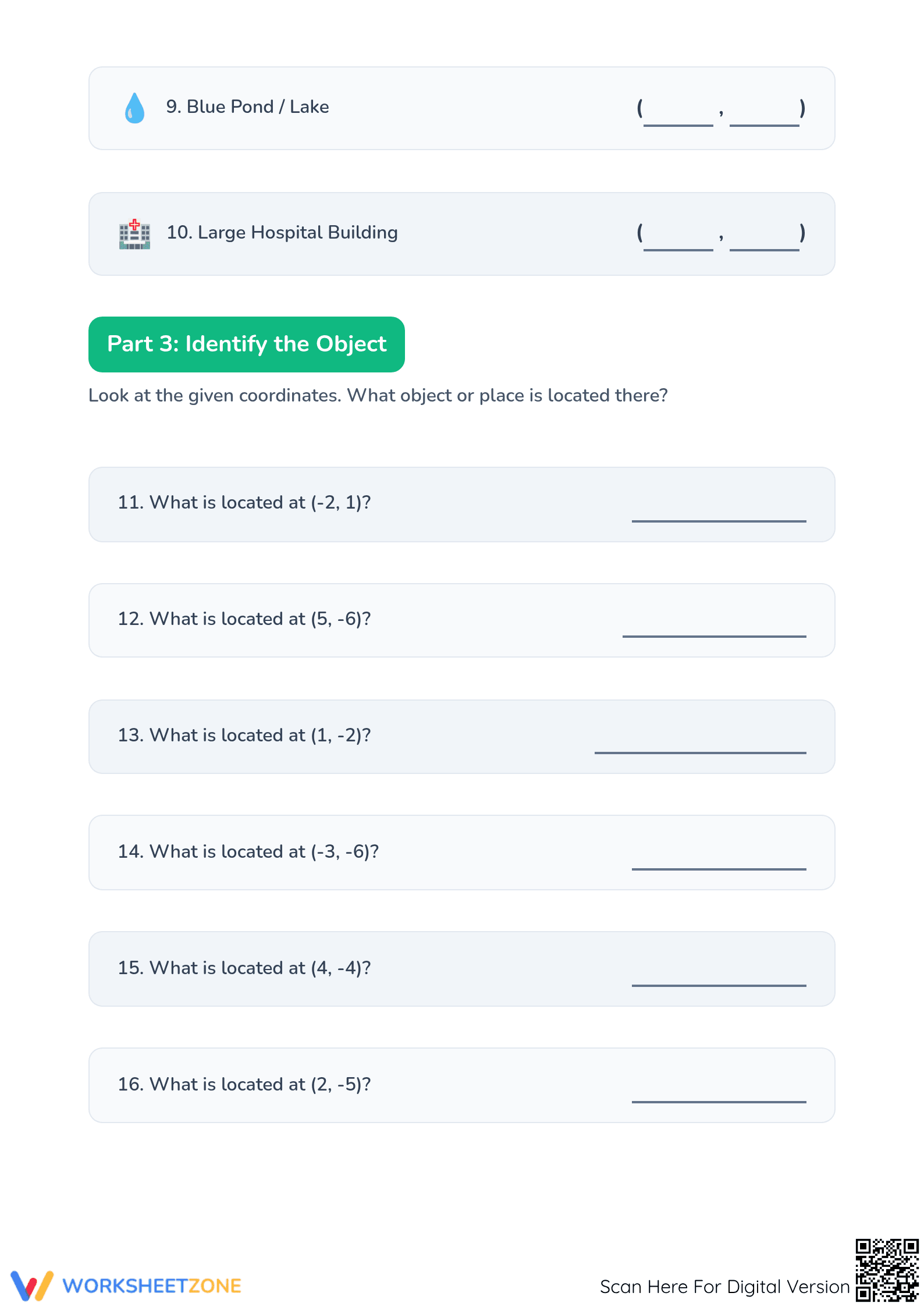
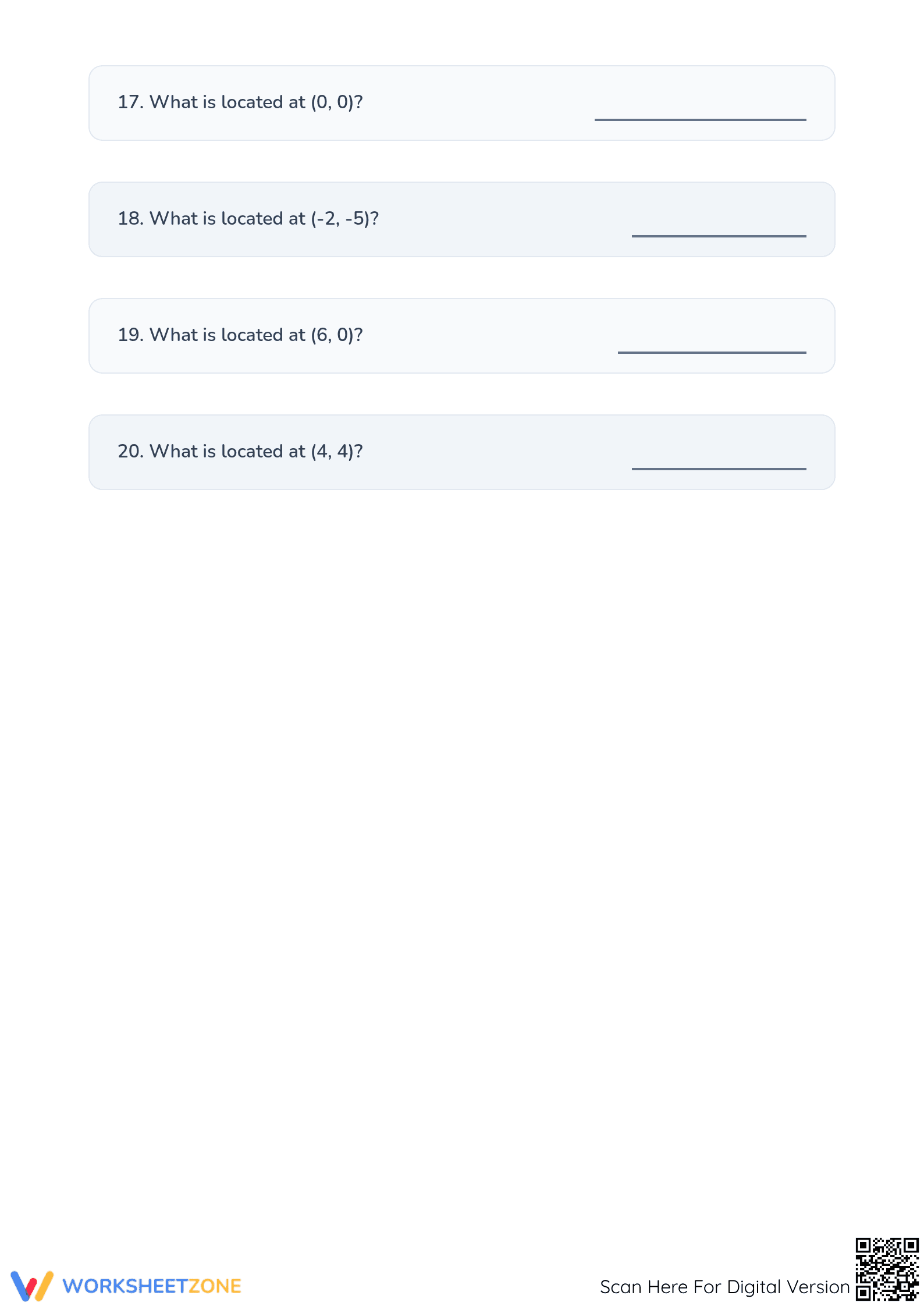
This comprehensive 4-page PDF features a detailed town map overlaid on a Cartesian plane with axes ranging from -6 to 6. The first section challenges students to find the exact (x, y) coordinates for ten specific icons, such as the hospital, school bus, and various houses. The second half reverses the task, providing ten sets of coordinates and requiring students to identify the object located at each point. A full answer key is provided for quick grading.
Skill Progression
- Guided observation: Students begin by analyzing the visual town map and locating landmarks within the four quadrants.
- Supported identification: Learners determine coordinates for ten objects, requiring careful counting along both axes.
- Independent verification: Students use given coordinates to identify specific objects, reinforcing the relationship between ordered pairs and plane locations.
This gradual-release approach builds confidence as students move from simple identification to conceptual application of coordinate systems.
Standards Alignment
This resource is directly aligned to CCSS.MATH.CONTENT.6.NS.C.6.C, which requires students to find and position pairs of integers on a coordinate plane. It also supports foundational skills in graphing points while extending the concept to negative integers and all four quadrants. Both standard codes can be copied directly into lesson plans, IEP goals, or district curriculum mapping tools.
How to Use It
This worksheet is ideal for use after direct instruction on the Cartesian coordinate system. Use it as a collaborative math center activity where pairs of students verify each other's work or as a formative assessment to gauge mastery of integer positioning. Teachers should observe whether students consistently identify the x-axis before the y-axis, providing a perfect opportunity to correct the common directional error before it becomes a habit.
Who It's For
Designed for 6th-grade math students, this worksheet also serves as an excellent challenge for 5th-grade learners or a necessary review for 7th-graders. It is particularly effective for visual learners who benefit from concrete representations of abstract mathematical concepts. Pair this resource with a physical grid activity or a digital coordinate game to create a multi-sensory learning experience that accommodates diverse classroom needs.
Accurate graphing on a coordinate plane is a prerequisite for understanding functions and geometric transformations in higher-level mathematics. According to research from the RAND AIRS 2024 report, contextualized math problems—such as navigating a town map—significantly improve student engagement and retention compared to abstract grid practice. This worksheet addresses CCSS.MATH.CONTENT.6.NS.C.6.C by requiring students to navigate all four quadrants, building the fluency needed to find and position pairs of integers correctly. Fisher & Frey (2014) emphasize that such structured practice supports the gradual release of responsibility, moving students from teacher-led modeling to independent mastery. Educators can rely on this aligned material to meet rigorous state standards while providing students with the essential practice required for long-term academic success in STEM fields.


