


























Views
Downloads

Touch Dot Math Worksheet | Grade 1 Printable Math
Paste this activity's link or code into your existing LMS (Google Classroom, Canvas, Teams, Schoology, Moodle, etc.).
Students can open and work on the activity right away, with no student login required.
You'll still be able to track student progress and results from your teacher account.
This large-print math worksheet builds addition and subtraction fluency within 20 using multisensory touch dot cues. Students count on and count back on tactile dot points to solve computation problems with confidence. The structured format supports early learners and special education students toward accurate independent calculation.
At a Glance
- Grade: 1 · Subject: Math
- Standard:
CCSS.MATH.CONTENT.1.OA.C.6— Add and subtract within 20 using strategies such as counting on- Skill Focus: Touch dot computation within 20
- Format: 3 pages · 18 problems · Answer key included · PDF
- Best For: Special education and Tier 2 intervention
- Time: 15–20 minutes
What's Inside
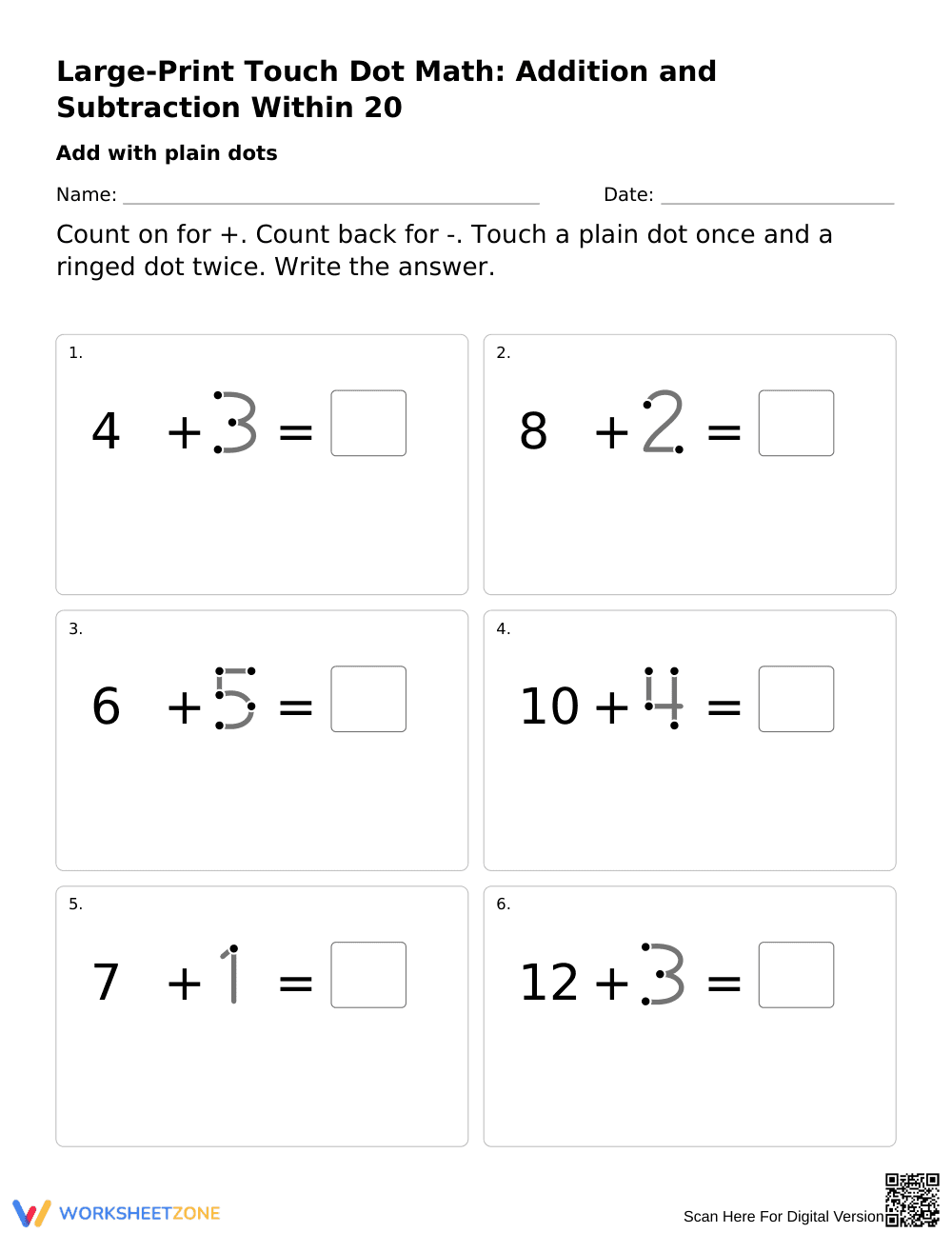
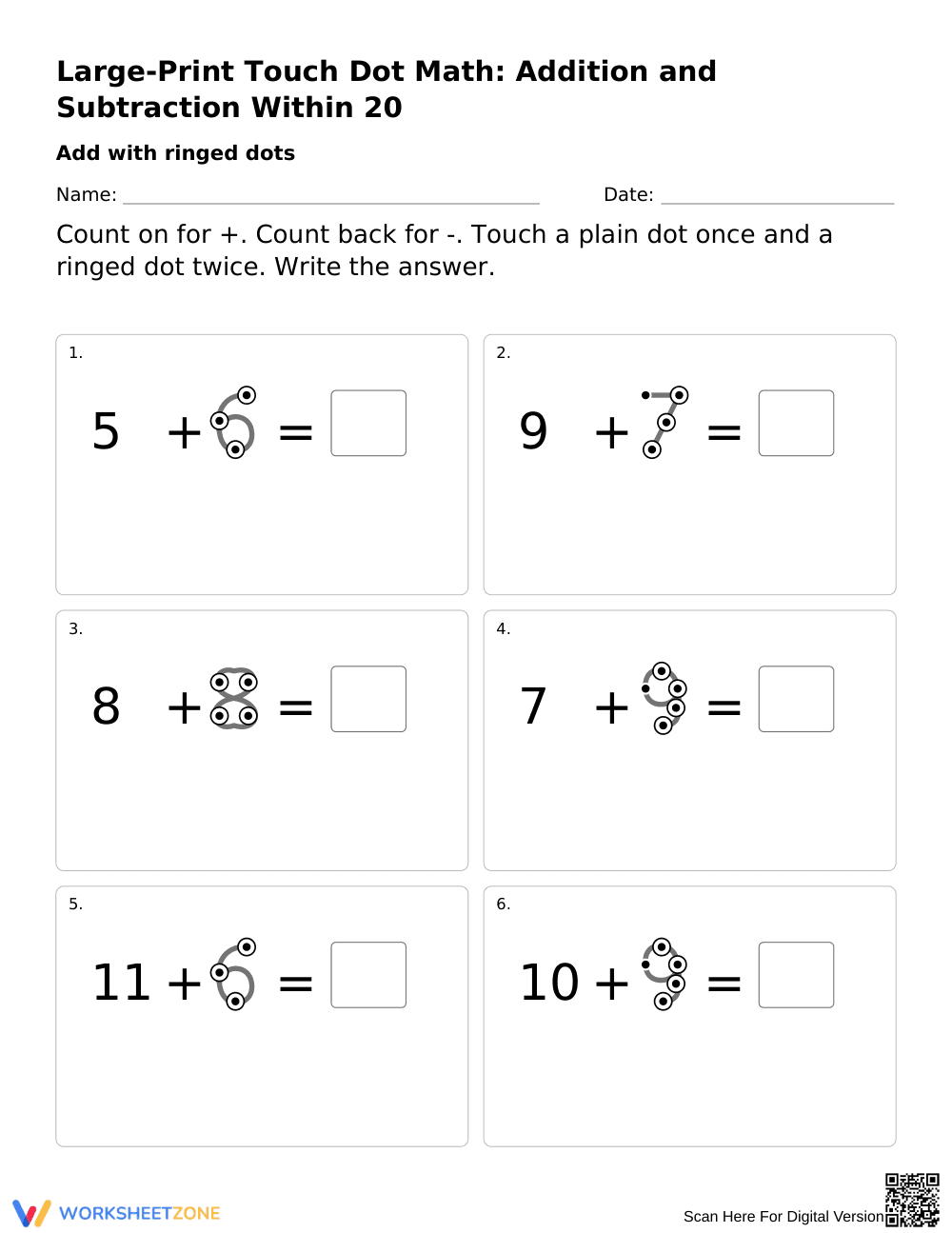
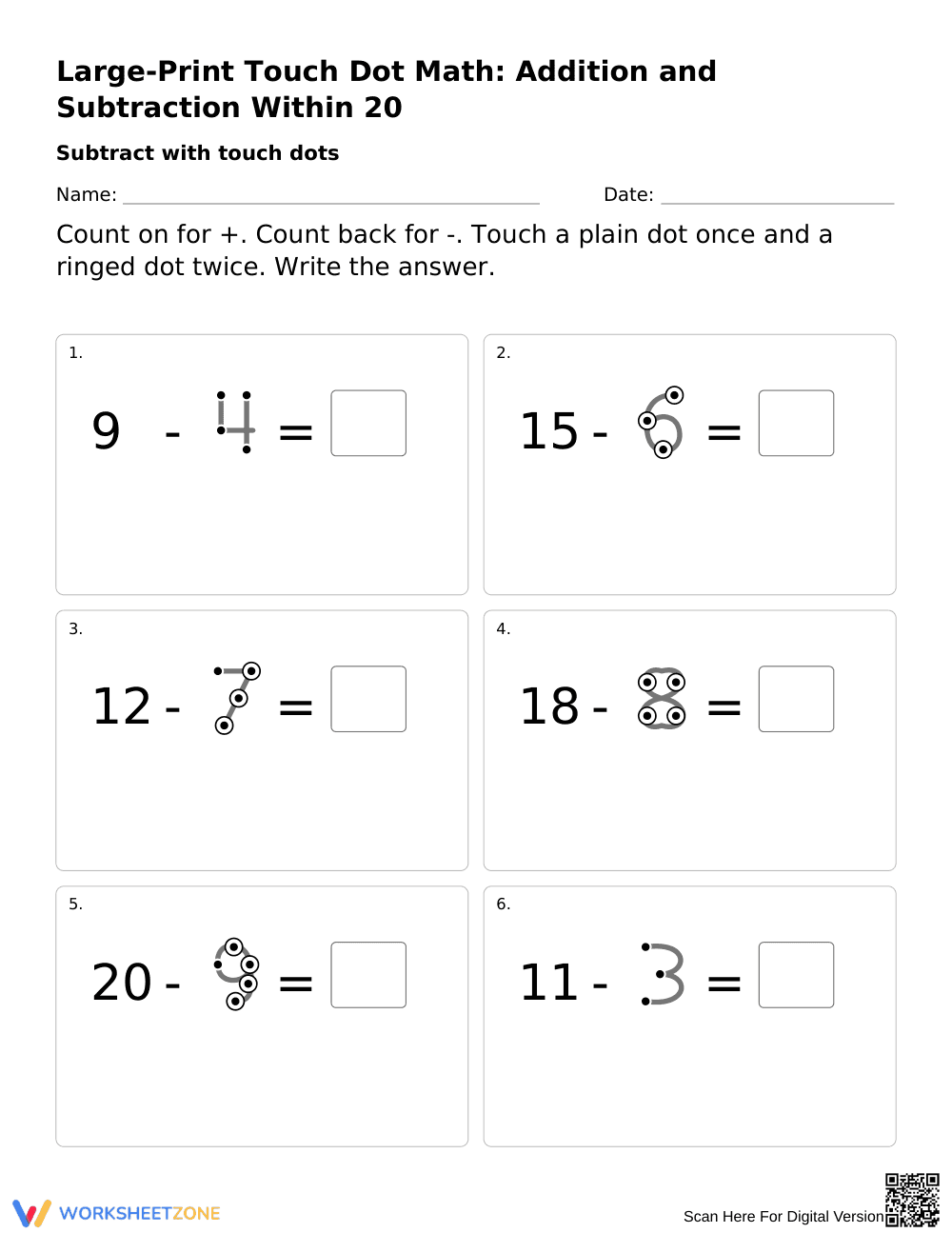
The resource contains 3 student activity pages with 6 large-print problems per page, totaling 18 structured tasks. Page 1 covers addition with single touch dots on numbers 1 through 5. Page 2 provides addition with double-touch ringed dots on numbers 6 through 9. Page 3 presents subtraction within 20. A full answer key is included.
Skill Progression
This resource utilizes a scaffolded sequence that moves students systematically from basic counting to mixed operations:
- Guided practice (Set 1): 6 single-touch addition problems establishing finger placement and counting on from the first addend.
- Supported practice (Set 2): 6 double-touch ringed addition problems requiring double taps on numbers 6 to 9 to reach sums to 19.
- Independent practice (Set 3): 6 touch dot subtraction problems requiring students to count backward from minuends up to 20.
This progression mirrors the gradual-release model, fostering computational independence.
Standards Alignment
This worksheet aligns with CCSS.MATH.CONTENT.1.OA.C.6: Add and subtract within 20, demonstrating fluency for addition and subtraction within 10 using strategies such as counting on and counting back. It also supports CCSS.MATH.CONTENT.1.OA.C.5 by relating counting to computation. Both standard codes can be copied directly into lesson plans, IEP goals, or district curriculum mapping tools.
How to Use It
Use this resource during small-group guided math or for independent practice following teacher modeling. As a formative assessment tip, verify that students double-touch ringed dots in correct order while counting aloud. Expected completion time is 15 to 20 minutes.
Who It's For
This worksheet serves Grade 1 learners, Tier 2 intervention students, and special education classrooms. The spacious, 6-box layout accommodates learners with fine motor or visual tracking challenges. Pair this worksheet with a touch-point number line or anchor chart during introductory instruction.
Targeting CCSS.MATH.CONTENT.1.OA.C.6, this worksheet systematically develops addition and subtraction within 20 through multisensory touch points and structured counting strategies. According to research on scaffolded mathematics instruction by Fisher & Frey (2014), structured tactile cues and gradual-release problem sets significantly enhance conceptual retention and computational accuracy for emerging mathematicians. By isolating addends and subtrahends with explicit touch dot configurations, the activity enables students to bridge the cognitive gap between concrete counting objects and symbolic mental math. The sequential transition from single-touch points to double-touch ringed dots provides the exact scaffolding required for students with learning differences to achieve calculation automaticity. Educators utilizing this 18-problem resource can reliably document student progress toward IEP annual mathematics goals and standards-based mastery milestones across general education, intervention, and resource room learning environments with total instructional fidelity.


