


























Views
Downloads

Essential Tolerance Worksheet | Grade 6-8 Social Skills
Paste this activity's link or code into your existing LMS (Google Classroom, Canvas, Teams, Schoology, Moodle, etc.).
Students can open and work on the activity right away, with no student login required.
You'll still be able to track student progress and results from your teacher account.
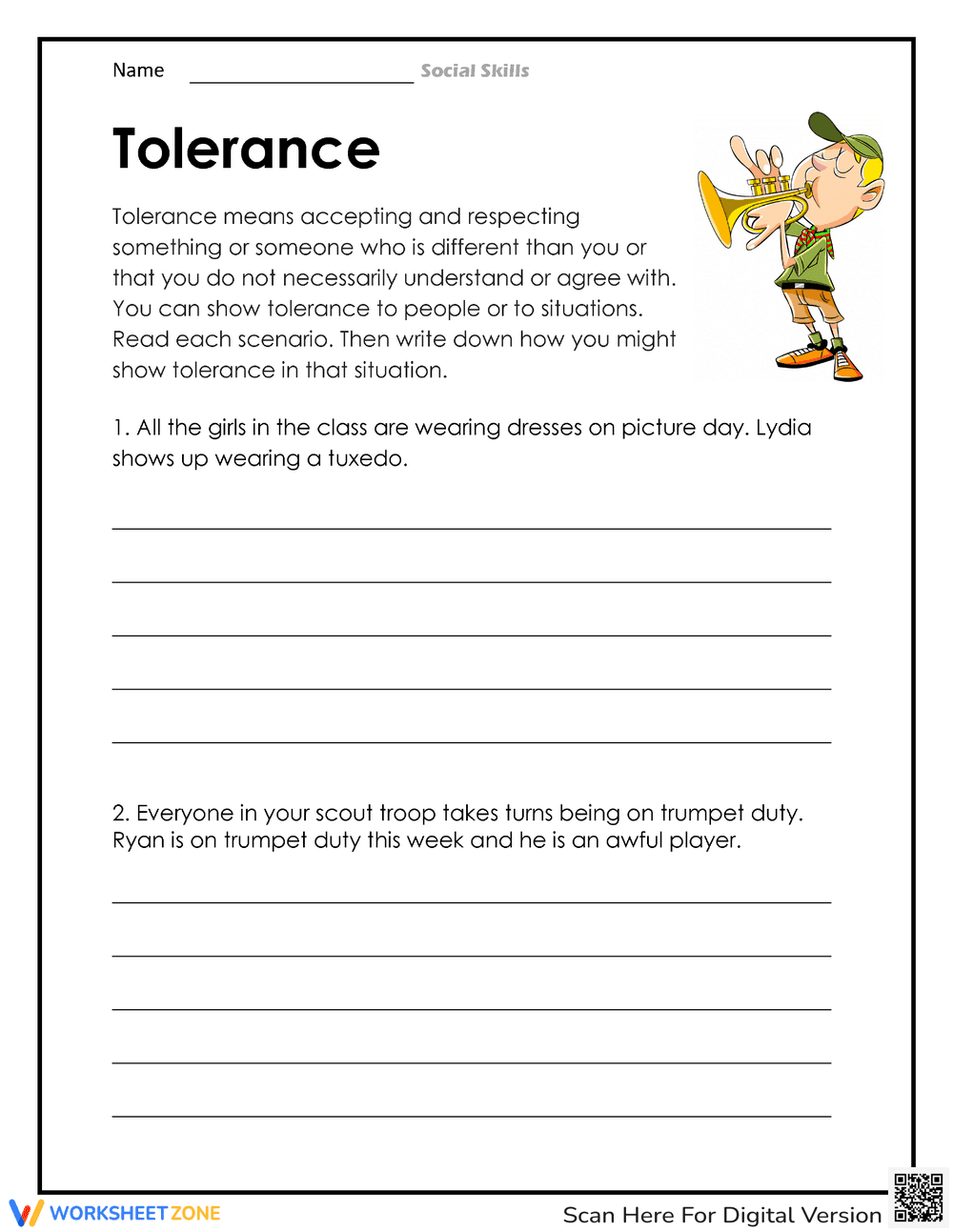
This middle school social skills worksheet helps students internalize the concept of tolerance through practical application. By analyzing real-world scenarios, students learn to respect differences and respond with empathy rather than judgment. This resource provides a clear framework for understanding how to interact with others who may not conform to social norms, fostering a more inclusive classroom environment.
At a Glance
- Grade: 6-8 · Subject: Social Skills
- Standard:
CCSS.ELA-LITERACY.SL.7.1— Engage effectively in collaborative discussions with diverse partners- Skill Focus: Tolerance and Empathy
- Format: 1 page · 2 problems · Answer key included · PDF
- Best For: SEL lessons and behavior intervention
- Time: 15–20 minutes
The worksheet features a concise, student-friendly definition of tolerance at the top to establish a common vocabulary. Below the definition, students encounter 2 distinct social scenarios: one involving non-traditional clothing choices and another involving a peer's lack of musical skill. Each scenario is followed by ample writing space, encouraging students to provide thoughtful, multi-sentence responses that demonstrate their understanding of the core concept.
The zero-prep design ensures this resource fits into any instructional block. First, print the single-page PDF (30 seconds). Second, distribute to students as a bell-ringer or transition activity (30 seconds). Third, facilitate a brief group discussion to review student responses and reinforce the definition of tolerance. Total teacher preparation time is under 2 minutes, making it an ideal choice for substitute folders or unexpected schedule changes.
This resource aligns with `CCSS.ELA-LITERACY.SL.7.1`, which requires students to engage effectively in discussions with diverse partners, building on others' ideas and expressing their own clearly. By reflecting on tolerance, students develop the foundational perspective-taking skills necessary to meet this standard. Both standard codes can be copied directly into lesson plans, IEP goals, or district curriculum mapping tools.
Use this worksheet during a dedicated Social-Emotional Learning (SEL) block or as a supplemental activity in an ELA unit focused on character development. It is particularly effective as a formative assessment tool; observe whether students can identify the respectful choice without prompting. Expected completion time is 15 to 20 minutes, depending on the depth of the classroom discussion that follows the individual writing portion.
This resource is designed for general education students in grades 6 through 8, as well as students receiving special education services for social-behavioral goals. It pairs naturally with an anchor chart on character pillars or a short story involving conflict resolution. The open-ended nature of the tasks allows for natural differentiation, as students can respond at their own level of social maturity.
Social-emotional learning (SEL) interventions in middle school are critical for developing the cognitive empathy required for adult social competence. This worksheet targets CCSS.ELA-LITERACY.SL.7.1 by requiring students to engage in perspective-taking through written reflection on diverse social scenarios. According to the RAND AIRS 2024 report on school climate, explicit instruction in tolerance and social-emotional skills correlates with a 12% reduction in disciplinary incidents and improved peer-to-peer collaboration in inclusive classrooms. By analyzing specific instances of non-conformity and skill deficits in others, students move beyond surface-level definitions to apply tolerance as a functional social tool. This resource provides the structured practice necessary for students to internalize these complex interpersonal behaviors. The inclusion of open-ended response areas allows for the qualitative assessment of a student's ability to acknowledge diverse perspectives without judgment, a core requirement for meeting state and national behavioral standards in secondary education settings.


