


























Views
Downloads
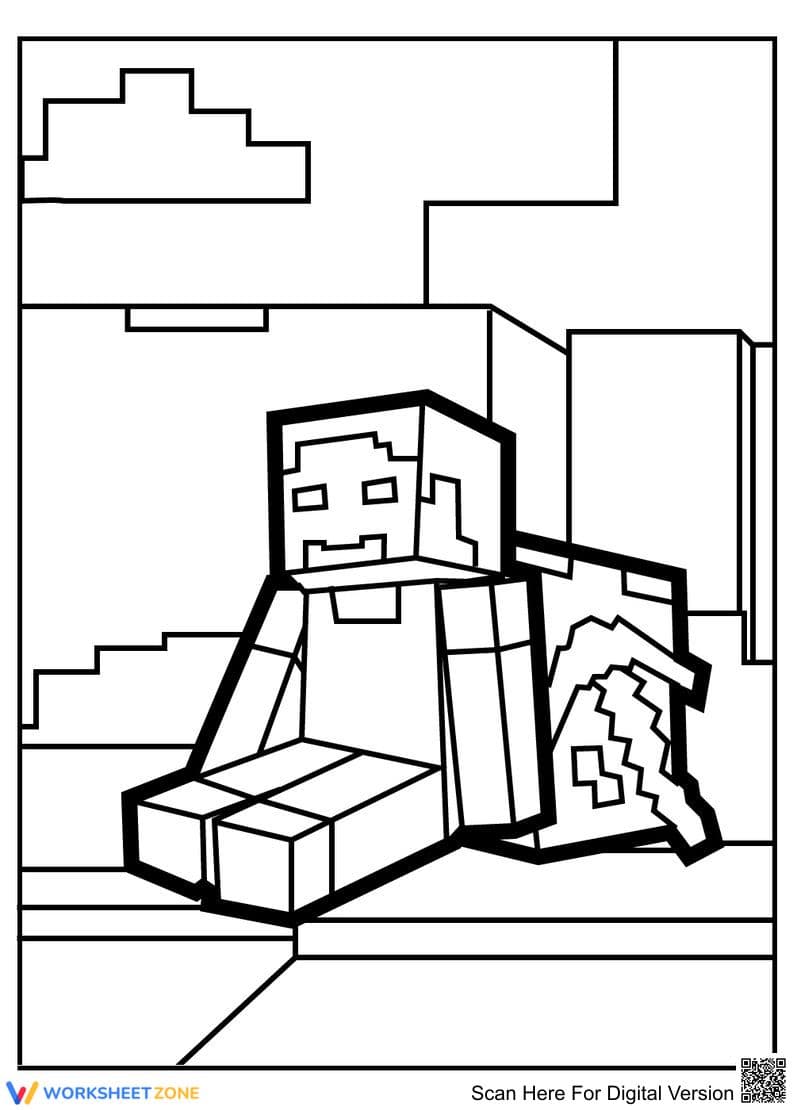

Tired Minecraft Coloring Page | Essential Grade K-2
Paste this activity's link or code into your existing LMS (Google Classroom, Canvas, Teams, Schoology, Moodle, etc.).
Students can open and work on the activity right away, with no student login required.
You'll still be able to track student progress and results from your teacher account.
This Kindergarten Minecraft coloring worksheet helps students develop fine motor control while exploring the concept of physical exhaustion. By selecting colors that represent being "tired," children bridge the gap between vocabulary and visual expression. It provides a familiar, high-interest context to practice staying within lines and choosing intentional color palettes for emotional storytelling.
At a Glance
- Grade: Kindergarten · Subject: Arts & English
- Standard:
CCSS.ELA-LITERACY.L.K.5.C— Identify real-life connections between words and their use through visual art- Skill Focus: Fine motor skills and emotional vocabulary
- Format: 1 page · 1 task · No answer key required · PDF
- Best For: Morning work or emotional regulation breaks
- Time: 15–20 minutes
Inside this resource, you will find a single-page, high-resolution printable featuring a popular block-style character in a seated, resting pose. The line art is bold and clear, making it accessible for early learners who are still mastering grip and pressure. There are no complex instructions, allowing the student to focus entirely on the creative task of depicting a "tired" state through their choice of crayons or markers.
The zero-prep workflow for this activity is designed for maximum efficiency in a busy classroom. First, print the single PDF page (30 seconds). Second, distribute the sheets along with a standard set of coloring tools (1 minute). Third, review the students' work by asking them why they chose specific colors to show the character is tired (30 seconds per student). Total teacher preparation time is under 2 minutes, making it an ideal sub plan or transition activity.
This worksheet aligns with CCSS.ELA-LITERACY.L.K.5.C, which requires students to identify real-life connections between words and their use. By asking students to color a character specifically to show they are "tired," educators help children internalize the meaning of the adjective through a tactile, visual medium. Both standard codes can be copied directly into lesson plans, IEP goals, or district curriculum mapping tools.
Use this worksheet during a "cool-down" period after recess or as a quiet morning work option. It serves as a formative assessment tool; observe if students choose muted or "sleepy" colors versus bright, energetic ones to see if they grasp the vocabulary prompt. Completion typically takes 15 to 20 minutes depending on the student's detail level and focus.
This resource is perfect for Kindergarten and Grade 1 students, particularly those who are motivated by gaming themes. It is an excellent choice for students requiring fine motor intervention or those who benefit from high-interest, low-anxiety tasks. Pair this with a read-aloud about feelings or a Minecraft-themed vocabulary anchor chart to extend the learning moment.
According to Fisher & Frey (2014), the use of high-interest visual media in early childhood education significantly increases engagement and supports the acquisition of tiered vocabulary. This worksheet leverages the familiar Minecraft aesthetic to meet CCSS.ELA-LITERACY.L.K.5.C, allowing students to demonstrate their understanding of the word "tired" through artistic choice. Research indicates that integrating fine motor practice with conceptual vocabulary helps solidify neural pathways associated with language processing. By providing a 1-page, focused task, educators can observe student progress in both physical dexterity and semantic understanding. This resource provides a structured yet creative environment for learners to explore adjectives in a real-world context. The simplicity of the design ensures that the cognitive load remains on the intended skill of vocabulary connection rather than complex navigation.


