


























Views
Downloads


Thunder and Lightning Worksheet | Essential Grade 5 Science
Paste this activity's link or code into your existing LMS (Google Classroom, Canvas, Teams, Schoology, Moodle, etc.).
Students can open and work on the activity right away, with no student login required.
You'll still be able to track student progress and results from your teacher account.
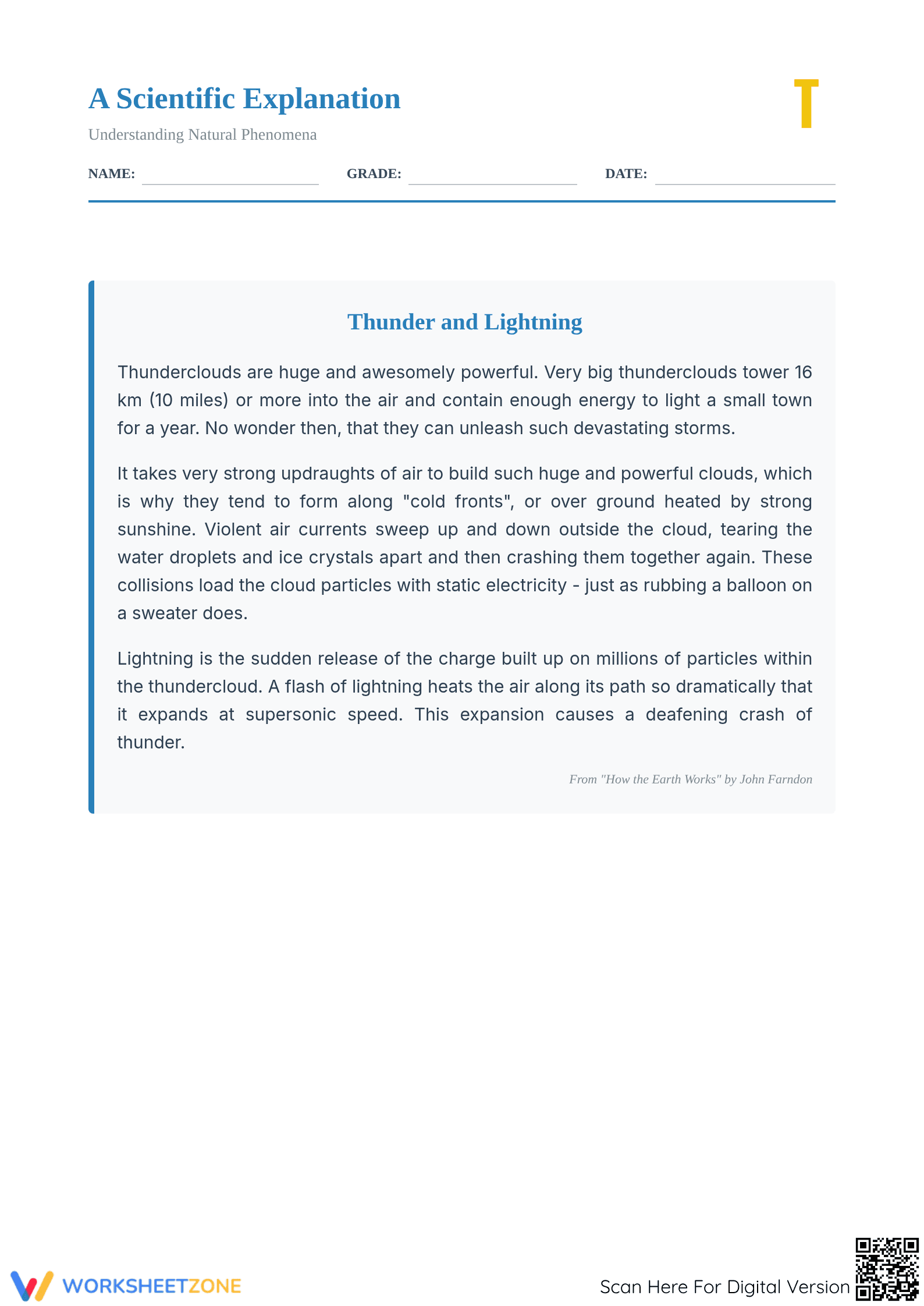
This Grade 5 science and literacy worksheet provides a comprehensive look at the mechanics of atmospheric electricity. Students read a detailed passage explaining how updraughts and static charges create lightning, followed by thunder's supersonic expansion. By connecting physical processes to observable weather events, learners build a functional understanding of natural phenomena while strengthening their informational reading skills.
At a Glance
- Grade: 5 · Subject: Science & ELA
- Standard:
CCSS.ELA-LITERACY.RI.5.3— Explain the relationships or interactions between scientific concepts in a text- Skill Focus: Scientific Explanation & Reading Comprehension
- Format: 3 pages · 12 problems · Answer key included · PDF
- Best For: Independent practice or emergency sub plans
- Time: 30–45 minutes
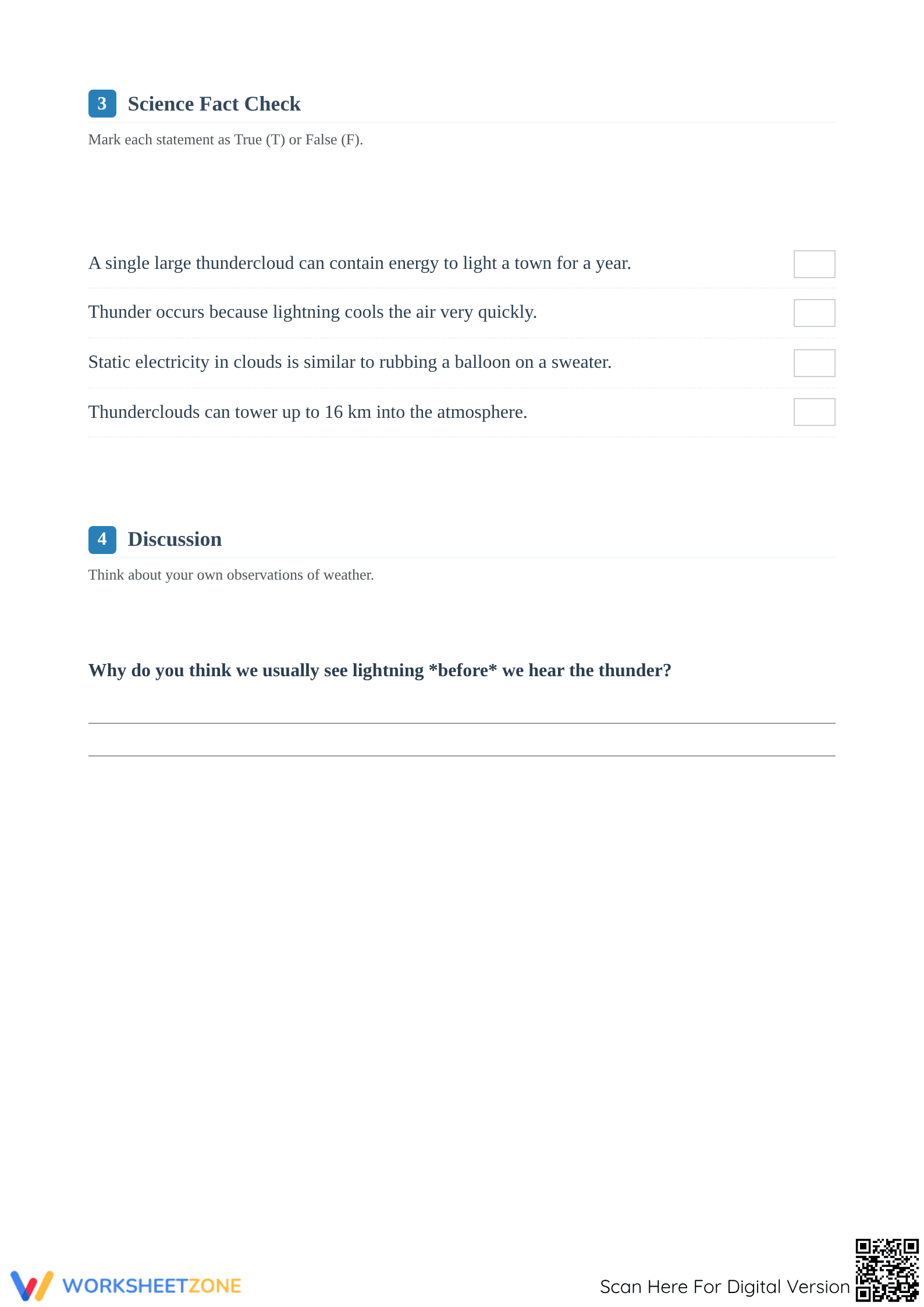
The resource consists of a three-page instructional packet. Page one features a high-quality reading passage titled "Thunder and Lightning." Page two contains three open-ended "Key Concepts" questions and a "Vocabulary Search" where students identify synonyms for descriptive scientific terms. Page three concludes with a four-item "Science Fact Check" and a critical thinking discussion prompt regarding the speed of light and sound. A full answer key is included for all objective tasks.
The zero-prep design allows for an immediate classroom workflow. First, print the three-page PDF (30 seconds). Second, distribute the materials to students for independent reading and task completion (30 minutes). Finally, use the provided answer key for a whole-class review or quick grading (5 minutes). This process requires less than 2 minutes of teacher preparation time, making it an ideal choice for busy mornings or unexpected absences.
This worksheet is primarily aligned with `CCSS.ELA-LITERACY.RI.5.3`, which requires students to explain the relationships or interactions between scientific concepts based on specific information in the text. It also supports NGSS 4-ESS3-2 by exploring natural hazards. Both standard codes can be copied directly into lesson plans, IEP goals, or district curriculum mapping tools.
Assign this worksheet during a weather unit after introducing the concept of static electricity. It serves as an excellent formative assessment to see if students can translate technical descriptions into their own words. Alternatively, use it as a literacy-focused science center where students work in pairs to find evidence in the text. Expect students to spend approximately 35 minutes on the full packet.
This resource is designed for Grade 4 and Grade 5 students who are transitioning to more complex informational texts. It is particularly helpful for English Language Learners (ELLs) due to the explicit vocabulary matching task. Pair this worksheet with a physical demonstration of static electricity using a balloon to provide a concrete anchor for the abstract concepts described in the text.
Research by Fisher & Frey (2014) emphasizes the importance of complex informational texts in developing disciplinary literacy. This worksheet aligns with CCSS.ELA-LITERACY.RI.5.3 by requiring students to explain the relationship between static electricity and lightning formation based on specific evidence from the text. By integrating vocabulary acquisition with conceptual science knowledge, the resource supports the gradual release of responsibility model. Students move from identifying key concepts to evaluating truth-claims and finally engaging in higher-order discussion regarding the speed of light versus sound. Such structured interactions with scientific explanations are critical for meeting NAEP proficiency standards in reading and science. The inclusion of a complete answer key ensures that feedback is immediate, a factor that significantly correlates with student retention of complex natural phenomena. This resource provides a robust framework for Grade 5 learners to synthesize informational details into a coherent understanding of atmospheric events.


