


























Views
Downloads

Character Traits Analysis Worksheet | Printable Grade 3-7
Paste this activity's link or code into your existing LMS (Google Classroom, Canvas, Teams, Schoology, Moodle, etc.).
Students can open and work on the activity right away, with no student login required.
You'll still be able to track student progress and results from your teacher account.
Identifying personality characteristics is a foundational literacy and social-emotional skill. This character traits analysis worksheet provides a structured framework for students in grades 3 through 7 to observe behavior and articulate personality through descriptive language. By connecting traits to specific behavioral evidence, learners build the analytical muscles required for deep character study.
At a Glance
- Grade: 3-7 · Subject: English Language Arts
- Standard:
CCSS.ELA-LITERACY.RL.4.3— Describe in depth a character using specific details from observation- Skill Focus: Characterization & Evidence Collection
- Format: 2 pages · 4 tasks · Answer key included · PDF
- Best For: Literacy centers, sub plans, and SEL
- Time: 25–35 minutes
Resource Components
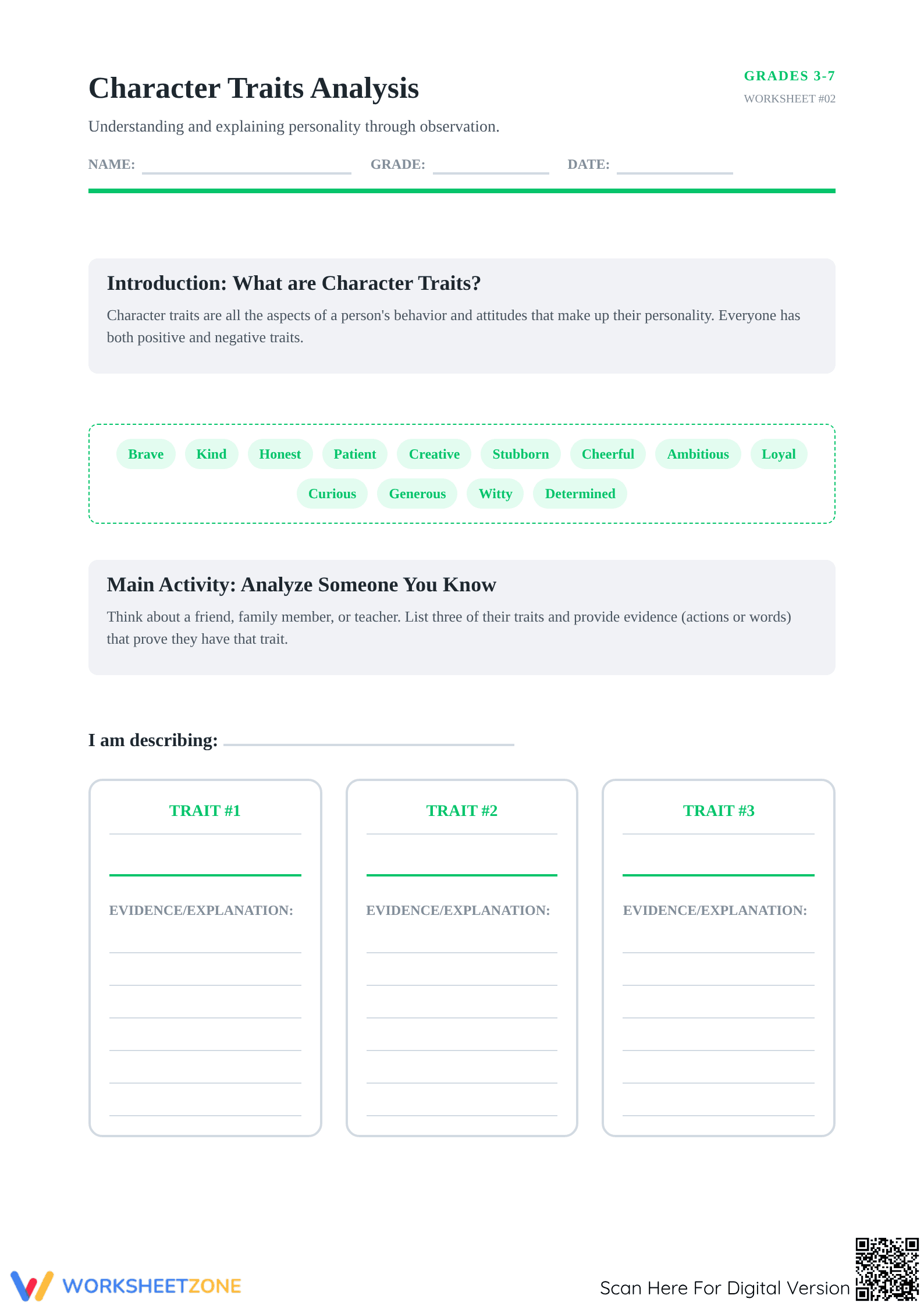
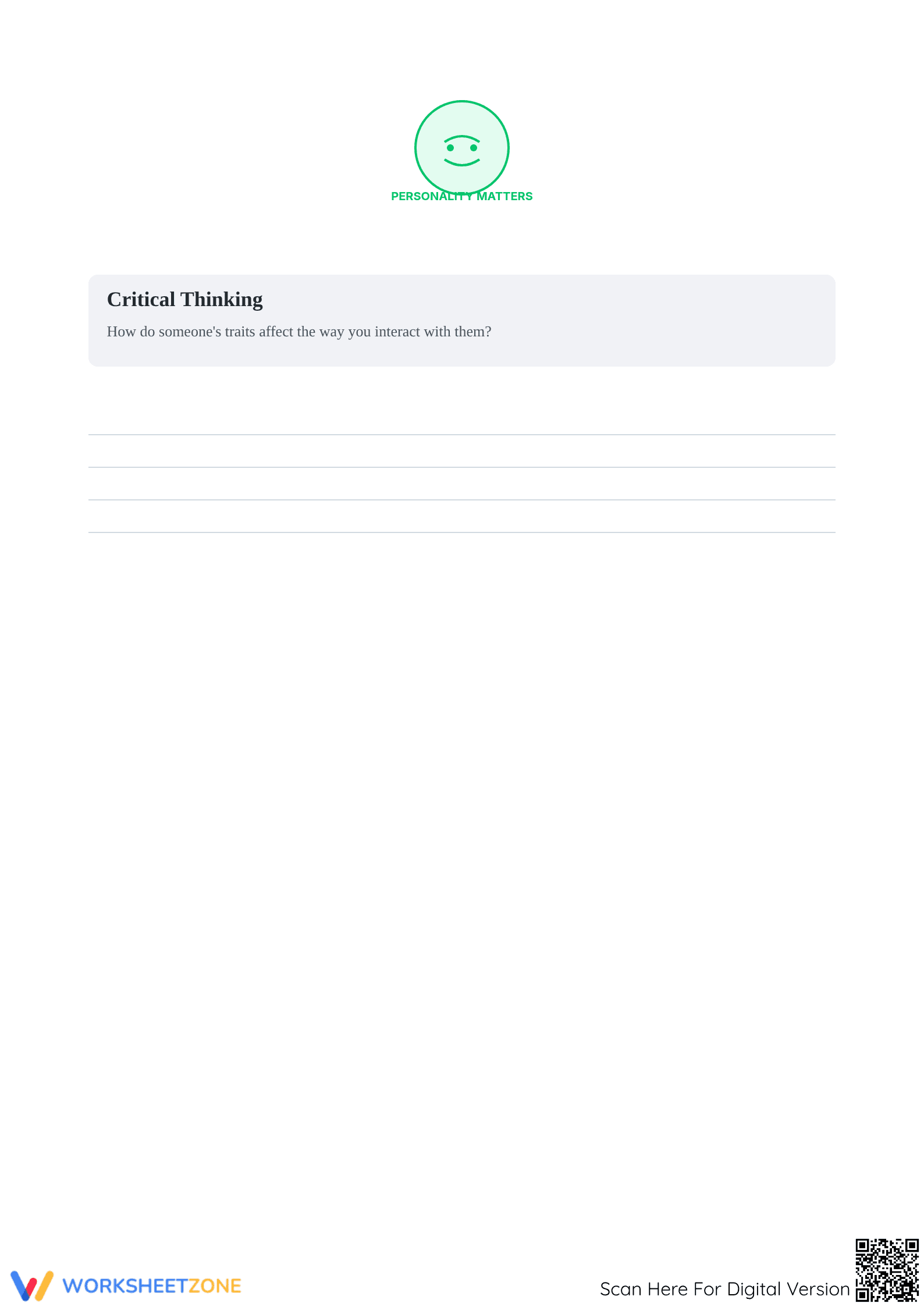
This two-page resource features a comprehensive introduction to character traits, defining them as personality aspects reflected in behavior. It includes a curated word bank with 13 descriptive terms ranging from "ambitious" to "witty." The main activity provides three dedicated evidence blocks for detailed observation, while the second page offers a critical thinking prompt to extend the learning.
Zero-Prep Workflow
The zero-prep design ensures this worksheet is ready for immediate classroom use. Teachers can follow a simple three-step workflow. First, print the two-page PDF (10 seconds). Second, distribute the materials to students (30 seconds). Third, review responses using the provided answer key (60 seconds). This streamlined process makes the resource an ideal candidate for sub plans or literacy center rotations.
Standards Alignment
This worksheet is aligned to CCSS.ELA-LITERACY.RL.4.3, which requires students to describe in depth a character, setting, or event in a story or drama, drawing on specific details. While this activity focuses on real-world observation, it builds the prerequisite skills for literary analysis. Both standard codes can be copied directly into lesson plans, IEP goals, or district curriculum mapping tools.
Instructional Applications
Implement this worksheet as a bridge between SEL and literary analysis. Use it during instruction to model how specific actions prove a trait. As a formative assessment, observe if students can differentiate between temporary emotions and permanent character traits. This activity typically takes 30 minutes, making it a perfect fit for a focused ELA block or a character study unit.
Target Audience
Designed for upper elementary and middle school students, this resource supports a wide range of learners through its scaffolded word bank and clear organizational structure. It pairs naturally with character-heavy mentor texts or as a standalone personality study. Special education teachers will find the structured layout helpful for students requiring graphic organizers for writing.
The development of characterization skills is essential for reading comprehension and narrative writing. Research by Fisher & Frey (2014) emphasizes the importance of providing students with scaffolds, such as word banks and graphic organizers, to facilitate the transition from literal observation to inferential thinking. This worksheet addresses the CCSS.ELA-LITERACY.RL.4.3 standard by requiring students to justify their trait selection with specific behavioral evidence. By focusing on someone they know, the activity leverages personal relevance to increase student engagement and deepen their understanding of personality dynamics. This evidence-based approach ensures that learners are not merely guessing at traits but are building a logical case based on observable facts. Such rigorous practice is a hallmark of high-quality ELA instruction and prepares students for the complex character analysis demanded in higher-grade levels and college-prep coursework.


