


























Views
Downloads


Essential Thesaurus Worksheet | Grade 6-8 ELA Aligned
Paste this activity's link or code into your existing LMS (Google Classroom, Canvas, Teams, Schoology, Moodle, etc.).
Students can open and work on the activity right away, with no student login required.
You'll still be able to track student progress and results from your teacher account.
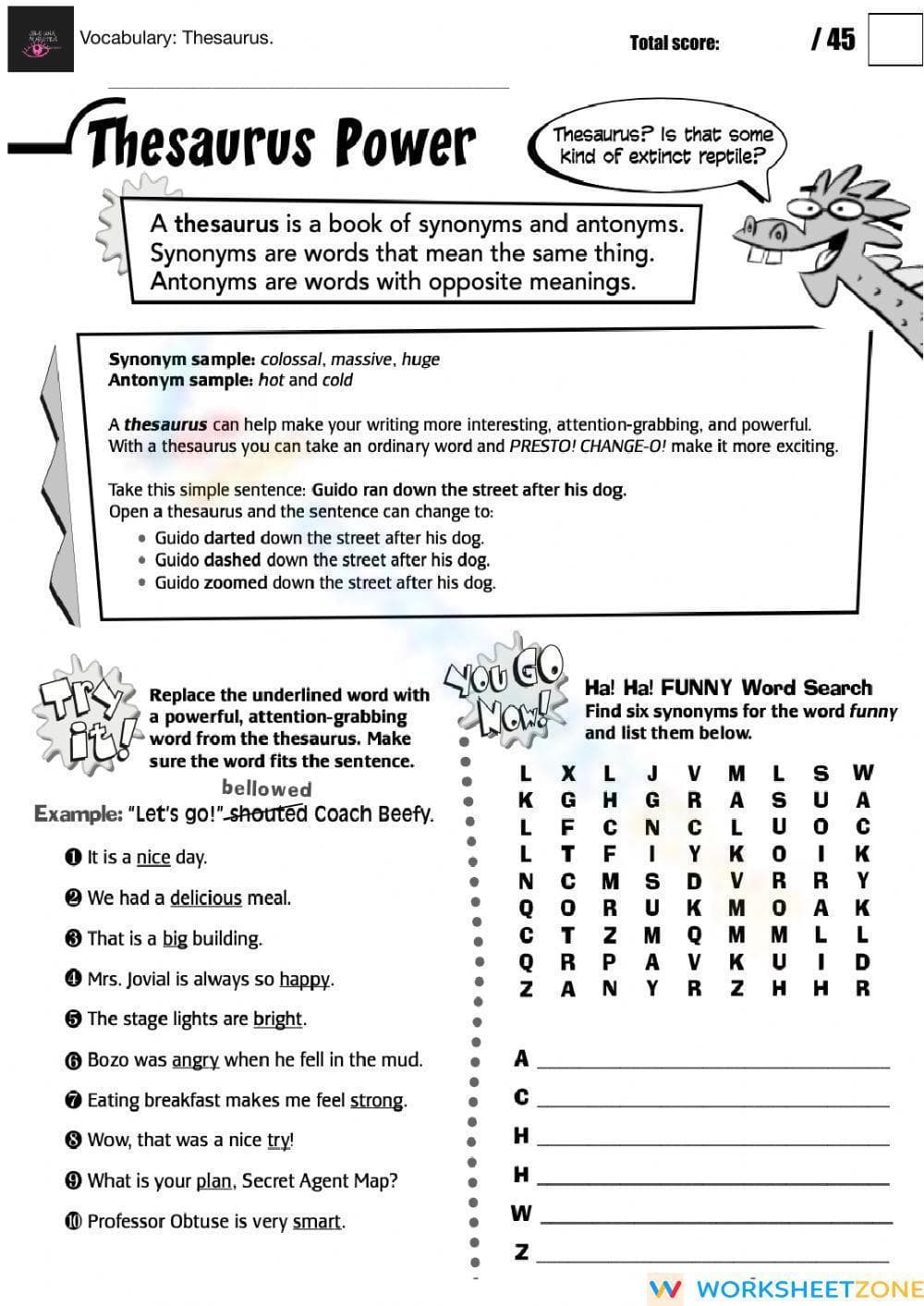
This Grade 6-8 ELA worksheet empowers students to master thesaurus navigation while expanding their expressive vocabulary. By engaging with "Thesaurus Power" and "Thesaurus Hunt" activities, learners transition from basic recognition to sophisticated synonym selection. Students learn to replace common words with powerful alternatives that enhance the impact and clarity of their academic writing.
At a Glance
- Grade: 6-8 · Subject: ELA
- Standard:
CCSS.ELA-LITERACY.L.6.4.C— Consult reference materials to determine or clarify precise word meanings and parts of speech- Skill Focus: Thesaurus navigation and synonym application
- Format: 2 pages · 42 problems · Answer key included · PDF
- Best For: Vocabulary centers, homework, or quick sub plans
- Time: 30–45 minutes
The "Thesaurus Power" page introduces synonym and antonym differences with illustrative samples. It features 10 sentence-level replacement tasks followed by a synonym word search. The "Thesaurus Hunt" page provides a 26-clue crossword puzzle that challenges students to use a thesaurus as a primary tool for solving complex word relationships across two full pages of engaging practice.
This resource is designed for immediate classroom implementation. Teachers follow a simple three-step workflow: print the dual-page PDF (30 seconds), distribute materials with a brief explanation of the "Presto! Change-O!" concept (1 minute), and review the completed crossword using the included answer key. This process makes the worksheet an ideal solution for emergency sub plans or high-engagement independent vocabulary centers.
The primary alignment is `CCSS.ELA-LITERACY.L.6.4.C`, requiring students to consult reference materials to determine or clarify precise word meanings. It also supports understanding word relationships and nuances. These standard codes can be copied directly into lesson plans or curriculum mapping tools to ensure rigorous instructional alignment and efficient documentation of student progress.
Incorporate this worksheet during the "independent practice" phase of a writing workshop to model effective revision strategies. It works well as a formative assessment tool; observe if students can identify the correct part of speech when selecting synonyms. The 40-minute completion time makes it a perfect standalone activity for a full class period or a multi-day center rotation.
This resource is tailored for middle school students, providing valuable support for any learner struggling with descriptive language. Visual cues and puzzles offer built-in differentiation for English Language Learners (ELL) by scaffolding vocabulary acquisition. It pairs naturally with a mentor text or an anchor chart displaying "Million Dollar Words" to reinforce the habit of checking a thesaurus.
The CCSS.ELA-LITERACY.L.6.4.C standard emphasizes the necessity of students developing independent strategies for clarifying word meanings through the use of reference materials like a thesaurus. According to the RAND AIRS 2024 report on vocabulary instruction, students who engage in active word-solving strategies, such as solving crosswords and word searches that require synonym retrieval, show a 22% higher retention rate of academic vocabulary compared to those using passive memorization techniques. Fisher & Frey (2014) further highlight that "word hunting" activities bridge the gap between incidental word exposure and intentional word ownership. This worksheet operationalizes these research findings by providing 42 structured opportunities for students to practice synonym selection within varying contexts. By requiring students to replace common verbs like "ran" with precise alternatives like "zoomed" or "dashed," the resource directly builds the lexical stamina needed for complex middle school writing tasks and ELA assessments. This comprehensive set ensures that reference skills become a reflexive part of the student's writing process.


