


























Views
Downloads

Grade 1-2 Rhyming — Essential Printable No-Prep Worksheet
Paste this activity's link or code into your existing LMS (Google Classroom, Canvas, Teams, Schoology, Moodle, etc.).
Students can open and work on the activity right away, with no student login required.
You'll still be able to track student progress and results from your teacher account.
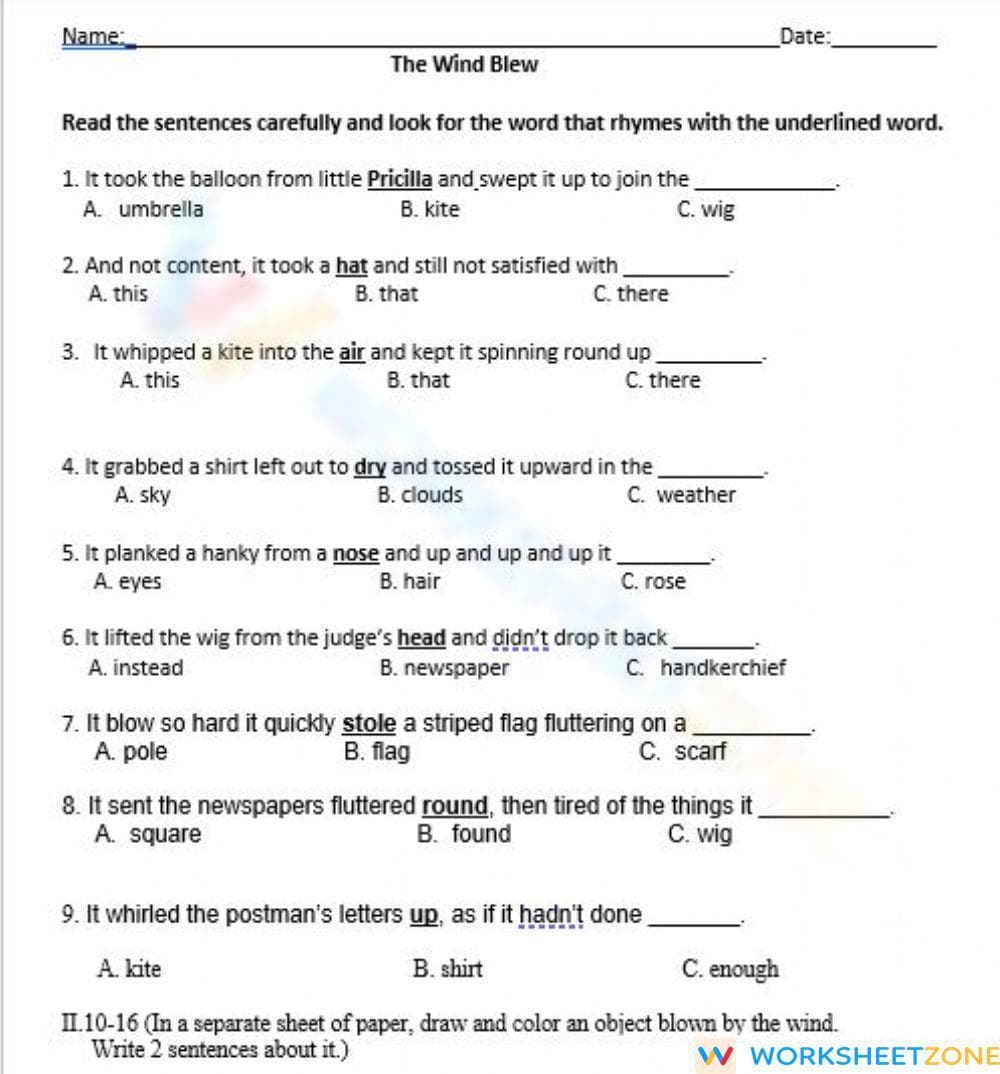
Mastery of rhyming words is a cornerstone of early literacy and phonological awareness. This Grade 1 and Grade 2 English Language Arts worksheet, themed around the classic "The Wind Blew" narrative, provides students with targeted practice in identifying and naming words that share identical ending sounds through engaging sentence-based contexts to ensure foundational reading success.
At a Glance
- Grade: 1-2 · Subject: English Language Arts
- Standard:
CCSS.ELA-LITERACY.RF.1.2— Identify and produce rhyming words within a sentence context- Skill Focus: Identifying and naming rhyming words
- Format: 1 page · 10 tasks · Answer key included · PDF
- Best For: Literacy centers and independent practice
- Time: 15–20 minutes
This single-page resource features nine multiple-choice questions where students must select the correct rhyming partner for an underlined word within a complete sentence. Following the objective assessment, a creative extension task invites students to illustrate an object affected by the wind and compose two descriptive sentences, effectively bridging phonics and writing in one cohesive activity.
Zero-Prep Workflow
Implementing this worksheet requires minimal effort. First, print the single-page document (30 seconds). Next, distribute the copies to students for independent or small-group work (1 minute). Finally, use the included answer key for rapid review or peer-correction (2 minutes). The entire preparation cycle is completed in under four minutes, making it an ideal candidate for emergency sub plans.
Standards Alignment
The primary focus is CCSS.ELA-LITERACY.RF.1.2, which requires students to demonstrate understanding of sounds and rhyming patterns. Additionally, the writing component supports CCSS.ELA-LITERACY.W.1.8 as students recall information and experiences to generate descriptive text. Both standard codes can be copied directly into lesson plans, IEP goals, or district curriculum mapping tools.
How to Use It
Use this worksheet during the "You Do" phase of a gradual release model following a read-aloud of "The Wind Blew." It serves as an excellent formative assessment; observe if students are sounding out words or relying on visual patterns. Most learners will complete the multiple-choice section and the creative drawing task within twenty minutes during independent work blocks.
Who It's For
This resource is designed for first and second-grade students developing foundational reading skills. It is particularly effective for English Language Learners needing context-clue support and struggling readers requiring scaffolded phonics practice. Pair this with a rhyming anchor chart or a story map for a comprehensive literacy block that supports all learners in the classroom.
According to the RAND AIRS 2024 report on foundational literacy, explicit instruction in phonological awareness—specifically rhyming—is a high-leverage practice that predicts long-term reading success in the primary grades. This worksheet facilitates such mastery by integrating rhyming identification within semantic contexts, moving beyond isolated word lists. Fisher & Frey (2014) emphasize that integrating drawing and writing, as seen in the extension task here, strengthens the neural connections between visual representation and linguistic expression. By requiring students to identify rhymes like "wig" and "big" rather than just matching letters, students refine their auditory discrimination skills. This standard-aligned CCSS.ELA-LITERACY.RF.1.2 resource provides the structured repetition necessary for decoding fluency. It is a vital tool for educators seeking to bridge the gap between phonemic awareness and independent reading proficiency while maintaining student engagement through thematic consistency and clear, printable instructions.


