




























Views
Downloads
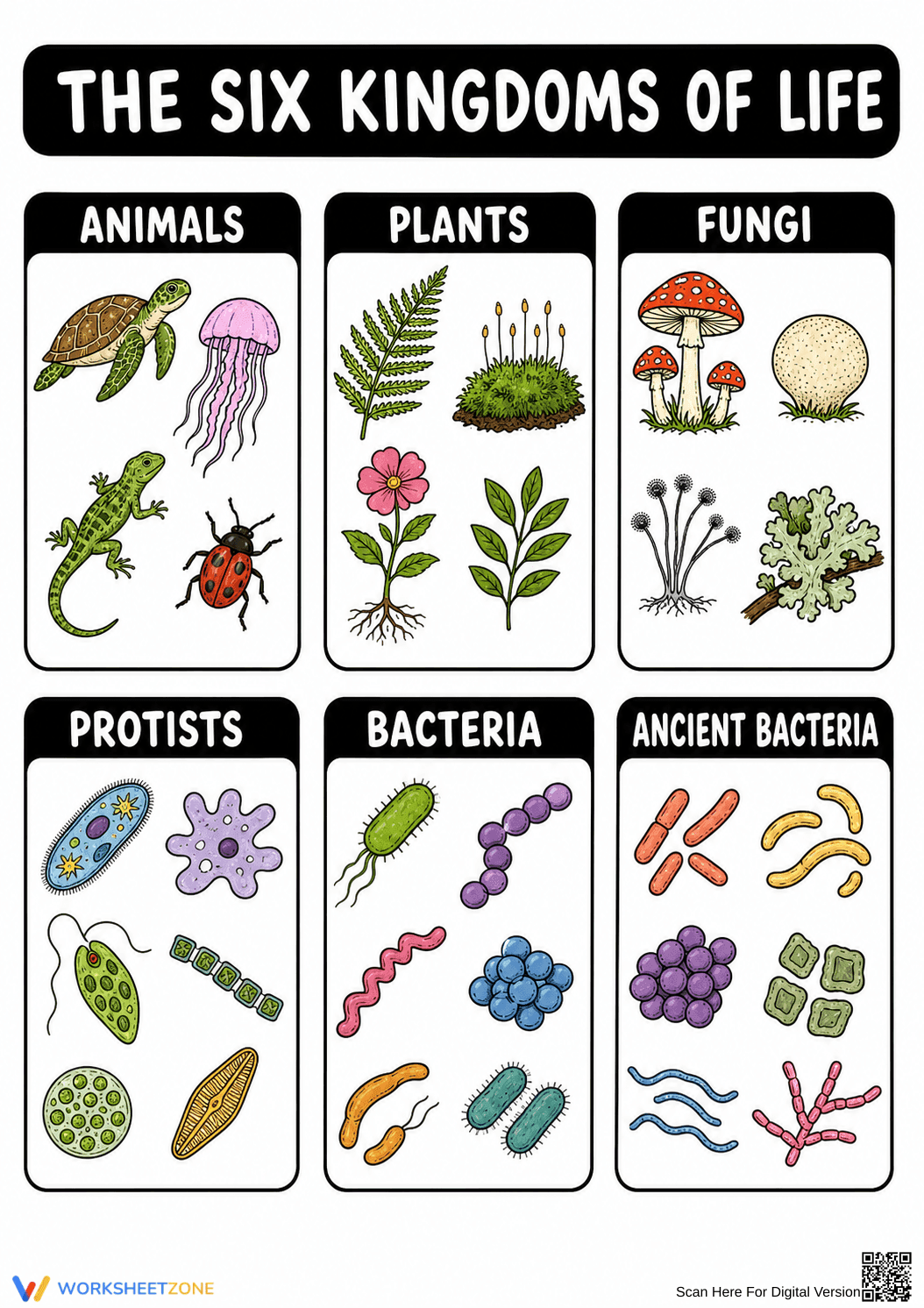

Essential Six Kingdoms of Life Worksheet | Grade 10-12

Paste this activity's link or code into your existing LMS (Google Classroom, Canvas, Teams, Schoology, Moodle, etc.).
Students can open and work on the activity right away, with no student login required.
You'll still be able to track student progress and results from your teacher account.
This worksheet provides a comprehensive visual breakdown of the Six Kingdoms of Life, enabling high school biology students to categorize organisms based on cellular and structural characteristics. By providing clear examples for Animals, Plants, Fungi, Protists, Bacteria, and Ancient Bacteria, it serves as a foundational reference for complex evolutionary studies and taxonomic classification.
At a Glance
- Grade: 10-12 · Subject: Biology
- Standard:
HS-LS4-1— Communicate scientific information that common ancestry and biological evolution are supported by multiple lines of evidence.- Skill Focus: Biological Classification
- Format: 1 page · 6 categories · Visual Reference · PDF
- Best For: Visual learners and anchor chart creation
- Time: 15–20 minutes
This single-page PDF features a high-resolution diagram of the six biological kingdoms. Each section includes detailed illustrations of representative organisms, such as reptiles and invertebrates for Animals, or various spore-bearing structures for Fungi. The layout is designed for quick scanning, making it an ideal student reference sheet or classroom poster for high school science labs.
Zero-Prep Workflow:
- Print: Select the "Fit to Page" option and print in color to preserve the visual distinctions between kingdoms (30 seconds).
- Distribute: Hand out as a supplemental reference during lectures on taxonomy, phylogeny, or domain-level classification (1 minute).
- Review: Use the visual cues to prompt student discussion on the differences between prokaryotic and eukaryotic kingdoms (5 minutes).
Total teacher prep time is under 2 minutes, making this an excellent resource for emergency sub plans or quick review sessions.
Standards Alignment: This resource supports the understanding of biological diversity and the hierarchical organization of life under HS-LS4-1. By identifying the distinct traits of the six kingdoms, students build the prerequisite knowledge for analyzing evolutionary relationships and common ancestry. Both standard codes can be copied directly into lesson plans, IEP goals, or district curriculum mapping tools.
How to Use It: Use this worksheet as a "desk mat" reference during a lab on microscopic life to help students categorize observed specimens. Alternatively, assign it as a pre-reading visual aid before a unit on evolutionary biology. Formative assessment tip: Ask students to add one additional organism to each kingdom based on their prior knowledge to check for comprehension. Expected completion time is 15 to 20 minutes.
Who It's For: This resource is tailored for high school biology students, including those in AP Biology requiring a quick taxonomic refresher. It is particularly effective for English Language Learners (ELL) and visual learners who benefit from pictorial representations of abstract scientific concepts. Pair this with a dichotomous key activity for a complete classification lesson.
According to the RAND AIRS 2024 report, high-quality visual aids in secondary science education significantly improve the retention of complex hierarchical systems like biological taxonomy. This worksheet aligns with the HS-LS4-1 standard by providing the necessary visual scaffolding for students to differentiate between the six kingdoms of life: Animals, Plants, Fungi, Protists, Bacteria, and Ancient Bacteria. Research by Fisher & Frey (2014) emphasizes that graphic organizers and visual models are essential for students to move from surface-level identification to deep conceptual understanding of biological diversity. By utilizing this structured diagram, educators can facilitate a more efficient transition into advanced evolutionary theory and phylogenetic analysis. This resource serves as a reliable, evidence-based tool for classroom instruction, ensuring that students meet core competency requirements in life science classification while reducing cognitive load during initial instruction.


