


























Views
Downloads
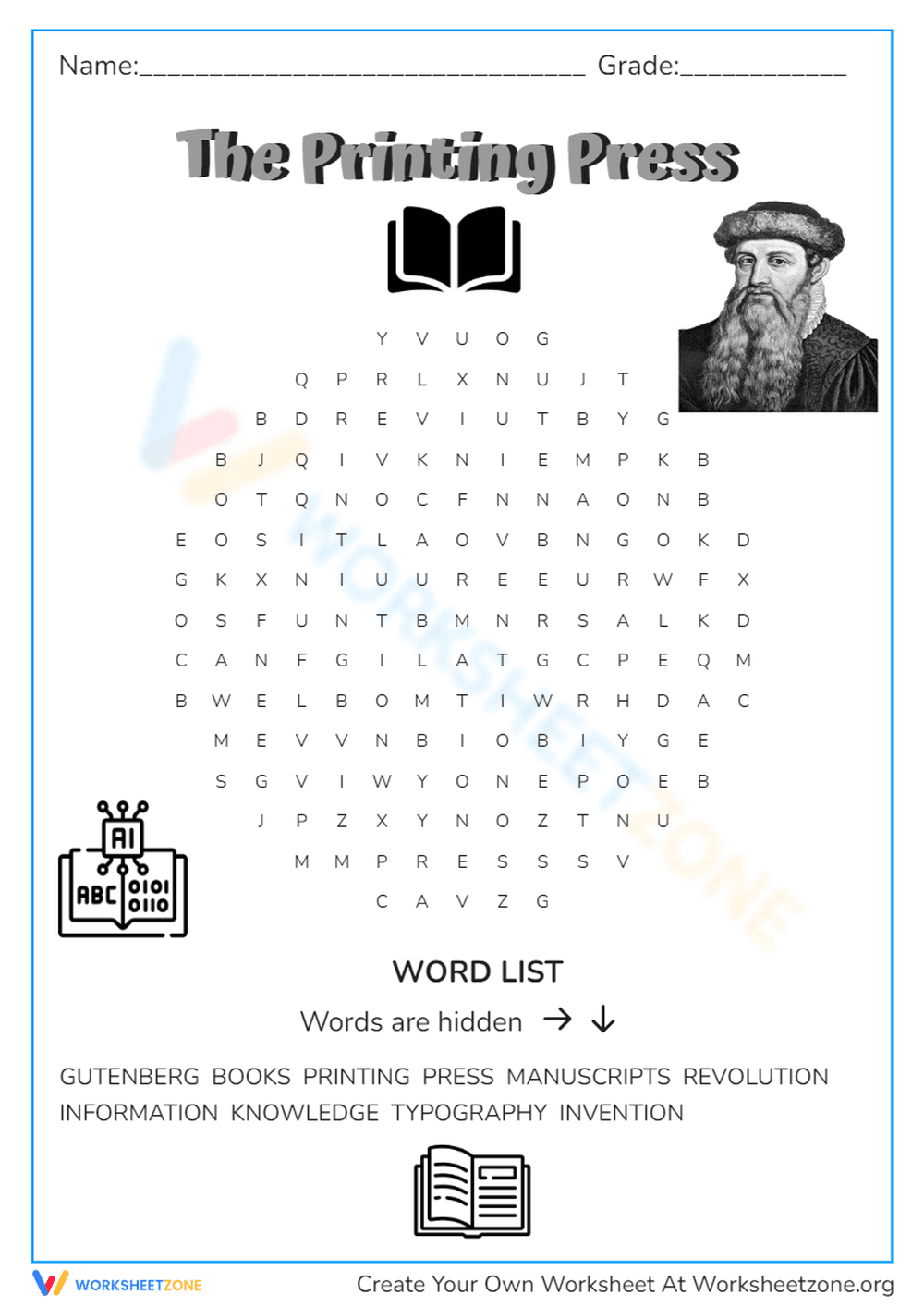

Printable Printing Press Word Search | Grade 3
Paste this activity's link or code into your existing LMS (Google Classroom, Canvas, Teams, Schoology, Moodle, etc.).
Students can open and work on the activity right away, with no student login required.
You'll still be able to track student progress and results from your teacher account.
This printable word search worksheet introduces students to essential vocabulary related to Johannes Gutenberg and the printing press. By actively scanning for domain-specific historical terms, learners reinforce their spelling and word recognition skills while building foundational knowledge about one of history's most significant inventions.
At a Glance
- Grade: 3 · Subject: ELA
- Standard:
CCSS.ELA-LITERACY.L.3.6— Acquire and use domain-specific words- Skill Focus: Vocabulary Recognition
- Format: 1 page · 10 problems · Answer key included · PDF
- Best For: Independent practice
- Time: 10–15 minutes
This single-page resource features a classic word search puzzle containing ten key terms associated with the Renaissance and early bookmaking. Students will locate words such as "manuscripts," "typography," and "revolution" hidden horizontally and vertically within the grid. The clear layout minimizes distractions, and the answer key ensures quick verification. A brief visual of Gutenberg provides helpful historical context.
Zero-Prep Workflow
This resource is designed for immediate classroom implementation with minimal teacher setup:
- Print (1 minute): Print copies directly from the PDF.
- Distribute (1 minute): Hand out the puzzle during morning work, transitions, or as a fast-finisher activity.
- Review (1 minute): Use the provided answer key to quickly check student progress or allow for peer grading.
With a total teacher prep time of under two minutes, this activity is highly suitable for emergency sub plans or unexpected schedule changes.
Standards Alignment
This activity aligns with CCSS.ELA-LITERACY.L.3.6: Acquire and use accurately grade-appropriate conversational, general academic, and domain-specific words and phrases. By engaging with targeted historical vocabulary, students build the background knowledge necessary for reading complex informational texts. Both standard codes can be copied directly into lesson plans, IEP goals, or district curriculum mapping tools.
How to Use It
Use this word search to introduce a social studies unit on the Renaissance. Teachers can assign it as morning work to activate prior knowledge before direct instruction begins. Alternatively, it functions well as a quiet, independent task for early finishers after a reading comprehension lesson. As a formative assessment observation tip, educators can monitor which students struggle to locate longer, multi-syllabic words like "information" or "typography," indicating a potential need for targeted spelling or visual tracking support. Expected completion time ranges from 10 to 15 minutes.
Who It's For
Designed for third-grade students, this worksheet remains accessible for second graders needing an extension or fourth graders requiring review. For differentiation, provide highlighters to students who benefit from visual tracking aids, or pair English Language Learners with a peer to discuss term meanings. This puzzle pairs naturally with an introductory reading passage about Johannes Gutenberg or an anchor chart detailing the evolution of written language.
Integrating domain-specific vocabulary exercises like this printing press word search directly supports CCSS.ELA-LITERACY.L.3.6, which requires students to acquire and use domain-specific words. According to Fisher & Frey (2014), repeated exposure to academic terminology in low-stakes, engaging formats significantly increases long-term retention and reading comprehension. When learners actively search for terms such as "manuscripts" and "typography," they process the orthographic structure of the words, reinforcing both spelling and visual recognition. This foundational skill building is critical for students as they transition from learning to read to reading to learn. By embedding historical concepts into accessible puzzles, educators can effectively bridge the gap between literacy instruction and social studies content. This approach ensures that students develop the robust vocabulary necessary to tackle complex informational texts with confidence and accuracy.


