


























Views
Downloads
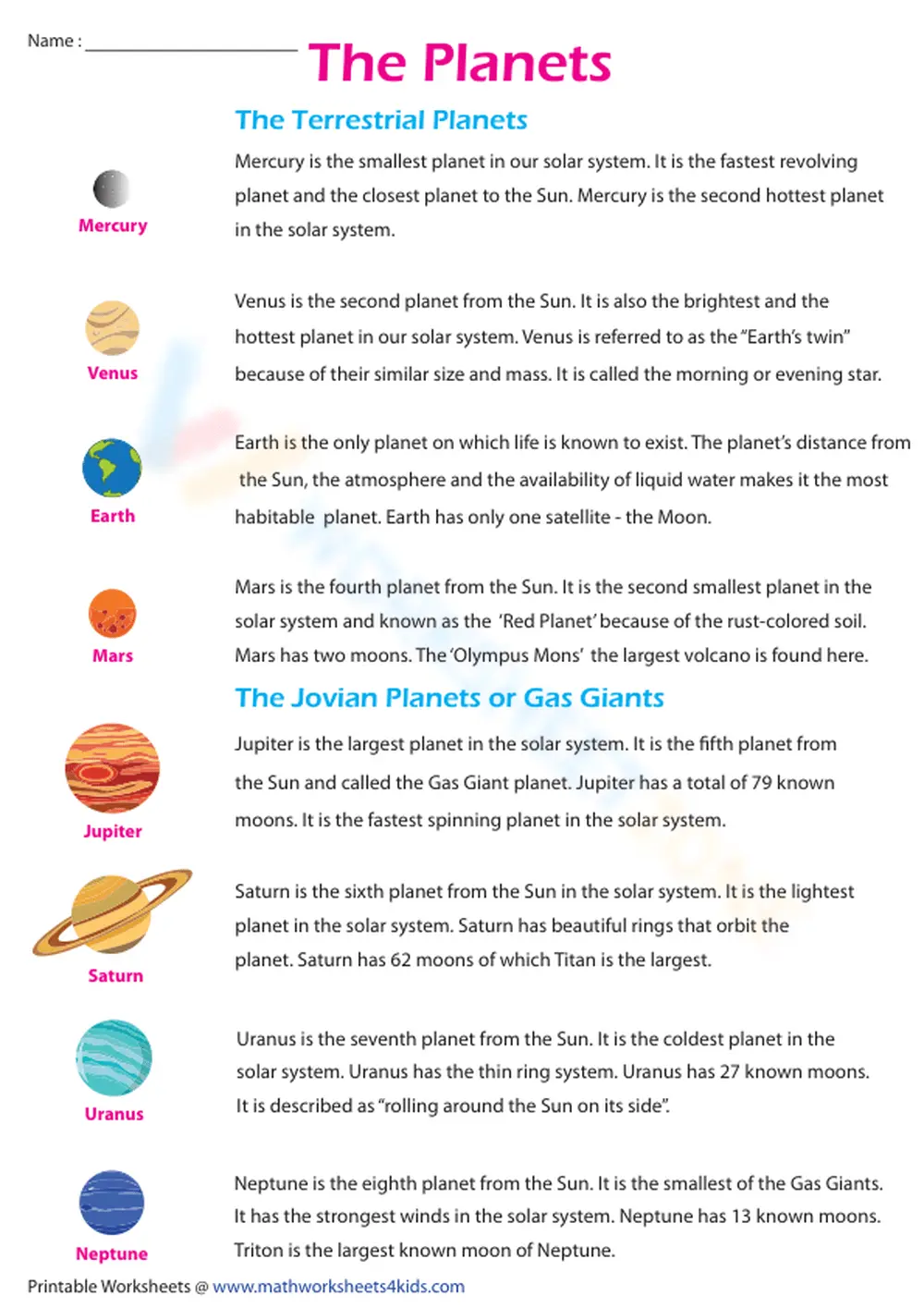

Essential Planets Facts Sheet | Grade 4-5 Science Aligned
Paste this activity's link or code into your existing LMS (Google Classroom, Canvas, Teams, Schoology, Moodle, etc.).
Students can open and work on the activity right away, with no student login required.
You'll still be able to track student progress and results from your teacher account.
This Grade 4-5 planets facts sheet provides students with a comprehensive overview of our solar system, categorizing planets into terrestrial and Jovian groups. Students gain immediate access to vital statistics for all eight planets, including size, composition, and orbital characteristics. This printable resource serves as an ideal reference for astronomy units and independent science research projects.
At a Glance
- Grade: 4-5 · Subject: Science
- Standard:
5-ESS1-2— Use data to identify properties and patterns of celestial objects in the sky- Skill Focus: Solar system characteristics and planetary data
- Format: 1 page · 8 facts · Reference sheet included · PDF
- Best For: Classroom reference and science notebook inserts
- Time: 10–15 minutes
What's Inside
This single-page fact sheet is organized into sections for Terrestrial and Jovian planets. Each of the eight planets features a dedicated text block containing data points such as relative size, distance from the Sun, and moon counts. The layout includes visual icons for each planet, helping students distinguish between rocky worlds and gas giants like Jupiter or Saturn.
Zero-Prep Workflow
Print the copies for your cohort (30 seconds). Second, distribute the sheets during your introductory astronomy lesson or as a supplemental resource for a research task (1 minute). Finally, review the key differences between terrestrial and Jovian planets as a class check for understanding (5 minutes). Total preparation time is well under two minutes.
Standards Alignment
This resource is primary aligned to 5-ESS1-2, which focuses on representing data to reveal patterns in objects in the sky. By providing structured data on planetary orbits and characteristics, this sheet supports the foundational knowledge required to understand broader celestial patterns. Both standard codes can be copied directly into lesson plans, IEP goals, or district curriculum mapping tools.
How to Use It
Use this fact sheet during the "Explain" phase of a science lesson. Students can use the data provided to compare characteristics of rocky planets versus gas giants. For a formative assessment, ask students to identify which planet has the most moons based on the text. This resource is expected to take 10-15 minutes for initial review.
Who It's For
This sheet is designed for Grade 4 and Grade 5 students studying Earth and space sciences. It is helpful for visual learners who benefit from having key facts organized in a central location. It pairs naturally with a blank solar system map or a Venn diagram comparing different planetary categories.
Effective science instruction relies on accurate data representation and the categorization of complex systems, a practice supported by RAND AIRS 2024. This worksheet leverages 5-ESS1-2 to provide a clear, evidence-based overview of planetary properties, helping students build mental models of the solar system. By distinguishing between terrestrial and Jovian planets, the resource facilitates higher-order thinking and data analysis skills. Research from Fisher & Frey (2014) emphasizes that providing students with structured informational texts like this guide reduces cognitive load and allows for deeper engagement with scientific concepts. This approach ensures that learners are not just memorizing facts but are recognizing the structural patterns that define our celestial neighborhood. The inclusion of moon counts and orbital facts provides the necessary quantitative data for students to make evidence-based comparisons between different planetary bodies, aligning with modern inquiry-based science standards used across various state frameworks to promote astronomical literacy.


