




























Views
Downloads

Printable Nervous System Diagram | Grade 6 Science

Paste this activity's link or code into your existing LMS (Google Classroom, Canvas, Teams, Schoology, Moodle, etc.).
Students can open and work on the activity right away, with no student login required.
You'll still be able to track student progress and results from your teacher account.
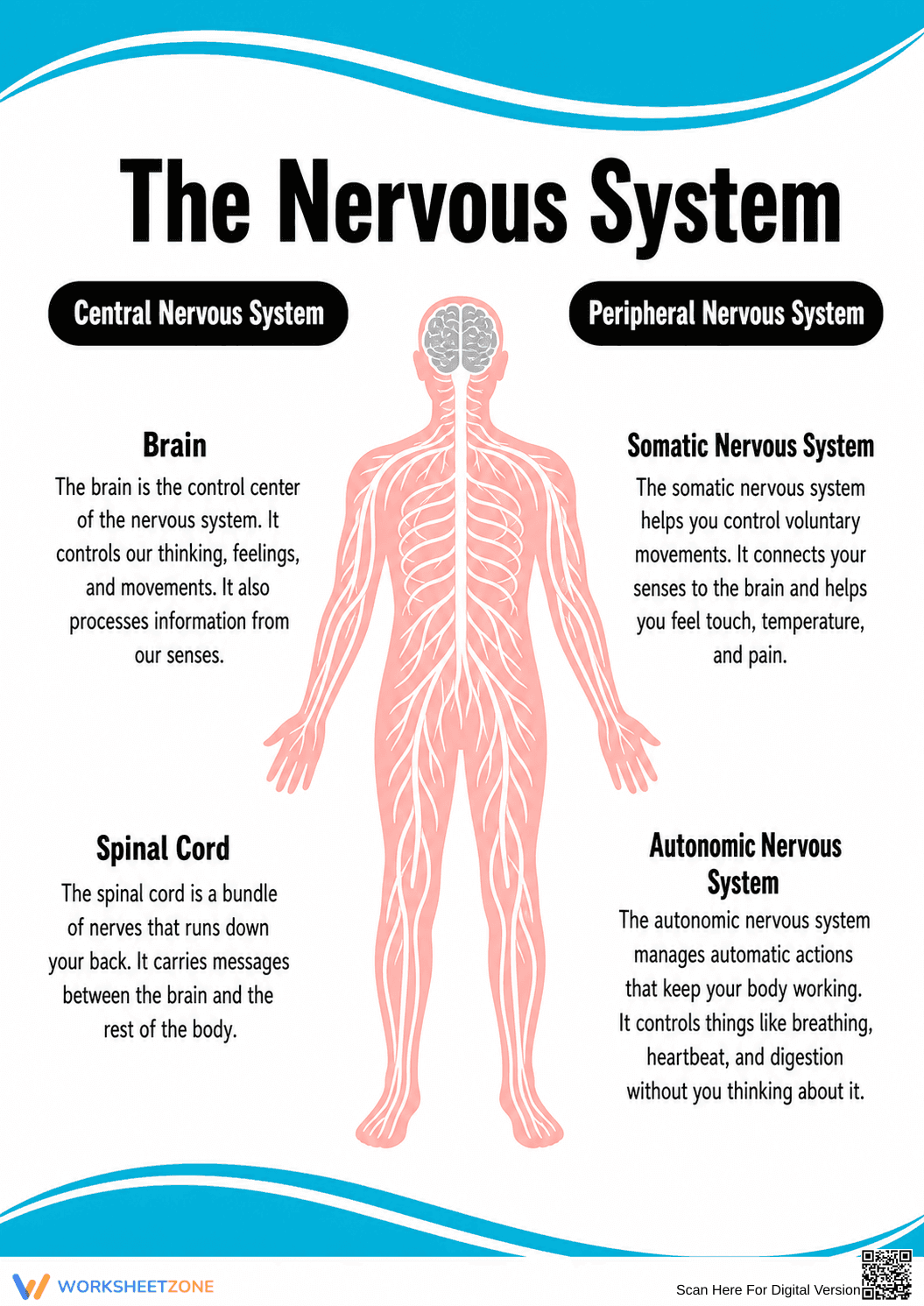
This Grade 6 science worksheet introduces students to the complex structures of the human body by focusing on the nervous system. By reading clear, student-friendly text paired with a detailed anatomical diagram, learners will understand how the central and peripheral nervous systems control voluntary and automatic functions.
At a Glance
- Grade: 6 · Subject: Science
- Standard:
MS-LS1-3— Understand how body subsystems interact to support life- Skill Focus: Identifying nervous system functions
- Format: 1 page · 0 problems · No answer key needed · PDF
- Best For: Direct instruction and reference
- Time: 10–15 minutes
This single-page informational worksheet features a high-quality anatomical diagram of the human body, specifically highlighting the brain, spinal cord, and nerve pathways. The text is broken down into highly readable sections that define the Central Nervous System and the Peripheral Nervous System. Students will find concise explanations of the somatic and autonomic nervous systems, making complex biological concepts accessible without overwhelming cognitive load.
Zero-Prep Workflow
This resource is designed for immediate classroom implementation with absolutely no teacher preparation required.
- Print (1 minute): Simply print the PDF as a handout or project it directly onto your smartboard.
- Distribute (1 minute): Pass out the diagram to students as they enter the room for an immediate bell-ringer reading activity.
- Review (5 minutes): Read through the four main quadrants together, checking for understanding on the difference between voluntary and automatic actions.
With under two minutes of total prep time, this sheet is an excellent addition to any emergency sub plan or introductory lesson.
Standards Alignment
This resource aligns with Next Generation Science Standard MS-LS1-3: Use argument supported by evidence for how the body is a system of interacting subsystems composed of groups of cells. It specifically supports the foundational knowledge required to understand how the nervous system acts as the primary control center, interacting with the muscular and digestive subsystems. Both standard codes can be copied directly into lesson plans, IEP goals, or district curriculum mapping tools.
How to Use It
Use this diagram before direct instruction as an anchor chart to build background knowledge. Have students glue it into their interactive science notebooks so they can reference the definitions of the somatic and autonomic systems during later labs. As a formative assessment observation tip, ask students to point to the specific part of the diagram that would activate when they touch a hot stove versus when they digest their lunch. Expected completion time for reading and discussion is 10 to 15 minutes.
Who It's For
This reference worksheet is primarily designed for middle school life science students in grades 5 through 7. The chunked text and strong visual supports make it highly effective for visual learners, English Language Learners (ELLs), and students who require reading accommodations. It pairs perfectly with a blank labeling worksheet or a direct instruction lesson on human body systems.
Integrating visual diagrams with chunked informational text significantly reduces cognitive load for middle school students encountering complex biological systems. According to ScienceDirect TpT Analysis, providing explicit visual aids alongside concise definitions improves retention of anatomical vocabulary by allowing students to dual-code the information. This resource directly supports MS-LS1-3 by helping students understand how body subsystems interact to support life. When learners can clearly distinguish between the central and peripheral nervous systems, they are better equipped to construct evidence-based arguments about how the brain, spinal cord, and nerves coordinate to maintain homeostasis. By utilizing this structured reference guide, educators ensure that foundational life science concepts are accessible, accurate, and visually engaging for all learners in the classroom, setting the stage for deeper exploration of human anatomy.


