


























Views
Plays

Connotation and Denotation Practice | Grade 6-8 Essential
Paste this activity's link or code into your existing LMS (Google Classroom, Canvas, Teams, Schoology, Moodle, etc.).
Students can open and work on the activity right away, with no student login required.
You'll still be able to track student progress and results from your teacher account.
This comprehensive middle school ELA worksheet helps students master the critical distinction between literal definitions and the emotional weight of language. By analyzing diction, tone, and nuance, learners develop the ability to decode an author's intent and improve their own descriptive writing. Students will move beyond basic definitions to evaluate how specific word choices shift the mood of a passage from positive to negative.
At a Glance
- Grade: 6-8 · Subject: English Language Arts
- Standard:
CCSS.ELA-LITERACY.L.6.5.c— Distinguish among the connotations of words with similar denotations- Skill Focus: Connotation vs. Denotation
- Format: 5 pages · 15 problems · Answer key included · PDF
- Best For: Vocabulary development and tone analysis
- Time: 25–35 minutes
What's Inside: This 5-page instructional resource features 15 structured multiple-choice questions designed to build vocabulary depth. The layout includes visual anchors and memes to engage middle school learners while defining core concepts like diction, tone, and nuance. The worksheet provides contrasting passages about the same topic to highlight how word choice alters meaning, followed by specific word-level analysis and a complete answer key for immediate feedback.
Skill Progression
- Guided Practice: The first 4 questions establish a foundation by defining diction, tone, nuance, and connotation using visual cues and clear multiple-choice options.
- Supported Practice: Questions 5 through 8 present paired reading passages, requiring students to identify the overall emotional charge (positive or negative) based on specific descriptive clusters.
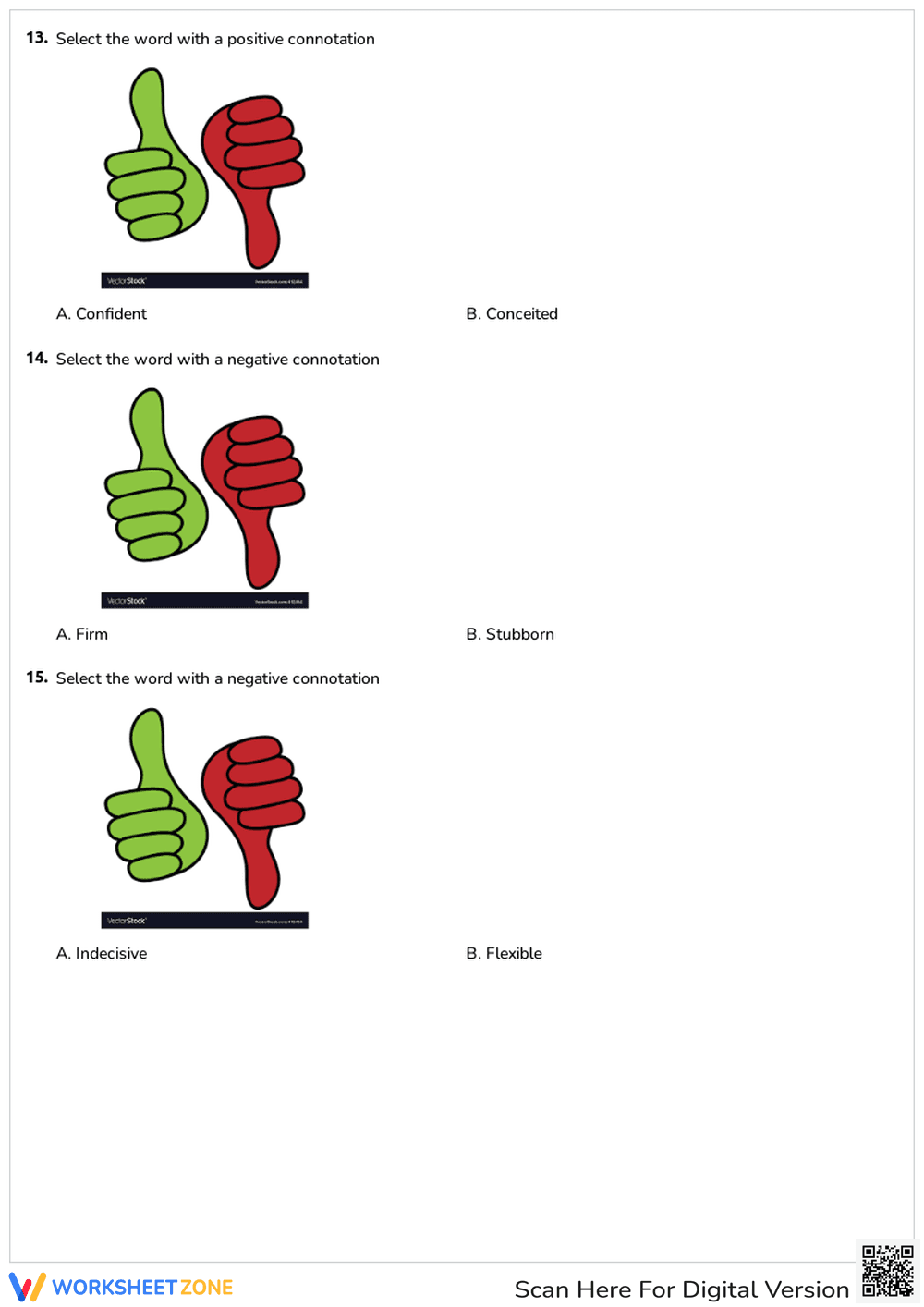
- Independent Practice: The final 7 questions challenge students to determine denotative meanings in context and select the most appropriate word to match a required connotation, such as distinguishing between "firm" and "stubborn."
This sequence follows a gradual-release model, moving from conceptual identification to applied analysis of linguistic subtleties.
Standards Alignment: This resource is directly aligned to `CCSS.ELA-LITERACY.L.6.5.c`, which requires students to distinguish among the connotations of words with similar denotations. It also supports broader vocabulary acquisition goals by focusing on how word relationships and nuances impact text complexity. The standard code can be copied directly into lesson plans or curriculum mapping tools.
How to Use It: This worksheet is ideal for use during the "We Do" or "You Do" phase of a lesson on author's craft. Assign it as a formative assessment after a direct instruction session on tone to see which students can successfully identify the emotional subtext of a passage. Expected completion time is approximately 30 minutes, making it a perfect fit for a standard class period.
Who It's For: This resource is designed for Grade 6, 7, and 8 students who are moving toward more sophisticated literary analysis. It is particularly effective for English Language Learners (ELLs) who need explicit practice with the non-literal meanings of English vocabulary. Pair this worksheet with a tone and mood anchor chart to reinforce the impact of word choice in narrative texts.
According to Fisher & Frey (2014), developing a student's sensitivity to word nuance is a hallmark of advanced literacy. This worksheet targets CCSS.ELA-LITERACY.L.6.5.c by providing 15 specific opportunities for students to evaluate the emotional associations (connotations) versus the literal meanings (denotations) of words. By contrasting terms like "lanky" and "thin," the material forces students to engage with the subtle shifts in intensity that define high-quality diction. Research indicates that explicit instruction in these linguistic categories significantly improves reading comprehension and the ability to interpret an author's perspective. This structured practice ensures that students can move beyond surface-level reading to understand the underlying attitude and tone of complex texts, providing a necessary bridge to high school level rhetoric skills.


