


























Views
Plays
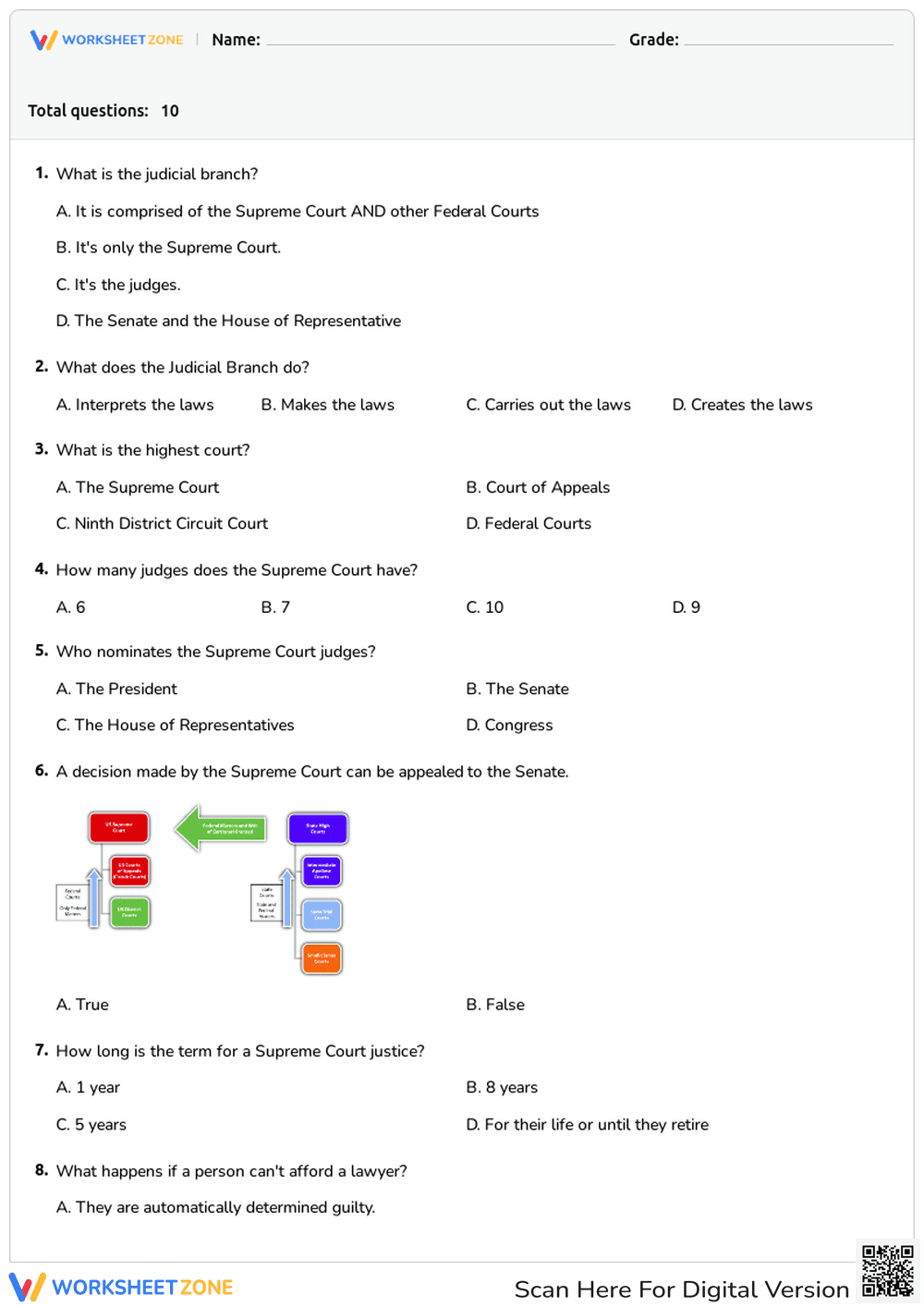


Judicial Branch Structure Worksheet | Grade 5 Essential
Paste this activity's link or code into your existing LMS (Google Classroom, Canvas, Teams, Schoology, Moodle, etc.).
Students can open and work on the activity right away, with no student login required.
You'll still be able to track student progress and results from your teacher account.
This Grade 5 Social Studies worksheet provides a comprehensive review of the Judicial Branch's structure and functions. Students analyze the hierarchy of the federal court system, the role of the Supreme Court, and the process of judicial nominations. By engaging with these 10 targeted questions, learners solidify their understanding of how the American legal system interprets laws and protects rights.
At a Glance
- Grade: 5 · Subject: Social Studies
- Standard:
CCSS.ELA-LITERACY.RI.5.3— Explain the relationships or interactions between individuals, events, or concepts in a text- Skill Focus: Judicial Branch Structure
- Format: 2 pages · 10 problems · Answer key included · PDF
- Best For: Civics assessment or independent review
- Time: 15–20 minutes
What's Inside: This resource features a two-page assessment with 10 multiple-choice questions testing foundational knowledge of the third branch of government. The worksheet includes a visual diagram of the court hierarchy, helping students visualize the path from District Courts to the Supreme Court. Topics covered include the number of justices, term lengths, the appeals process, and the right to legal representation. A clear, easy-to-grade answer key is provided for teacher convenience.
Zero-Prep Workflow: Implementing this worksheet requires minimal effort, making it ideal for busy educators or substitute plans. Print the PDF (30 seconds), distribute copies for independent or pair work (15 minutes), and review answers as a group to clarify misconceptions about the appellate process or judicial nominations (5 minutes). Total teacher preparation time is under two minutes.
Standards Alignment: The primary standard addressed is `CCSS.ELA-LITERACY.RI.5.3`, which requires students to explain the relationships or interactions between individuals, events, ideas, or concepts in a historical or technical text. By identifying how the President nominates judges and how the Senate confirms them, students demonstrate mastery of complex institutional interactions. This standard code can be copied directly into lesson plans, IEP goals, or district curriculum mapping tools.
How to Use It: Use this worksheet as a formative assessment at the conclusion of a unit on the three branches of government. It serves as an excellent exit ticket or a quick check for understanding before moving into more complex discussions about landmark Supreme Court cases. Teachers should observe students as they interpret the court hierarchy diagram in question six, as this visual literacy skill is a key indicator of conceptual mastery.
Who It's For: This resource is tailored for Grade 4, 5, and 6 students studying United States government and civics. It is particularly effective for learners who benefit from structured, multiple-choice formats and visual aids. Pair this worksheet with a primary source reading of Article III of the Constitution or a video overview of the Supreme Court to provide a multi-modal learning experience.
The RAND AIRS 2024 report suggests that instructional materials combining visual diagrams with text-based questioning improve student retention of civic structures. This worksheet aligns with these findings by requiring students to synthesize information through a court hierarchy chart and 10 multiple-choice items. By focusing on `CCSS.ELA-LITERACY.RI.5.3`, the resource ensures students understand the functional relationships between the President, Senate, and Federal Courts. Research indicates that structured practice in identifying judicial roles helps bridge the gap between abstract concepts and concrete operations. This printable PDF provides the necessary scaffolding for upper elementary students to achieve mastery in civics, making it a reliable tool for standard-aligned social studies curriculum implementation.


