




























Views
Downloads
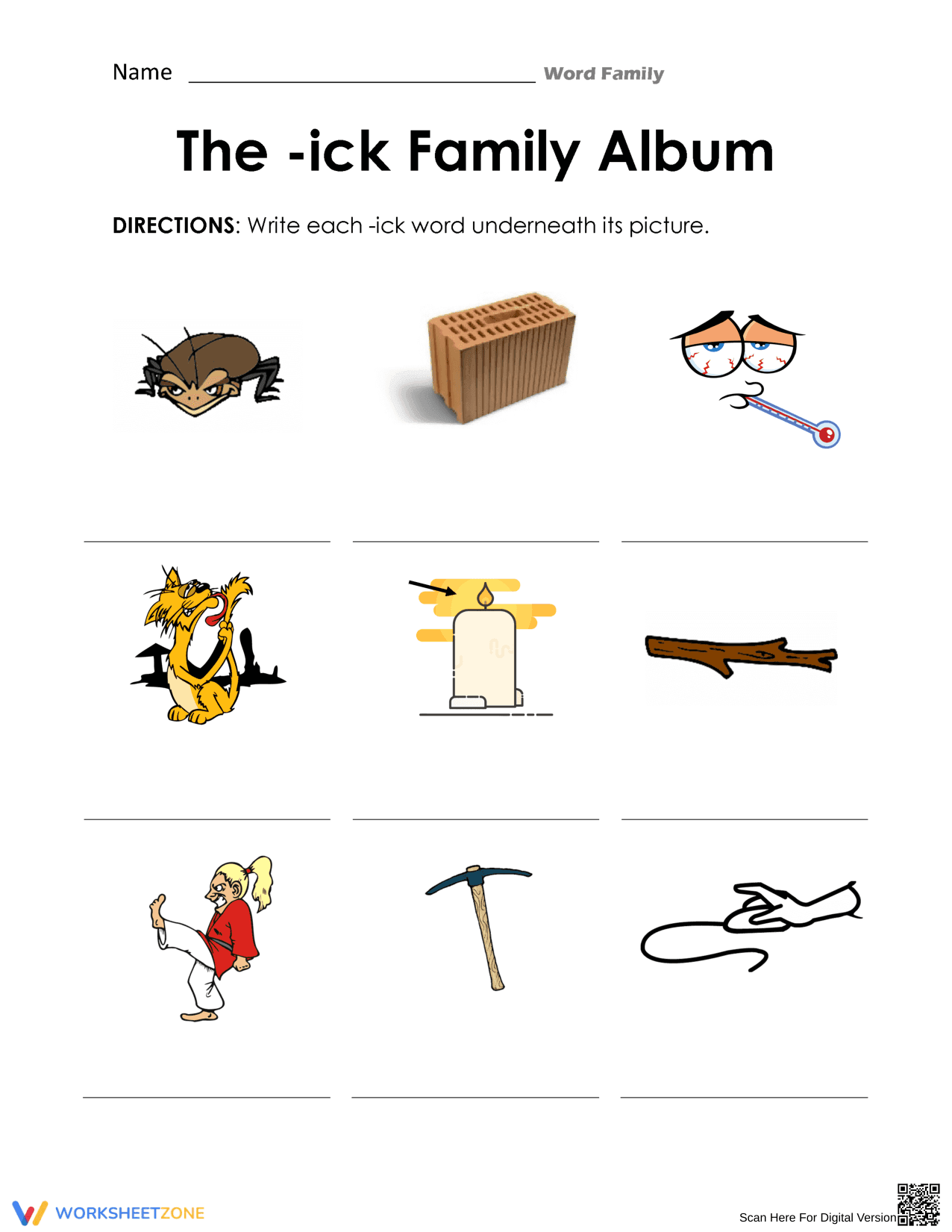

Printable -ick Family Album Worksheet | Grade 1 & 2 ELA

Paste this activity's link or code into your existing LMS (Google Classroom, Canvas, Teams, Schoology, Moodle, etc.).
Students can open and work on the activity right away, with no student login required.
You'll still be able to track student progress and results from your teacher account.
Mastering the -ick word family is a fundamental step in early literacy development. This printable worksheet provides Grade 1 and Grade 2 students with a focused labeling activity designed to reinforce phonics skills. By associating visual cues with specific consonant-vowel-consonant-consonant (CVCC) patterns, learners build the decoding speed necessary for reading fluency and spelling accuracy.
At a Glance
- Grade: 1-2 · Subject: English Language Arts
- Standard:
CCSS.ELA-LITERACY.RF.1.3.B— Decode one-syllable words by identifying common vowel-consonant-consonant patterns like the -ick rime- Skill Focus: Phonics and Word Families (-ick)
- Format: 1 page · 9 problems · Visual labeling tasks · PDF
- Best For: Independent phonics practice and morning work
- Time: 10–15 minutes
This resource consists of a single-page PDF containing nine distinct illustrations representing common -ick words. The layout is clean and intuitive, featuring pictures for brick, sick, stick, and more. Students are tasked with writing the correct word in the provided space beneath each image. This visual-to-text association helps solidify the relationship between the phoneme and grapheme, making it a reliable tool for early readers.
Zero-Prep Workflow
Teachers can implement this resource in three simple steps. First, print the single-sheet PDF for your entire class or a specific literacy group, which takes less than 30 seconds. Second, distribute the papers during your phonics block or as a quick transition activity. Finally, review the answers as a group to provide immediate feedback. Total teacher preparation time is under 2 minutes, making it ideal for sub plans.
Standards Alignment
The primary alignment for this activity is CCSS.ELA-LITERACY.RF.1.3.B, which requires students to decode regularly spelled one-syllable words. By focusing on the -ick rime, the worksheet helps students recognize a common spelling pattern that appears frequently in beginner-level texts. This standard code can be copied directly into lesson plans, IEP goals, or district curriculum mapping tools to ensure instructional consistency.
How to Use It
Use this worksheet as a formative assessment during your "I Do, We Do, You Do" instructional sequence. After teaching the -ick family, assign this page for independent practice to observe which students can independently map sounds to letters. It also serves as an excellent "Exit Ticket" or morning work activity to settle students into their literacy routine while maintaining a high standard of academic engagement.
Who It's For
This resource is tailored for first and second-grade students who are developing their foundational reading skills. It is particularly beneficial for English Language Learners (ELL) who need visual support to connect vocabulary to written forms. The simple directions and clear illustrations make it accessible for students working at various levels of proficiency, providing a successful independent learning experience.
Research highlights the efficacy of explicit phonics instruction in early literacy. According to the ScienceDirect TpT Analysis, structured activities that focus on specific rimes or word families, such as the -ick group, significantly improve a child's ability to recognize patterns in unfamiliar words. By engaging with 9 specific visual-to-word mapping tasks, students move beyond simple memorization toward a deeper understanding of phonetic structures. This worksheet aligns with CCSS.ELA-LITERACY.RF.1.3.B by providing the repetition necessary to transition from decoding to automaticity. The inclusion of clear, recognizable imagery ensures that students can focus on the spelling and phonetic components without the cognitive load of complex instructions. This approach supports the development of a robust orthographic lexicon, allowing young readers to decode one-syllable words with increasing confidence. Educators can rely on this systematic practice to bridge the gap between phonemic awareness and independent reading proficiency.


