


























Views
Downloads

Grade 9 Hero's Journey — Printable No-Prep Worksheet
Paste this activity's link or code into your existing LMS (Google Classroom, Canvas, Teams, Schoology, Moodle, etc.).
Students can open and work on the activity right away, with no student login required.
You'll still be able to track student progress and results from your teacher account.
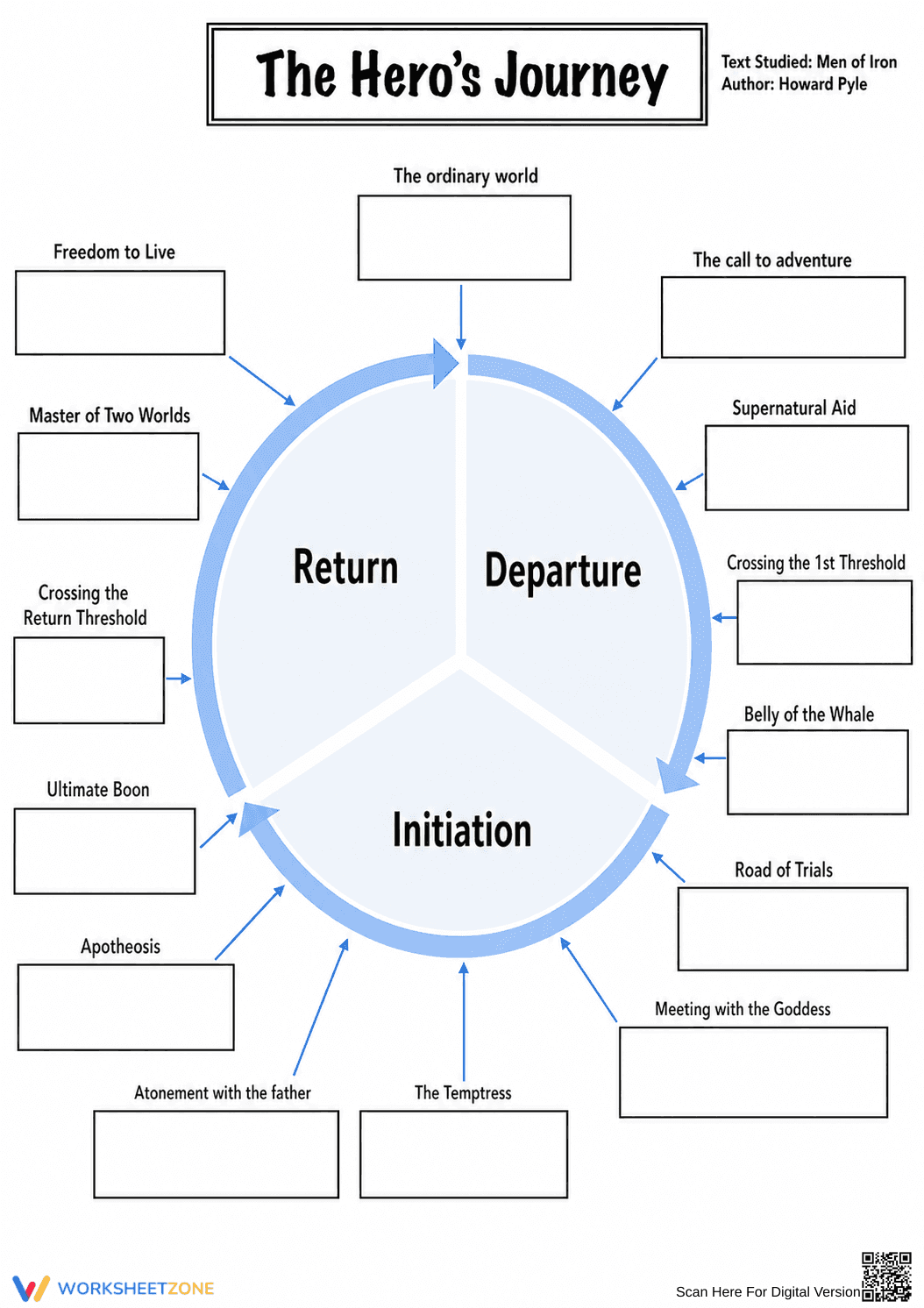
This printable graphic organizer helps students analyze narrative structure by mapping a text to the classic Hero's Journey archetype. By identifying specific plot points that align with stages like the Call to Adventure and the Road of Trials, students deepen their reading comprehension and structural analysis skills.
At a Glance
- Grade: 9 · Subject: English Language Arts
- Standard:
CCSS.ELA-LITERACY.RL.9-10.3— Analyze how characters develop and advance the plot- Skill Focus: Narrative Structure & Archetypes
- Format: 1 page · 14 problems · PDF
- Best For: Reading comprehension and literary analysis
- Time: 30–45 minutes
This single-page resource features a circular diagram divided into the three primary phases of the monomyth: Departure, Initiation, and Return. Surrounding the central cycle are 14 fill-in-the-blank boxes corresponding to archetypal steps, such as the Belly of the Whale and the Ultimate Boon. Though formatted for Howard Pyle's Men of Iron, the clear visual layout makes it highly adaptable for tracking character progression in any hero narrative.
Designed for immediate classroom implementation, this resource requires minimal setup:
- Print (1 minute): Generate copies of the single-page PDF for your class.
- Distribute (1 minute): Hand out the organizers after students read the target text.
- Review (5 minutes): Briefly explain the three main phases before letting students work independently or in pairs.
With under two minutes of prep time, this worksheet is an excellent addition to any literature unit or substitute plan.
This activity aligns to CCSS.ELA-LITERACY.RL.9-10.3: Analyze how complex characters develop over the course of a text, interact with others, and advance the plot. By categorizing textual evidence into the 14 stages of the monomyth, students demonstrate how incidents propel the action forward. Standard codes can be copied directly into lesson plans or IEP goals.
Use this graphic organizer as a during-reading activity where students fill in the 14 boxes incrementally. Alternatively, assign it as a summative review tool after completing a text, challenging students to synthesize the plot into the archetypal framework. As a formative assessment tip, observe which stages students struggle to identify; confusion around the Apotheosis often indicates a need to review character motivation. Expect students to spend 30 to 45 minutes completing the diagram.
This worksheet is ideal for high school English language arts students, particularly ninth graders encountering complex narrative structures. To support learners needing differentiation, teachers can pre-fill a few boxes to serve as anchor points. It pairs perfectly with introductory lessons on Joseph Campbell's monomyth.
Teaching narrative structure through established frameworks enhances reading comprehension. Providing students with visual graphic organizers helps them map complex relationships within a text, reducing cognitive load and allowing for deeper literary analysis. This worksheet applies that principle by requiring students to align textual evidence with the 14 stages of the monomyth. By mastering CCSS.ELA-LITERACY.RL.9-10.3 and analyzing how characters advance the plot, students build a foundational understanding of storytelling that transfers across genres. Recognizing these universal patterns improves academic performance and fosters critical thinking about daily media. This structured approach ensures learners can confidently dissect complex narratives.


