


























Views
Downloads
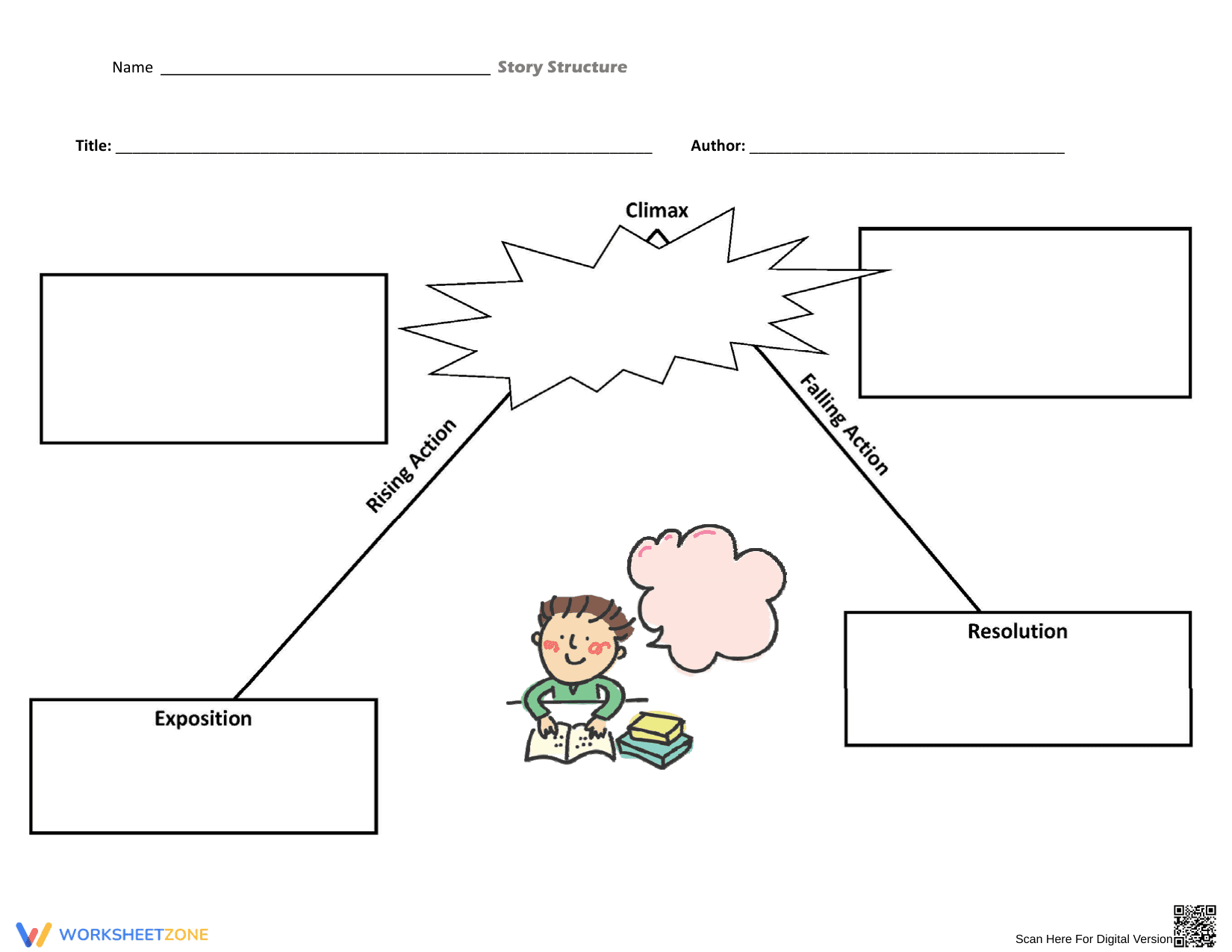

Printable Story Structure Plot Organizer — Grade 3-5 Ready
Paste this activity's link or code into your existing LMS (Google Classroom, Canvas, Teams, Schoology, Moodle, etc.).
Students can open and work on the activity right away, with no student login required.
You'll still be able to track student progress and results from your teacher account.
This Grade 4 story structure worksheet provides a clear visual framework for students to map out plot elements. By identifying the exposition, rising action, climax, falling action, and resolution, learners build a deeper understanding of narrative progression. This essential organizer helps students organize their thoughts and improve reading comprehension outcomes through active text analysis.
At a Glance
- Grade: 3–5 · Subject: ELA
- Standard:
CCSS.ELA-LITERACY.RL.4.3— Describe story events in depth drawing on specific details from the text- Skill Focus: Plot Structure (The Climb)
- Format: 1 page · 5 tasks · Organizer included · PDF
- Best For: Narrative analysis and story mapping
- Time: 15–25 minutes
What's Inside
The "The Climb" worksheet features a single-page graphic organizer designed to resemble a mountain peak, visually representing the rising and falling intensity of a story. It includes five distinct sections for exposition, rising action, climax, falling action, and resolution. The layout is clean and spacious, allowing students to write detailed descriptions of key events. This PDF format is ready for immediate printing and distribution in any classroom setting.
Zero-Prep Workflow
This resource is designed for a smooth classroom experience. First, print the single-page PDF (less than 30 seconds). Second, distribute the worksheet to your students as they finish a narrative text (under 1 minute). Third, review the completed plot mountains during a whole-class discussion or through individual check-ins (approximately 5 minutes). Total teacher preparation time is minimized for maximum instructional efficiency.
Standards Alignment
The primary focus is CCSS.ELA-LITERACY.RL.4.3: "Describe in depth a character, setting, or event in a story or drama, drawing on specific details in the text." By breaking down the sequence of events into a logical structure, students satisfy the requirements for deep narrative analysis. This standard code can be copied directly into lesson plans, IEP goals, or district curriculum mapping tools to ensure instructional compliance.
How to Use It
Use this organizer during the independent practice phase after reading a short story. Have students work individually to plot the main events, which serves as a great formative assessment to see if they can distinguish between rising and falling action. Alternatively, use it as a brainstorming tool before students begin writing their own original narratives to ensure they have a complete plot arc.
Who It's For
This worksheet is ideal for third, fourth, and fifth-grade students practicing literary analysis. It works exceptionally well for visual learners who benefit from seeing the "climb" of a story. It is a natural pairing for any short story passage or novel study, and it can be easily scaffolded by providing sentence starters for students who need additional writing support.
According to the RAND AIRS 2024 report, graphic organizers are a high-leverage instructional practice that significantly improves student recall and comprehension of narrative structures. By using the CCSS.ELA-LITERACY.RL.4.3 standard as a guide, this worksheet focuses on the plain-English skill of describing story events in depth. Fisher & Frey (2014) emphasize that visual mapping helps students transition from literal comprehension to inferential reasoning by requiring them to evaluate the relative importance of plot points. Research indicates that structured organizers reduce cognitive load, allowing students to focus on the relationships between exposition and resolution. This structured approach ensures that students can articulate the climax and falling action with precision. This resource provides a robust framework for mastery of plot analysis in elementary ELA. The NAEP data further supports that students who regularly use evidence-based organizers score higher on reading assessments.


