


























Views
Downloads
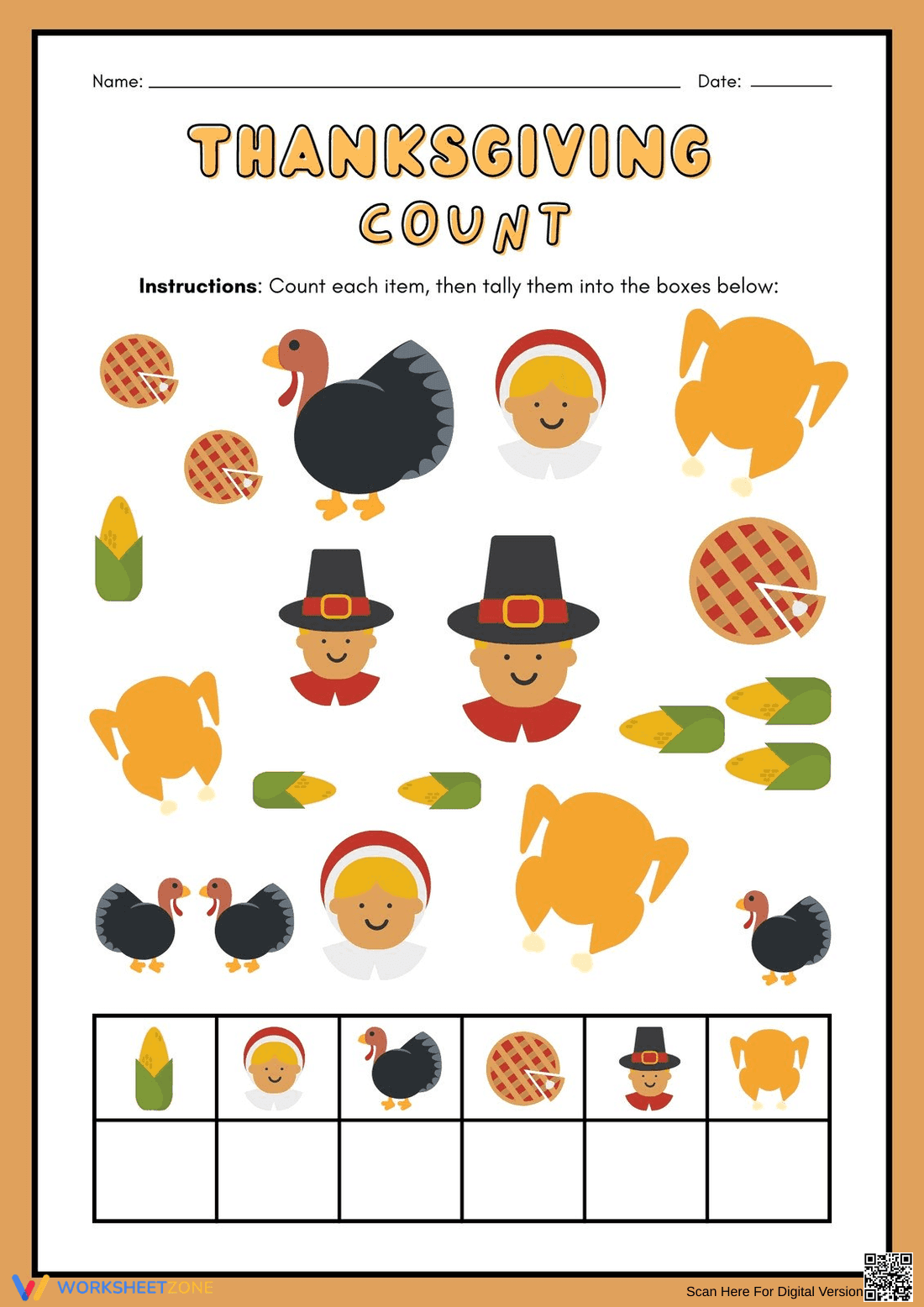

Printable Thanksgiving Counting Worksheet | Grade K Math
Paste this activity's link or code into your existing LMS (Google Classroom, Canvas, Teams, Schoology, Moodle, etc.).
Students can open and work on the activity right away, with no student login required.
You'll still be able to track student progress and results from your teacher account.
This festive Kindergarten math worksheet gives students engaging practice with counting and categorizing objects. By tallying Thanksgiving-themed items, early learners build foundational data collection skills and reinforce one-to-one correspondence. The straightforward layout ensures young students can independently complete the task while celebrating the holiday season.
At a Glance
- Grade: K · Subject: Math
- Standard:
CCSS.MATH.CONTENT.K.MD.B.3— Classify objects and count the number in each category- Skill Focus: Counting and tallying
- Format: 1 page · 6 problems · No answer key · PDF
- Best For: Independent practice
- Time: 10–15 minutes
This single-page printable features a scattered assortment of Thanksgiving images, including turkeys, pies, corn, and pilgrims. Students must locate each specific item type, count the total quantity, and record their findings in the corresponding boxes at the bottom of the page. The visual structure provides a clear, self-contained activity that requires no additional materials or complex instructions.
Zero-Prep Workflow
- Print (1 minute): Simply download the PDF and print a class set. The black-and-white friendly design ensures clear copies.
- Distribute (1 minute): Hand out the sheets along with pencils or crayons. No cutting, gluing, or special manipulatives are required.
- Review (3 minutes): Quickly model counting one item type and writing the number in the box before letting students work independently.
With a total teacher prep time of under two minutes, this resource is highly effective for busy holiday weeks. It also serves as an excellent, self-explanatory activity for substitute teacher plans.
Standards Alignment
This activity aligns directly with CCSS.MATH.CONTENT.K.MD.B.3: Classify objects into given categories; count the numbers of objects in each category and sort the categories by count. It also supports early cardinality skills by requiring students to connect physical counting to written numerals. Both standard codes can be copied directly into lesson plans, IEP goals, or district curriculum mapping tools.
How to Use It
Deploy this worksheet during morning work or as a math center activity before direct instruction on graphing. It provides a quiet, focused task that settles students into the learning environment. Alternatively, use it as a quick formative assessment after a lesson on sorting. While students work, observe whether they cross out items as they count—a key strategy for accuracy. Expected completion time ranges from 10 to 15 minutes, depending on the student's counting fluency.
Who It's For
This resource is designed for Kindergarten students mastering basic counting and sorting skills. For students needing extra support, provide physical counters to place over the images before tallying. Advanced learners can be challenged to write addition equations combining two categories (e.g., turkeys plus pies). Pair this worksheet with a seasonal read-aloud book to create a cohesive, cross-curricular holiday lesson.
Mastering early data skills through activities aligned with CCSS.MATH.CONTENT.K.MD.B.3 is critical for long-term mathematical proficiency. When students classify objects and count the number in each category, they develop essential cognitive frameworks for statistical reasoning. According to a 2024 report by EdReports, integrating thematic, visual counting tasks significantly improves engagement and retention in early childhood mathematics. Thematic elements, such as the Thanksgiving imagery used here, provide contextual anchors that help young learners grasp abstract numerical concepts. By systematically locating, counting, and recording data, students practice the precise one-to-one correspondence required for advanced arithmetic. This structured approach ensures that foundational gaps are minimized early in the academic journey. Consistent exposure to these targeted, standard-aligned classification exercises builds the automaticity necessary for future success in complex problem-solving and data analysis.


