




























Views
Downloads


Printable Tensile Strength of Wood Science Worksheet

Paste this activity's link or code into your existing LMS (Google Classroom, Canvas, Teams, Schoology, Moodle, etc.).
Students can open and work on the activity right away, with no student login required.
You'll still be able to track student progress and results from your teacher account.
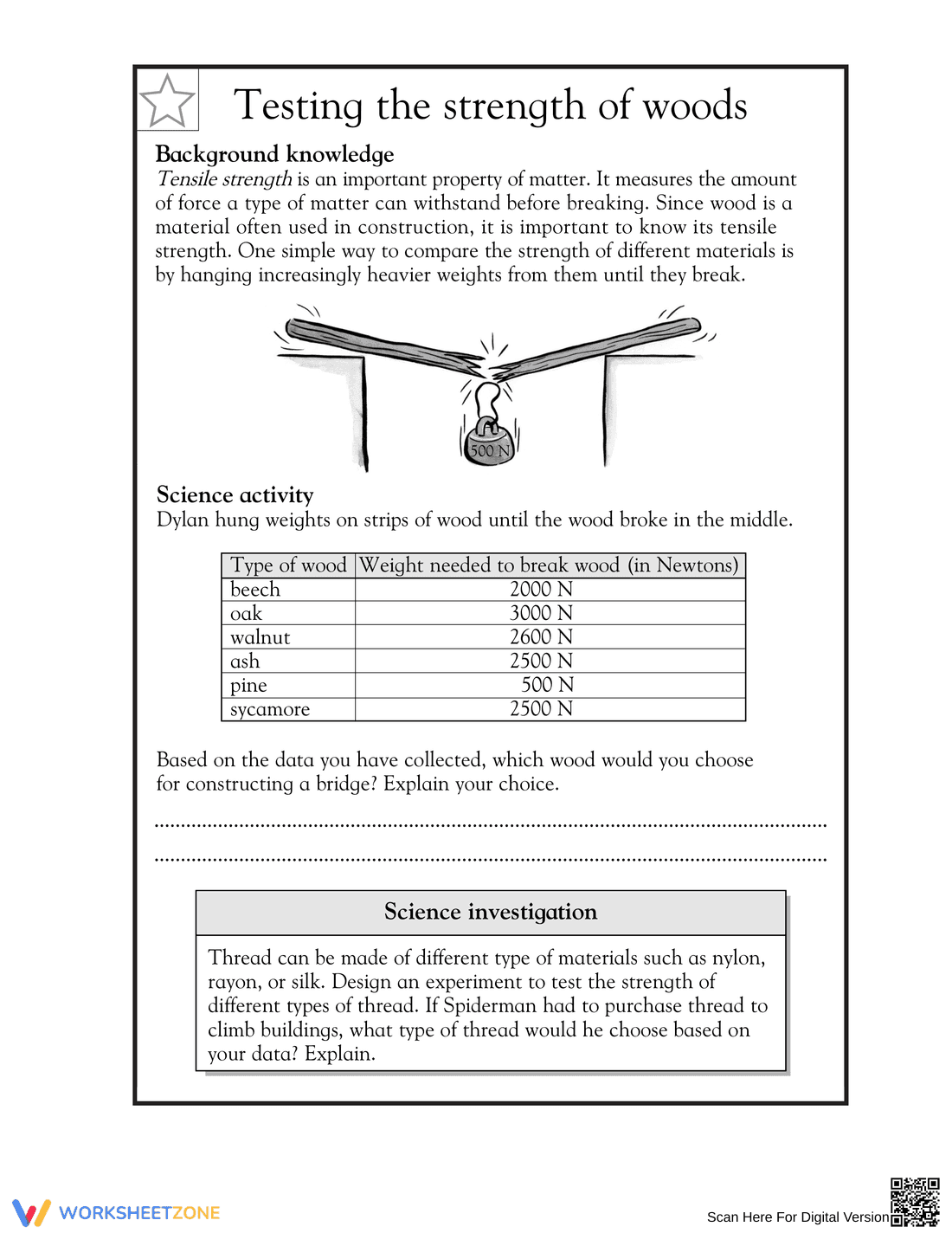
Students investigate the tensile strength of various woods to understand material properties in construction. This science worksheet guides fifth graders through data interpretation and experimental design, enabling them to evaluate which materials withstand the most force. By analyzing real-world metrics in Newtons, learners build a foundation for engineering and physical science mastery.
At a Glance
- Grade: 5 · Subject: Science
- Standard:
5-PS1-3— Make observations and measurements to identify materials based on their properties- Skill Focus: Tensile strength and data analysis
- Format: 1 page · 3 tasks · Answer key included · PDF
- Best For: Independent practice or small group science
- Time: 20–30 minutes
This comprehensive 1-page PDF includes a concise background knowledge section defining tensile strength as an essential property of matter. It features a detailed data table comparing six wood varieties—beech, oak, walnut, ash, pine, and sycamore—measured in Newtons. Students engage in critical thinking via a bridge-building application question and a creative Science Investigation task involving experimental design for threads.
Zero-Prep Workflow
- Print: Print the single-page PDF in seconds for the entire class.
- Distribute: Students read the background definition and analyze the Newton-based data table independently.
- Review: Facilitate a brief class review using the included answer key to verify student choices for the bridge-construction prompt.
Total preparation time is under two minutes, making it ideal for sub plans or quick science blocks.
Standards Alignment
This resource is explicitly aligned to 5-PS1-3, which requires students to make observations and measurements to identify materials based on their properties. By evaluating breaking points, learners quantify physical characteristics. The extension task aligns with 3-5-ETS1-1 engineering criteria. Both standard codes can be copied directly into lesson plans, IEP goals, or district curriculum mapping tools.
How to Use It
Use this worksheet during a unit on physical properties or as an introduction to engineering design. It serves as an excellent formative assessment tool; observe whether students can identify the strongest material (oak) versus the weakest (pine) using the numerical data provided. Assign it as a follow-up to a hands-on lab or as a standalone literacy-in-science activity to strengthen data literacy and argumentative writing skills.
Who It's For
This material is designed for Grade 5 students but remains accessible for Grade 4 advanced learners or Grade 6 review. It provides scaffolded background text for ELL students and clear visual aids for diverse learners. Naturally pair this worksheet with a physical material-testing lab or a reading passage about the history of bridge architecture to deepen conceptual connections.
Effective science instruction in the upper elementary years must transition from qualitative observations to quantitative data analysis. This worksheet facilitates that shift by requiring students to interpret tensile strength measured in Newtons, a standard unit of force. According to EdReports 2024, high-quality science materials must integrate engineering practices with core physical science content to ensure students develop a coherent understanding of how material properties influence real-world design decisions. By asking students to justify their choice of wood for a bridge and design an experiment for thread strength, this resource reinforces the Science and Engineering Practices (SEP) identified in the NGSS framework. This approach encourages learners to act as junior engineers, using empirical evidence to solve practical problems. The inclusion of clear background knowledge ensures that all students start with a shared vocabulary, promoting equity in the science classroom and supporting scientific literacy development across all learner populations.


