


























Views
Downloads
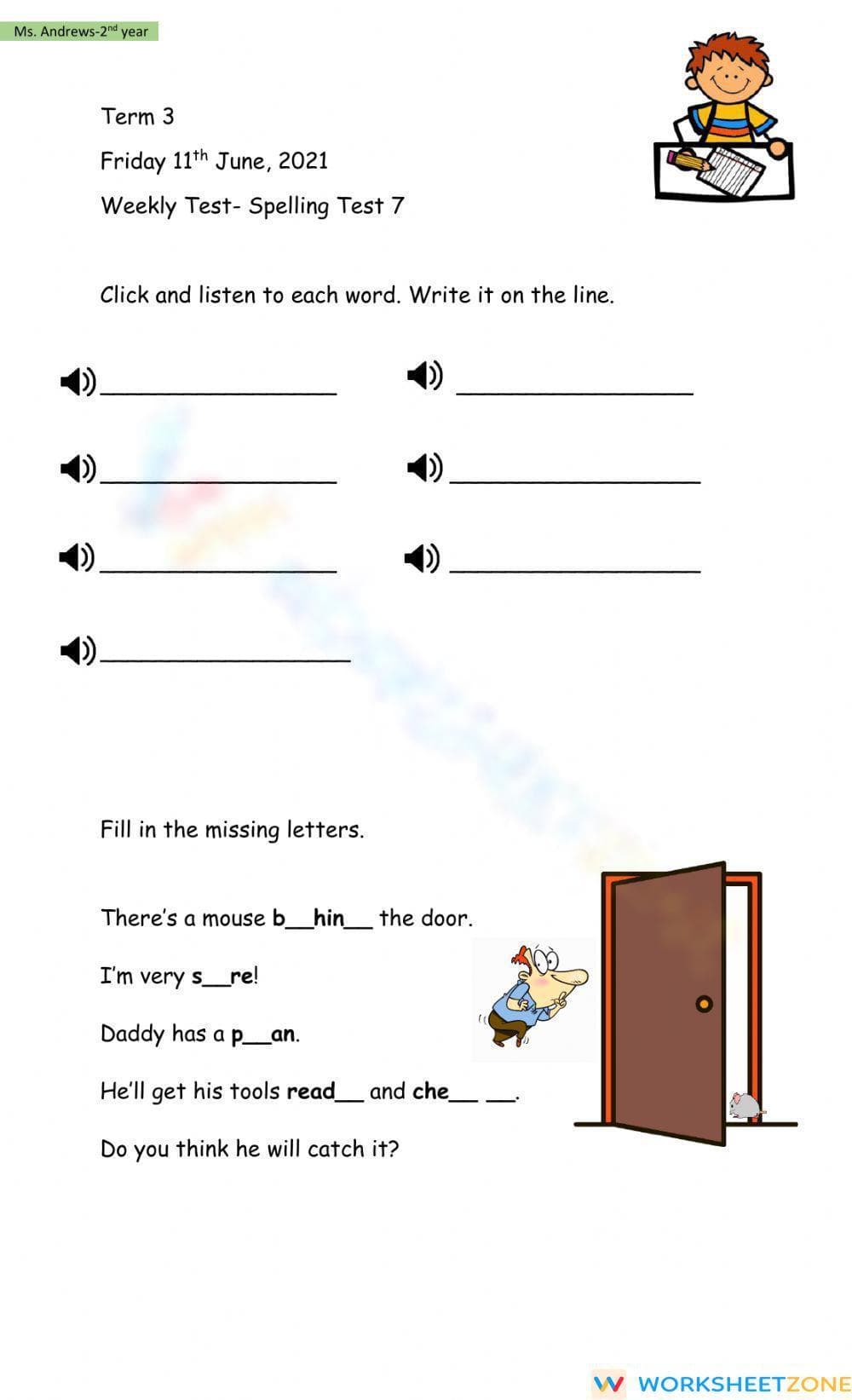

Essential Grade 2 Spelling Test | Printable Weekly 7
Paste this activity's link or code into your existing LMS (Google Classroom, Canvas, Teams, Schoology, Moodle, etc.).
Students can open and work on the activity right away, with no student login required.
You'll still be able to track student progress and results from your teacher account.
This Essential Grade 2 Spelling Test provides a comprehensive assessment for students to demonstrate mastery of phonemic awareness and spelling patterns. By engaging with both auditory and visual tasks, learners solidify their understanding of letter-sound relationships. This worksheet serves as a vital tool for teachers to track weekly progress and ensure students meet foundational literacy benchmarks effectively.
At a Glance
- Grade: 2 · Subject: English Language Arts
- Standard:
CCSS.ELA-LITERACY.L.2.2.D— Generalize learned spelling patterns when writing words- Skill Focus: Spelling, Phonics, and Auditory Processing
- Format: 1 page · 12 problems · Answer key included · PDF
- Best For: Weekly summative assessment or homework review
- Time: 15–20 minutes
The worksheet is structured into two distinct pedagogical segments. The first half features seven auditory-based lines where students listen and record dictated words, strengthening the connection between sound and script. The second half consists of five cloze-style sentences focusing on specific phonetic blends and silent letters. This one-page PDF includes a clear layout and a full answer key for efficient grading.
Zero-Prep Workflow
This resource is designed for a seamless, zero-prep classroom experience. Teachers can print the material in under 30 seconds, distribute it to the entire class in approximately one minute, and review the results using the provided answer key in less than five minutes. The total teacher preparation time is targeted at under two minutes, making it an ideal candidate for substitute plans.
Standards Alignment
The primary alignment is CCSS.ELA-LITERACY.L.2.2.D, which requires students to generalize learned spelling patterns when writing words. By identifying missing vowels and consonants in context, students also support related standards regarding phonetic analysis. Both standard codes can be copied directly into lesson plans, IEP goals, or district curriculum mapping tools to maintain rigorous instructional standards.
How to Use It
Deploy this worksheet during the final instructional block of the week as a summative assessment to gauge retention of current spelling lists. Teachers should observe students during the auditory section to identify those struggling with phoneme isolation. The worksheet typically takes 15-20 minutes to complete, providing immediate data on student mastery levels and intervention needs.
Who It's For
This assessment is tailored for Grade 2 students but is highly effective for Grade 1 advanced learners or Grade 3 students requiring remedial spelling support. It naturally pairs with a phonetic anchor chart to reinforce vocabulary acquisition. The dual-modality approach ensures that students with different learning styles can demonstrate their proficiency in English orthography during weekly reviews.
Spelling proficiency is a critical predictor of later reading fluency and academic writing success. According to EdReports 2024, consistent weekly assessment in phonemic patterns helps prevent long-term literacy gaps by identifying specific phonetic misunderstandings early. This worksheet specifically targets CCSS.ELA-LITERACY.L.2.2.D, ensuring students can accurately generalize spelling patterns within 12 diverse tasks. Fisher & Frey (2014) emphasize that integrated auditory and visual spelling practice accelerates the transition from phonetic to transitional spelling stages. By requiring students to fill in missing letters within complete sentences, this resource promotes contextual application rather than rote memorization. This balanced approach ensures that Grade 2 learners develop a robust orthographic lexicon necessary for effective communication. The clear structure and standardized format make it an essential component of a high-quality, evidence-based literacy program focused on student mastery and data-driven instruction.


