


























Views
Downloads

Grade 2 Spelling Test Worksheet — Printable No-Prep ELA
Paste this activity's link or code into your existing LMS (Google Classroom, Canvas, Teams, Schoology, Moodle, etc.).
Students can open and work on the activity right away, with no student login required.
You'll still be able to track student progress and results from your teacher account.
Grade 2 Spelling Assessment: Phonics and Sentence Application
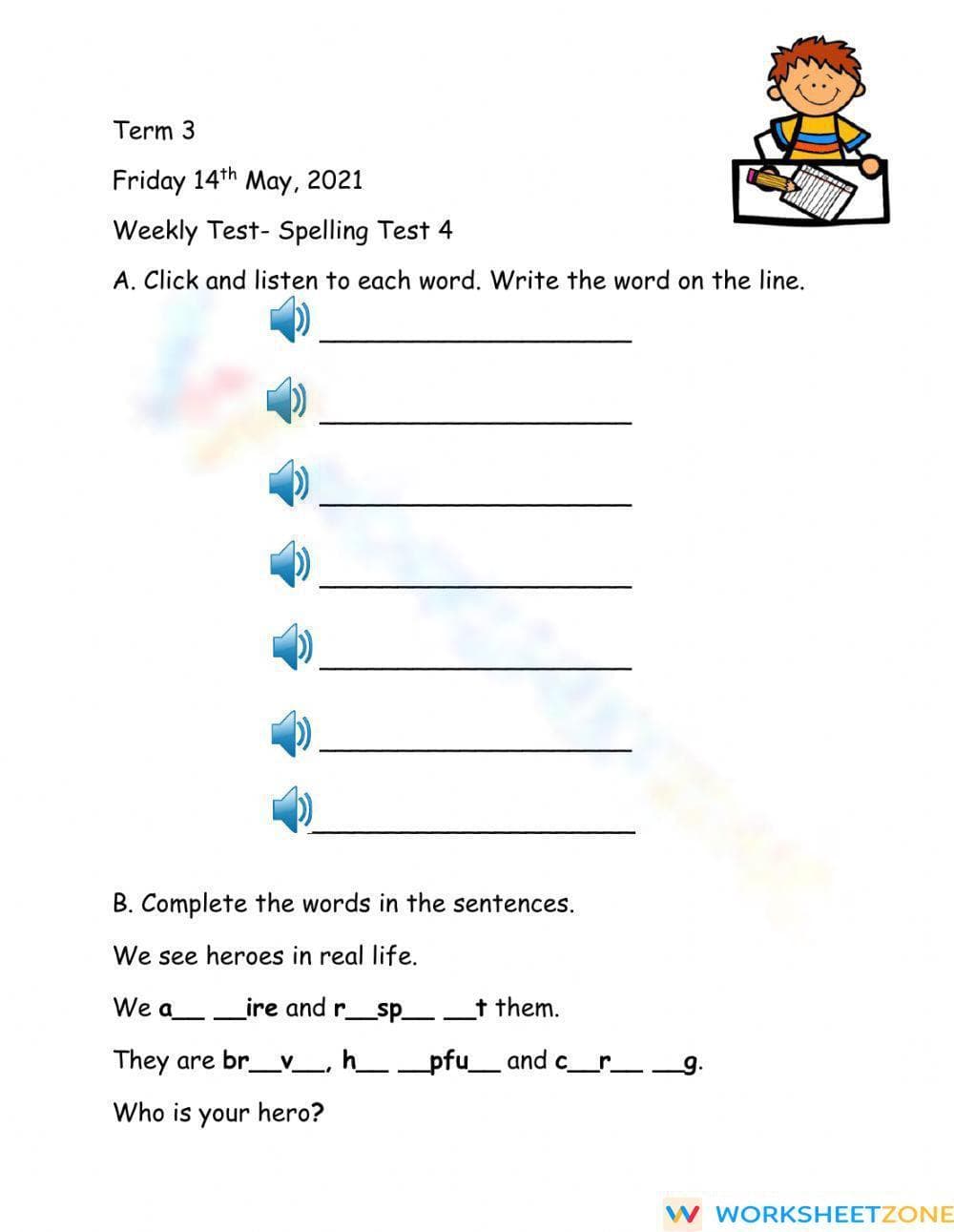
This Grade 2 spelling assessment worksheet provides a comprehensive evaluation of phonics mastery and contextual word usage through structured testing. Students accurately transcribe auditory cues into written text and apply spelling rules within complete sentences to demonstrate orthographic fluency. This resource ensures that foundational literacy skills are solidified through practical application and immediate formative feedback loops.
At a Glance
- Grade: 2 · Subject: English Language Arts
- Standard:
CCSS.ELA-LITERACY.L.2.2.D— Generalize learned spelling patterns when writing words to ensure accurate communication.- Skill Focus: Auditory spelling and contextual phonics
- Format: 1 page · 10 problems · Answer key included · PDF
- Best For: Weekly assessments and formative progress monitoring
- Time: 15–20 minutes
The "Weekly Test - Spelling Test 4" is a one-page instructional tool featuring two distinct sections. Part A includes seven listening-based tasks where students transcribe words from audio prompts, while Part B presents three cloze sentences requiring students to complete missing letters in vocabulary words. The clean layout and clear instructions minimize cognitive load, allowing students to focus entirely on their orthographic accuracy.
This zero-prep worksheet is designed for maximum efficiency in the modern classroom. Teachers can implement the workflow in three simple steps: Print the single-page document (30 seconds), distribute to students for the 15-minute assessment, and review results (60 seconds). With a total preparation time under two minutes, it serves as an ideal resource for substitute plans or Friday assessments. No additional materials or teacher setup are required beyond the basic printout.
This resource is strictly aligned to `CCSS.ELA-LITERACY.L.2.2.D`, which requires students to generalize learned spelling patterns when writing words. By combining transcription with sentence-level completion, the worksheet validates that students aren't just memorizing lists but are understanding the underlying phonetic structures. This standard code can be copied directly into lesson plans, IEP goals, or district curriculum mapping tools.
For optimal results, use this worksheet as a summative assessment at the end of a weekly spelling unit. It works best during a dedicated testing block after direct instruction on the specific phonics patterns of the week. Educators should observe student hesitation during the auditory section to identify specific phoneme-grapheme gaps. Completion typically ranges from 15 to 20 minutes depending on the student's processing speed.
This assessment is tailored for Grade 2 students but is highly effective for Grade 1 advanced learners or Grade 3 students requiring intervention. The inclusion of sentence context makes it an excellent tool for English Language Learners (ELL) who benefit from seeing vocabulary in use. It pairs naturally with a weekly reading passage or a phonics anchor chart focusing on irregular vowel teams or consonant blends.
The mastery of spelling patterns is a critical predictor of later reading fluency and writing proficiency, as detailed in the CCSS.ELA-LITERACY.L.2.2.D framework. According to research from Fisher & Frey (2014), regular formative assessment of phonics through transcription tasks allows educators to provide targeted interventions before literacy gaps widen. This worksheet facilitates that process by requiring students to accurately generalize learned spelling patterns across both isolated words and integrated sentences. By analyzing student performance on the 10 included tasks, teachers can gain a data-driven snapshot of orthographic development. This evidence-based approach aligns with the RAND AIRS 2024 recommendations for systematic literacy monitoring in early elementary grades. The combination of auditory processing and contextual application ensures a robust evaluation of the student's ability to navigate complex phonetic structures within the English language, ultimately supporting long-term academic success in writing and communication.


