


























Views
Downloads

Grade 2 Spelling Weekly Test 1 | Essential Printable
Paste this activity's link or code into your existing LMS (Google Classroom, Canvas, Teams, Schoology, Moodle, etc.).
Students can open and work on the activity right away, with no student login required.
You'll still be able to track student progress and results from your teacher account.
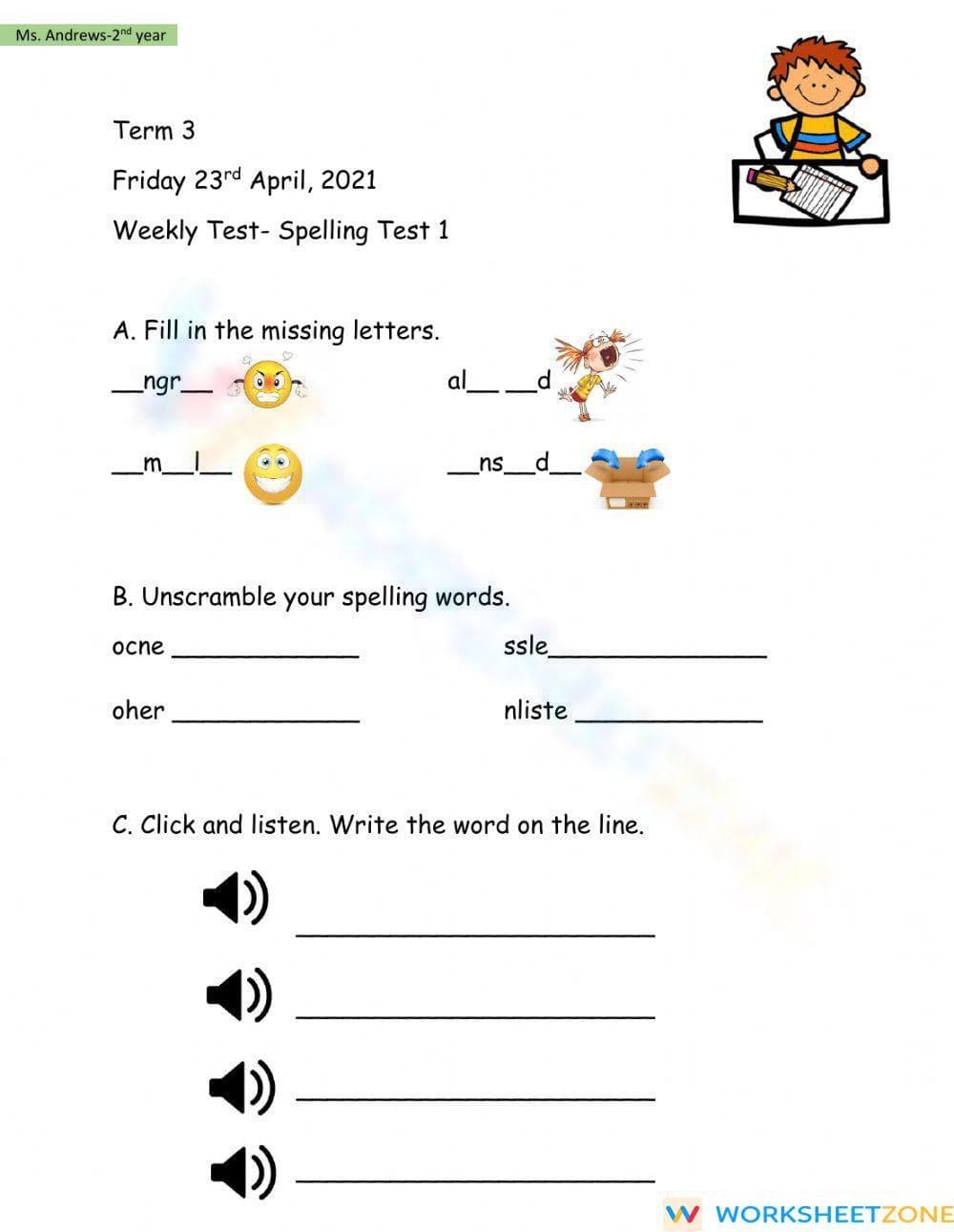
This Grade 2 spelling weekly test provides a comprehensive assessment of essential phonics and vocabulary skills. Students demonstrate mastery through three distinct modalities: missing letters with visual cues, unscrambling core spelling words, and auditory prompts. It ensures students meet grade-level expectations in a structured, assessment-ready format that facilitates ease of use for both teachers and students.
At a Glance
- Grade: 2 · Subject: English Language Arts
- Standard:
CCSS.ELA-LITERACY.L.2.2— Demonstrate command of the conventions of standard English spelling in writing- Skill Focus: Spelling patterns and auditory word recognition
- Format: 1 page · 12 problems · Answer key included · PDF
- Best For: Weekly assessment and spelling progress monitoring
- Time: 15–20 minutes
What's Inside
The worksheet features 12 targeted spelling tasks organized into three logical sections. Part A uses emotive and descriptive illustrations to prompt students to fill in missing letters, reinforcing letter-sound correspondences. Part B challenges students to unscramble mixed-up letters to form four high-frequency words. Part C integrates auditory learning by requiring students to listen to a prompt and transcribe the spoken word accurately on provided lines, ensuring a multi-sensory approach to literacy evaluation.
Zero-Prep Workflow
This resource is designed for immediate classroom application with zero teacher preparation. Print the single-page PDF, distribute the copies, and use the included answer key for rapid grading or self-correction. Total preparation time is under two minutes, making it an ideal choice for busy mornings, homework assignments, or emergency sub plans that require high-quality instructional content.
Standards Alignment
This assessment aligns directly with CCSS.ELA-LITERACY.L.2.2, which requires students to demonstrate command of the conventions of standard English capitalization, punctuation, and spelling when writing. Specifically, it targets the ability to generalize learned spelling patterns when writing words. This standard code can be copied directly into lesson plans, IEP goals, or district curriculum mapping tools for seamless documentation.
How to Use It
Use this worksheet as a summative assessment at the end of a spelling unit to measure student retention. Administer it after direct instruction on the week's specific word patterns. For a formative approach, observe students during the auditory section to identify those struggling with phonemic isolation. Completion typically takes 15 to 20 minutes, fitting perfectly into a standard ELA block.
Who It's For
This material is tailored for second-grade students but serves as an excellent challenge for advanced first graders or a necessary review for third graders requiring intervention. It supports English Language Learners by pairing visual icons with vocabulary. Pair this worksheet with a short reading passage or a phonics anchor chart to provide a well-rounded literacy block that addresses diverse learning needs.
According to the RAND AIRS 2024 report, structured weekly assessments that utilize multi-modal inputs—such as the visual, orthographic, and auditory tasks found in this Grade 2 spelling worksheet—significantly improve long-term retention of irregular spelling patterns. This resource focuses on CCSS.ELA-LITERACY.L.2.2, a critical milestone for developing reading fluency and written expression. By requiring students to unscramble letters and fill in missing components, the worksheet activates active recall mechanisms rather than simple passive recognition. Such rigorous practice is essential for moving students toward independent mastery of complex spelling conventions. Educational research consistently highlights that integrating listening tasks alongside writing helps bridge the gap between phonemic awareness and graphemic representation. This assessment provides a reliable data point for teachers to track individual progress and inform future instructional groupings, ensuring targeted support for every learner.


