


























Views
Downloads

L.2.2.D Worksheet: Grade 2 Spelling — Essential Aligned
Paste this activity's link or code into your existing LMS (Google Classroom, Canvas, Teams, Schoology, Moodle, etc.).
Students can open and work on the activity right away, with no student login required.
You'll still be able to track student progress and results from your teacher account.
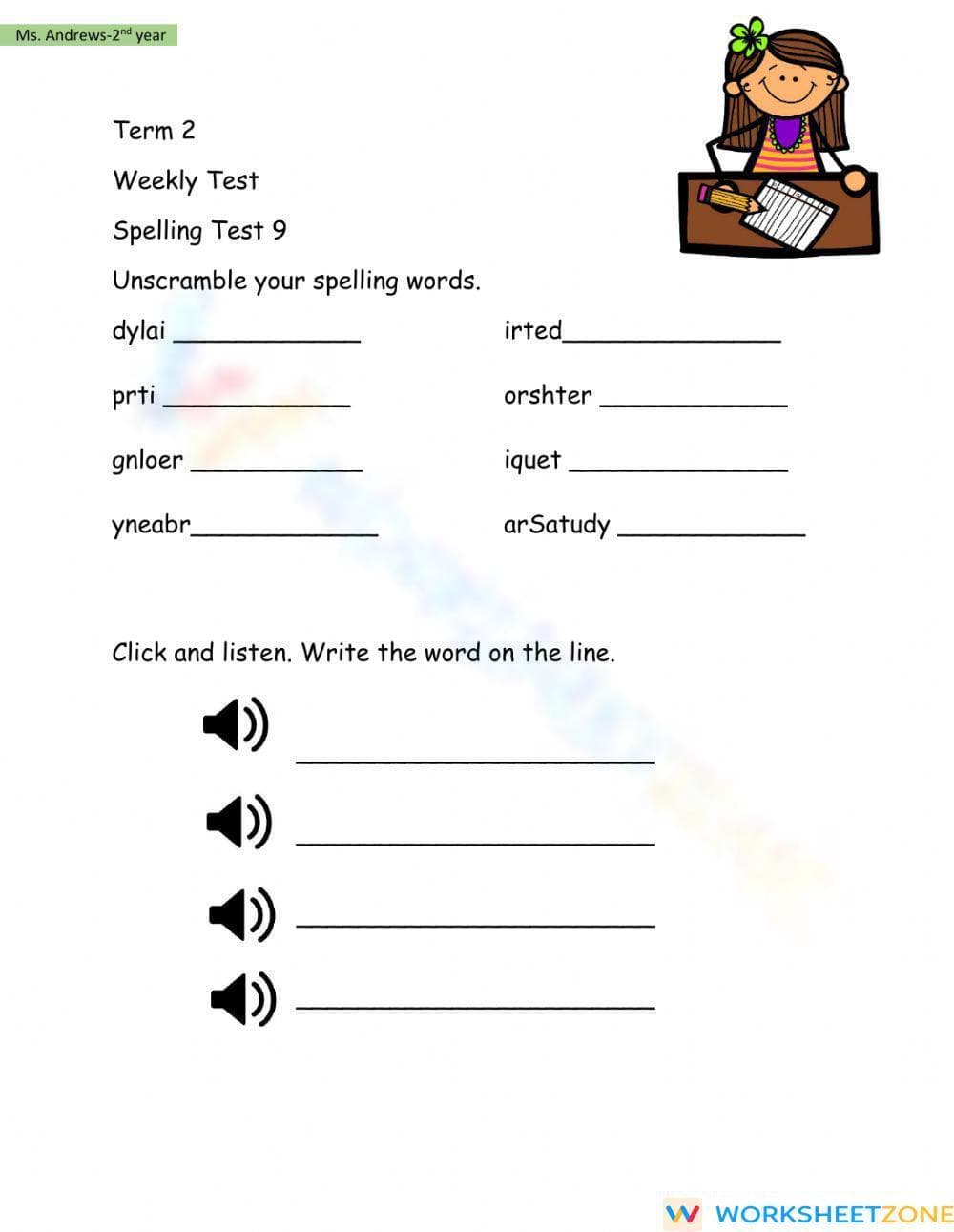
This Grade 2 spelling assessment provides a structured way to evaluate student mastery of high-frequency words. By combining cognitive unscrambling with phonological listening tasks, students demonstrate their ability to apply correct letter sequences. This resource ensures that spelling progress is tracked through direct evidence of independent word construction.
At a Glance
- Grade: 2 · Subject: ELA
- Standard:
CCSS.ELA-LITERACY.L.2.2.D— Generalize learned spelling patterns when writing words correctly- Skill Focus: Orthographic mapping and auditory processing
- Format: 1 page · 12 problems · Answer key included · PDF
- Best For: Weekly formative assessment and spelling tests
- Time: 15–20 minutes
Inside this assessment, you will find 12 specific tasks designed to measure literacy. The top half features 8 word-scramble problems requiring students to decode jumbled letters into familiar Grade 2 terms. The bottom half incorporates 4 listening prompts where students translate auditory cues into written form. The layout is spacious, allowing young learners room for clear letter formation.
The worksheet provides evidence for the L.2.2.D standard by testing both visual and auditory recall. Each unscrambled word serves as a data point for orthographic retrieval, while the listening tasks verify phoneme-grapheme correspondence. Educators can map these 12 responses to student progress trackers or IEP goals. High accuracy indicates a readiness to move toward complex multisyllabic spelling patterns in future units.
This worksheet is primarily aligned to CCSS.ELA-LITERACY.L.2.2.D, which requires students to generalize learned spelling patterns when writing words. It also supports CCSS.ELA-LITERACY.RF.2.3 by reinforcing phonics and word recognition through the decoding of scrambled letter strings. Both standard codes can be copied directly into lesson plans, IEP goals, or district curriculum mapping tools for efficient documentation of student learning outcomes.
Use this resource as a formal Friday spelling test or a mid-week formative check. During the listening portion, teachers can observe if students are using stretching techniques to identify individual sounds. This provides insight into which students may need additional phonemic awareness support. Most students will complete the entire page within a standard 20-minute instructional block.
This resource is ideal for Grade 2 students but serves as an excellent challenge for advanced Grade 1 learners or a vital review for Grade 3 students. It pairs naturally with weekly anchor charts that highlight vowel teams or common suffixes. The multi-modal approach supports diverse learners by providing both visual and auditory entry points into the spelling task, ensuring that no student is excluded.
Research from the RAND AIRS 2024 study emphasizes that effective orthographic development requires a combination of visual recognition and active construction. This worksheet facilitates that process by forcing students to manipulate letters during the unscrambling phase, which reinforces structural memory. Fisher & Frey (2014) highlight the importance of gradual release where assessments provide the final independent practice stage. By requiring students to generalize learned patterns across 12 distinct tasks, the resource aligns with evidence-based practices for improving literacy retention. The inclusion of the CCSS.ELA-LITERACY.L.2.2.D standard ensures that the practice is part of a larger linguistic framework for Grade 2 ELA development. Educators can rely on this assessment to produce high-signal data for parent-teacher conferences and internal RTI tier placement, making it an essential component of a comprehensive literacy curriculum.


