


























Views
Downloads
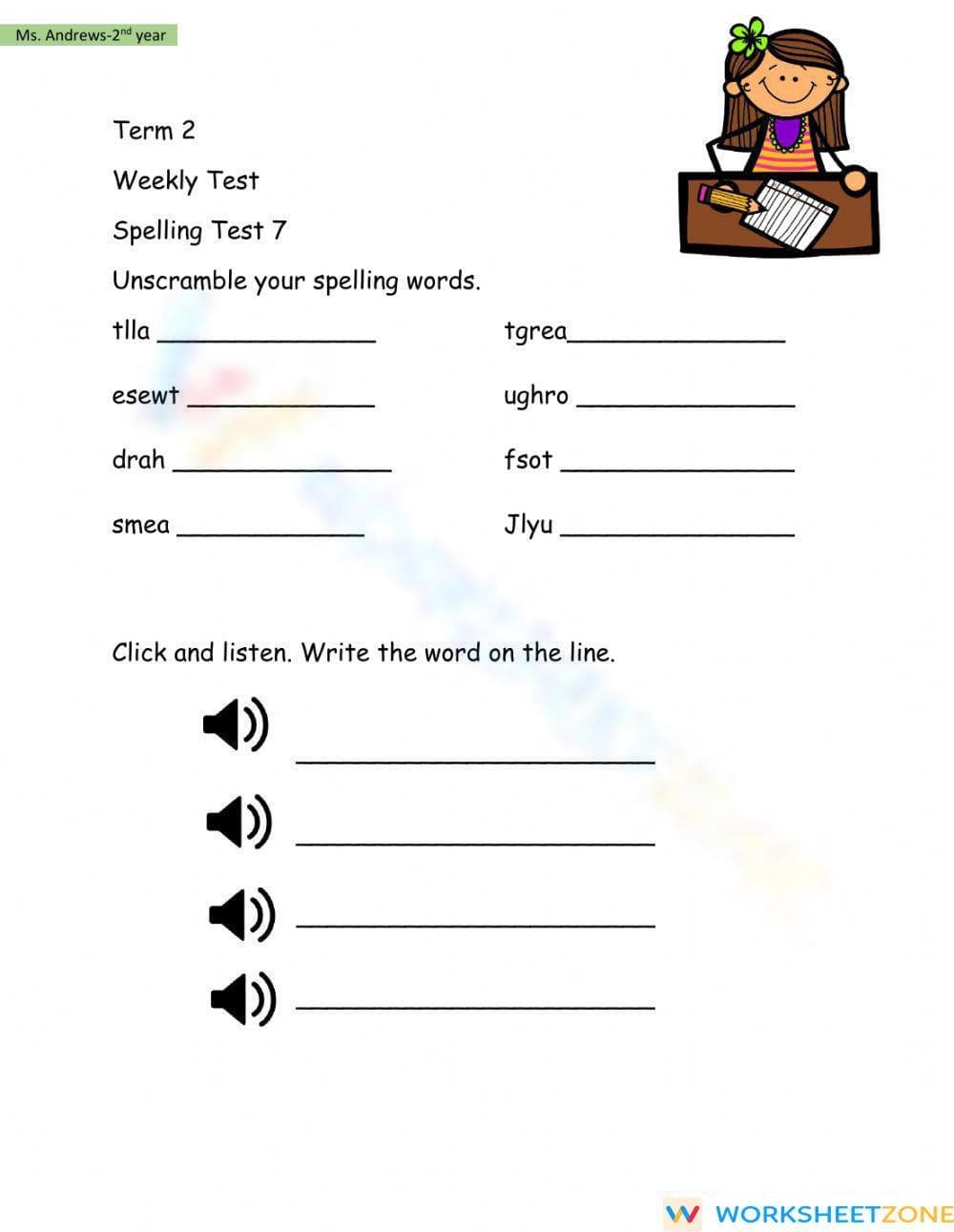

Grade 2 Spelling Test Worksheet — Printable Weekly Test
Paste this activity's link or code into your existing LMS (Google Classroom, Canvas, Teams, Schoology, Moodle, etc.).
Students can open and work on the activity right away, with no student login required.
You'll still be able to track student progress and results from your teacher account.
This Grade 2 spelling test worksheet provides a structured way for students to demonstrate mastery of essential high-frequency words through multi-sensory engagement. By combining word unscrambling with dictation, the resource ensures that learners can both recognize and produce correct letter sequences. It is a complete, ready-to-use assessment tool for any elementary ELA curriculum.
At a Glance
- Grade: 2 · Subject: English Language Arts
- Standard:
CCSS.ELA-LITERACY.L.2.2.D— Generalize learned spelling patterns when writing words- Skill Focus: Spelling and Word Scrambles
- Format: 1 page · 12 problems · Answer key included · PDF · Interactive digital version
- Best For: Weekly assessments and spelling progress monitoring
- Time: 15–20 minutes
What's Inside
This comprehensive spelling assessment is divided into two distinct pedagogical sections. The first half features eight scrambled words, including "great" and "tough," requiring students to apply phonics rules to reassemble correct spellings. The second half provides four lines for dictation, where students listen and write independently. The one-page layout is clean, professional, and includes a clear answer key for rapid grading.
Zero-Prep Workflow
The workflow for this resource is designed for maximum efficiency in the classroom. First, print the PDF for your class; no collation is required for this single-page assessment. Next, distribute the worksheets during your designated spelling block, which takes less than thirty seconds of teacher time. Finally, use the included answer key to grade the papers or have students peer-edit, allowing for immediate feedback in under two minutes total.
Standards Alignment
This worksheet is strictly aligned to `CCSS.ELA-LITERACY.L.2.2.D`, which requires students to generalize learned spelling patterns when writing words. By challenging students to unscramble mixed letter sets, the tasks force an active recall of spelling rules rather than passive recognition. Supporting `CCSS.ELA-LITERACY.L.2.2.E`, it also encourages the use of internal word banks for orthographic success. Both standard codes can be copied directly into lesson plans or IEP goals.
How to Use It
Use this worksheet as a formal weekly assessment on Fridays to gauge student progress after word study. It serves as a high-signal formative tool; if students struggle with the unscramble section, it indicates a need for more phonemic awareness training. Alternatively, it works perfectly as a quiet "morning work" activity or a reliable sub-plan filler, as the instructions are self-explanatory and require zero teacher intervention during completion.
Who It's For
This resource is tailored for second-grade students but is effective for first graders ready for challenges or third graders requiring remedial support. It is particularly useful for English Language Learners (ELLs) who benefit from the visual cues of scrambled letters to scaffold word construction. Pair this worksheet with a physical word wall or a digital anchor chart that highlights the weekly spelling patterns being tested.
Effective spelling instruction requires a transition from rote memorization to active manipulation of phonemes and graphemes. According to the ScienceDirect TpT Analysis, structured spelling tasks that include both visual reconstruction and auditory processing significantly improve long-term retention compared to simple repetitive writing. By aligning specifically with `CCSS.ELA-LITERACY.L.2.2.D`, this resource provides the necessary rigor for Grade 2 learners to master common spelling patterns and irregular words. The 12-task format is optimized for the typical attention span of elementary students while providing enough data points for a valid assessment of skill mastery. Teachers can confidently utilize this tool as a benchmark for student growth, knowing it reflects current research-based practices in literacy education and standards-aligned curriculum design.


