


























Views
Downloads
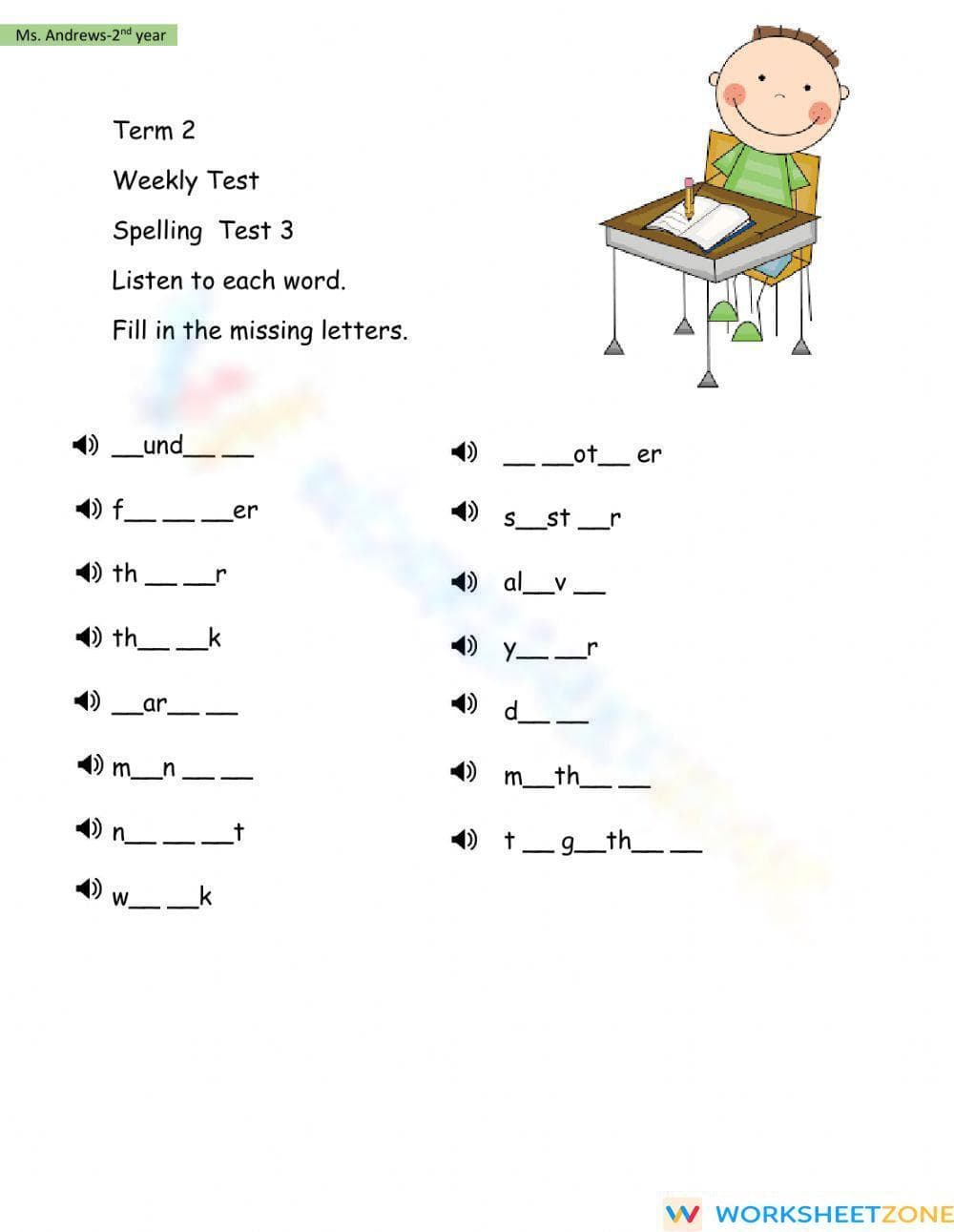

Essential Grade 2 Spelling Test | Term 2 Weekly Worksheet
Paste this activity's link or code into your existing LMS (Google Classroom, Canvas, Teams, Schoology, Moodle, etc.).
Students can open and work on the activity right away, with no student login required.
You'll still be able to track student progress and results from your teacher account.
This Term 2 spelling assessment helps Grade 2 students identify and generalize phonetic patterns within common vocabulary words. By filling in missing letters based on auditory cues, learners strengthen their orthographic mapping skills and improve their overall writing accuracy. This focused practice ensures students can apply phonological awareness to complex word structures effectively.
At a Glance
- Grade: 2 · Subject: English Language Arts
- Standard:
CCSS.ELA-LITERACY.L.2.2.D— Generalize learned spelling patterns when writing words to ensure accurate orthography- Skill Focus: Phonics and Spelling Patterns
- Format: 1 page · 16 problems · Answer key included · PDF
- Best For: Weekly spelling assessment and formative review
- Time: 10–15 minutes
This single-page worksheet features 16 individual word prompts designed for auditory-to-visual transcription. Each item provides a partial word frame where students must identify the missing vowels or consonants. The clean layout includes clear speaker icons to signal listening cues, accompanied by a student-friendly illustration of a child working at a desk to maintain engagement during the assessment.
The zero-prep workflow for this resource allows teachers to integrate it into a busy schedule with minimal friction. Simply print the document in under 30 seconds, distribute it to the class in less than one minute, and review the results using the included answer key in about 60 seconds. This efficient process makes it an ideal choice for emergency sub plans or quick weekly check-ins.
Aligned primarily to CCSS.ELA-LITERACY.L.2.2.D, this worksheet requires students to generalize learned spelling patterns when writing words. It also supports CCSS.ELA-LITERACY.RF.2.3, which focuses on knowing and applying grade-level phonics and word analysis skills in decoding words. Both standard codes can be copied directly into lesson plans, IEP goals, or district curriculum mapping tools.
Use this worksheet as a summative weekly test on Friday or as a mid-week formative check after direct instruction on specific vowel teams or consonant blends. While students work, observe whether they hesitate on initial blends versus final digraphs to identify specific instructional gaps. Completion typically takes 12 minutes, providing a rapid data point for your gradebook.
This resource is designed for Grade 2 students but is also appropriate for Grade 1 learners ready for a challenge or Kindergarten students working on advanced phonics. It serves as a helpful tool for English Language Learners (ELLs) who need visual scaffolds for word construction. Pair this with a phonics anchor chart or a short reading passage featuring the same spelling patterns for a comprehensive lesson.
Research by Fisher & Frey (2014) emphasizes that spelling instruction is most effective when students are required to actively manipulate letter patterns rather than just memorizing lists. This Term 2 weekly test applies this principle by providing 16 targeted tasks that demand orthographic processing. By focusing on CCSS.ELA-LITERACY.L.2.2.D, the worksheet ensures students move beyond simple rote recall toward a deeper understanding of how sounds map to specific letter combinations. This approach aligns with NAEP findings suggesting that strong phonics foundations in the early grades are critical predictors of later reading comprehension success. The worksheet's structure provides the necessary scaffolding for independent practice while allowing teachers to monitor progress through a clear, measurable format. This balance of auditory input and written output creates a robust learning experience that supports long-term retention of essential ELA skills and vocabulary development.


