




























Views
Downloads




Printable Telling Time Worksheet | Grade 1 Math Practice

Paste this activity's link or code into your existing LMS (Google Classroom, Canvas, Teams, Schoology, Moodle, etc.).
Students can open and work on the activity right away, with no student login required.
You'll still be able to track student progress and results from your teacher account.
Mastering the analog clock is a vital early math milestone. This telling time by the hour worksheet provides structured practice to help students identify and draw hourly intervals. By focusing on "o'clock" times, learners build a strong foundation before advancing to more complex half-hour measurements in higher grades.
At a Glance
- Grade: 1 · Subject: Math
- Standard:
CCSS.MATH.CONTENT.1.MD.B.3— Tell and write time in hours using analog clocks- Skill Focus: Telling time to the hour
- Format: 5 pages · 17 problems · Answer key included · PDF
- Best For: Primary math centers and independent practice
- Time: 20–30 minutes
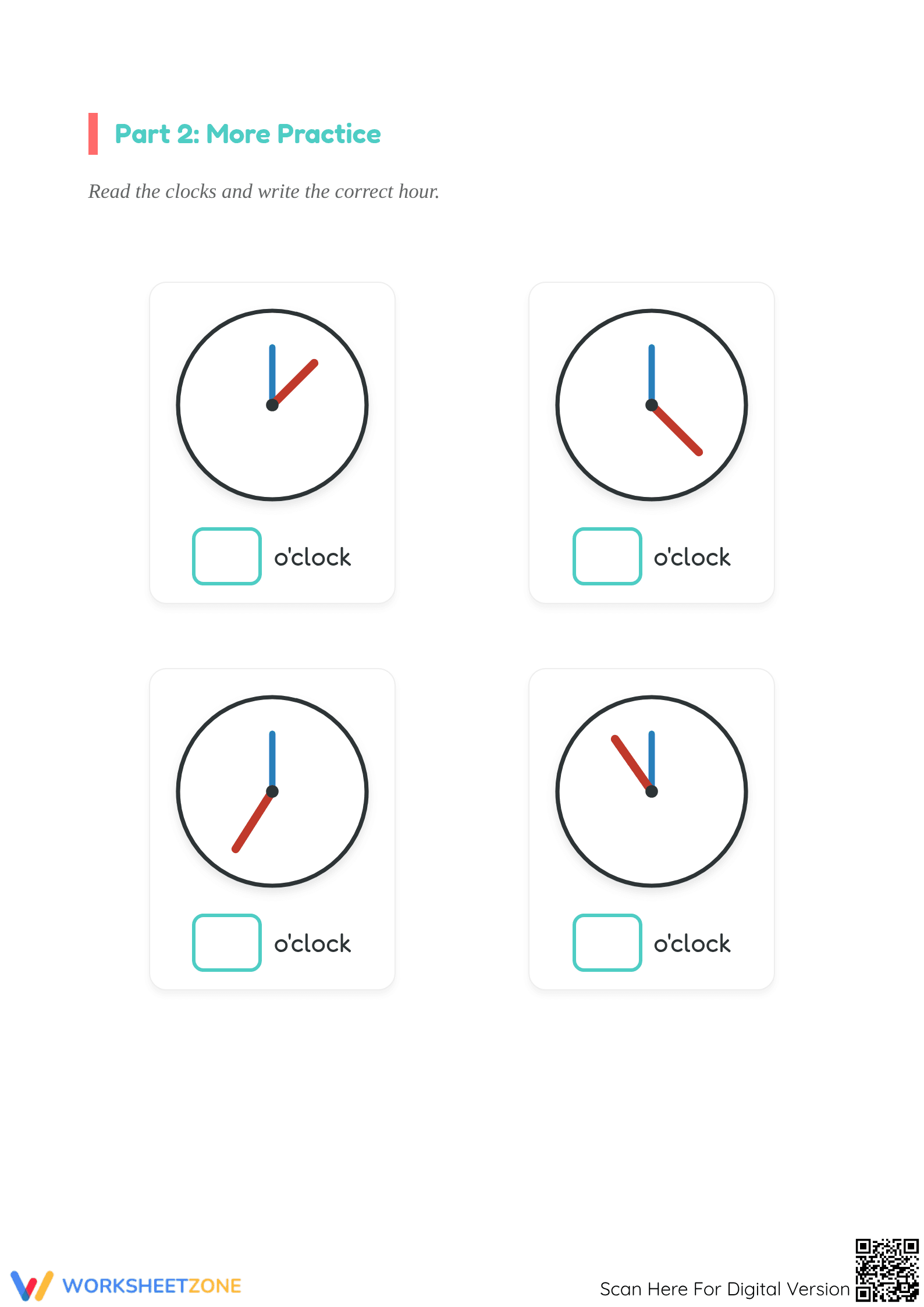
This comprehensive five-page packet features seventeen distinct tasks across four specialized sections. It includes clock face identification, hand-drawing exercises, and a personal daily routine application. Each page is designed with high-contrast analog faces and clear text boxes. A full answer key is included for immediate feedback, ensuring a complete and professional classroom resource ready for immediate printing.
- Guided Practice: Identifying the hour on six analog faces, focusing on the relationship between the hour hand and the fixed minute hand at twelve.
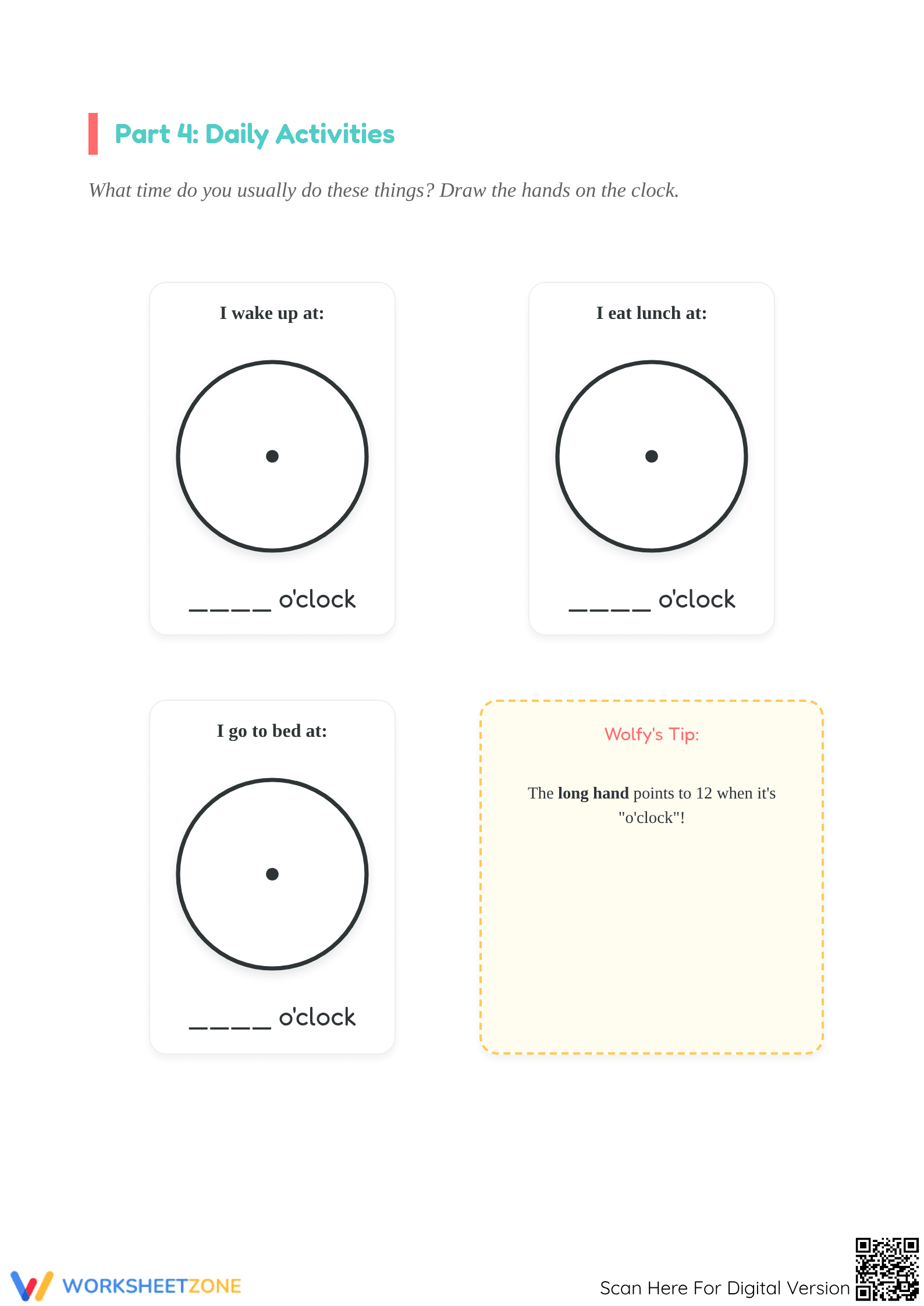
- Supported Practice: Four tasks where students draw clock hands based on specific "o'clock" prompts to practice hand length and positioning.
- Independent Practice: Routine application requiring students to draw hands and write times for daily activities like waking up or eating lunch.
This sequence follows a gradual-release model, moving from recognition to construction and application for comprehensive mastery of temporal concepts.
This resource is specifically aligned to CCSS.MATH.CONTENT.1.MD.B.3: "Tell and write time in hours and half-hours using analog and digital clocks." While it focuses on the hour, it serves as the essential prerequisite for half-hour mastery. This standard code can be copied directly into lesson plans, IEP goals, or district curriculum mapping tools.
Use this packet as a primary math center activity after a direct instruction lesson on clock hands. Alternatively, assign it as a cumulative homework assignment to verify student understanding of hourly intervals. For formative assessment, observe if students correctly place the shorter hand exactly on the numeral while keeping the longer hand vertical. This completion typically requires twenty to thirty minutes of focused classroom time.
This worksheet is ideal for Grade 1 students, though it is also effective for Kindergarten enrichment or Preschool introduction. It supports diverse learners through clear visual prompts and a consistent theme. Pair this resource with a physical geared teaching clock or a time-focused read-aloud passage to create a multisensory learning experience during your measurement unit.
The telling time by the hour worksheet aligns with CCSS.MATH.CONTENT.1.MD.B.3, focusing on the ability to tell and write time in hours using analog clocks. Research by Fisher & Frey (2014) highlights that scaffolding through a gradual release of responsibility is essential for early mathematical literacy. This material implements that research by transitioning students from simple identification to drawing clock hands and finally to applying time concepts to their personal daily routines. For early learners, the analog clock serves as a critical spatial-temporal tool that bridges abstract counting with concrete daily experiences. By maintaining a consistent focus on the "o'clock" position, this resource minimizes cognitive distractions and allows for the deep processing of the hour hand’s function. This proven instructional design ensures that students develop the necessary fluency for future time-telling standards while engaging with relatable, student-centered themes that promote mathematical confidence and retention.


