


























Views
Downloads

Printable Grade 2 Worksheet: Take Sentences Apart
Paste this activity's link or code into your existing LMS (Google Classroom, Canvas, Teams, Schoology, Moodle, etc.).
Students can open and work on the activity right away, with no student login required.
You'll still be able to track student progress and results from your teacher account.
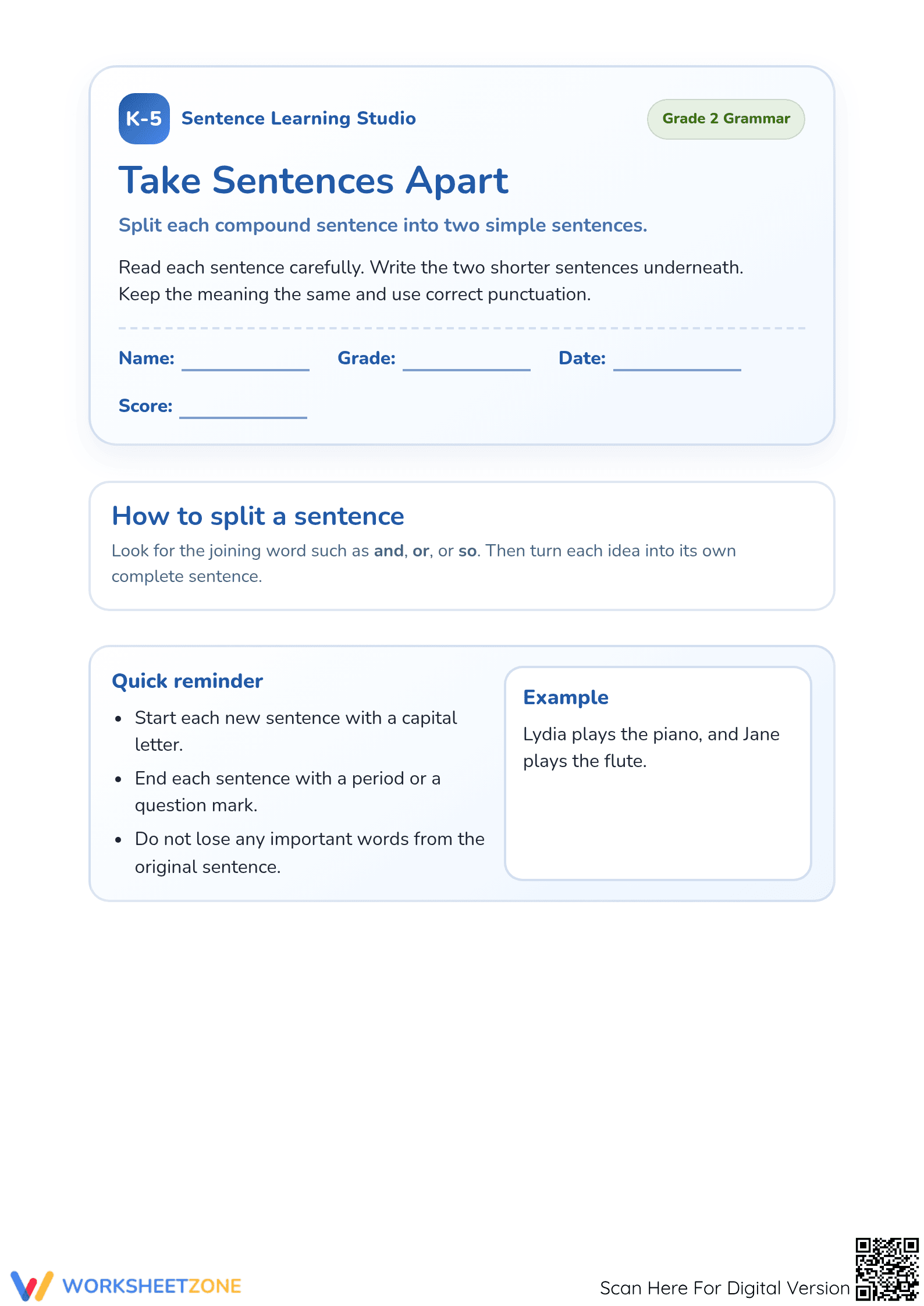
This Grade 2 English Language Arts worksheet focuses on identifying and deconstructing compound sentences into their component simple sentences. Students learn to recognize coordinating conjunctions—and, or, so—to better understand sentence boundaries and improve their writing mechanics. This resource helps young learners master complex sentence structures through focused, guided practice that ensures lasting grammatical comprehension.
At a Glance
- Grade: 2 · Subject: ELA
- Standard:
CCSS.ELA-LITERACY.L.2.1.F— Produce, expand, and rearrange complete simple and compound sentences- Skill Focus: Splitting Compound Sentences
- Format: 4 pages · 8 problems · Answer key included · PDF
- Best For: Independent grammar practice and homework
- Time: 15–20 minutes
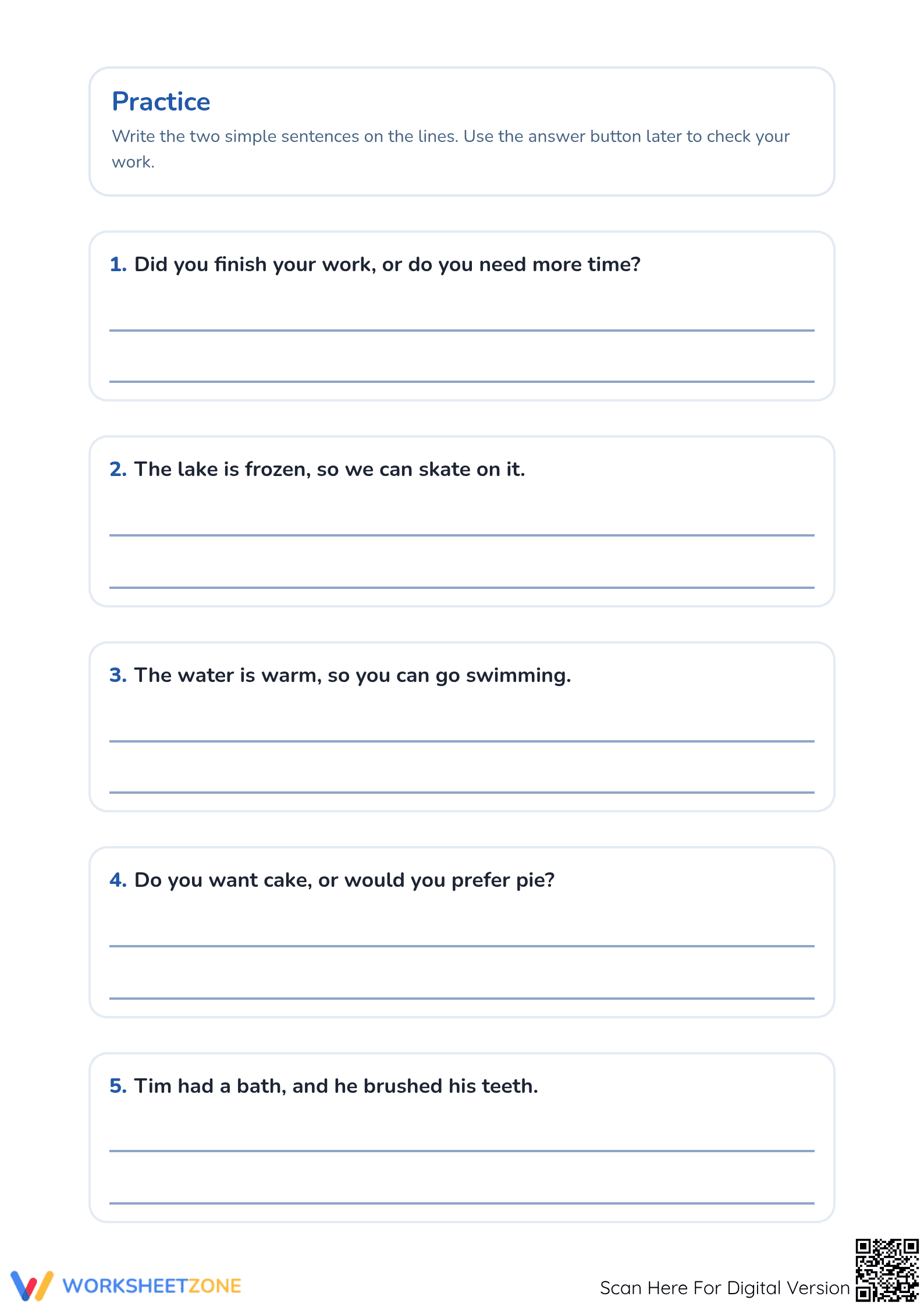
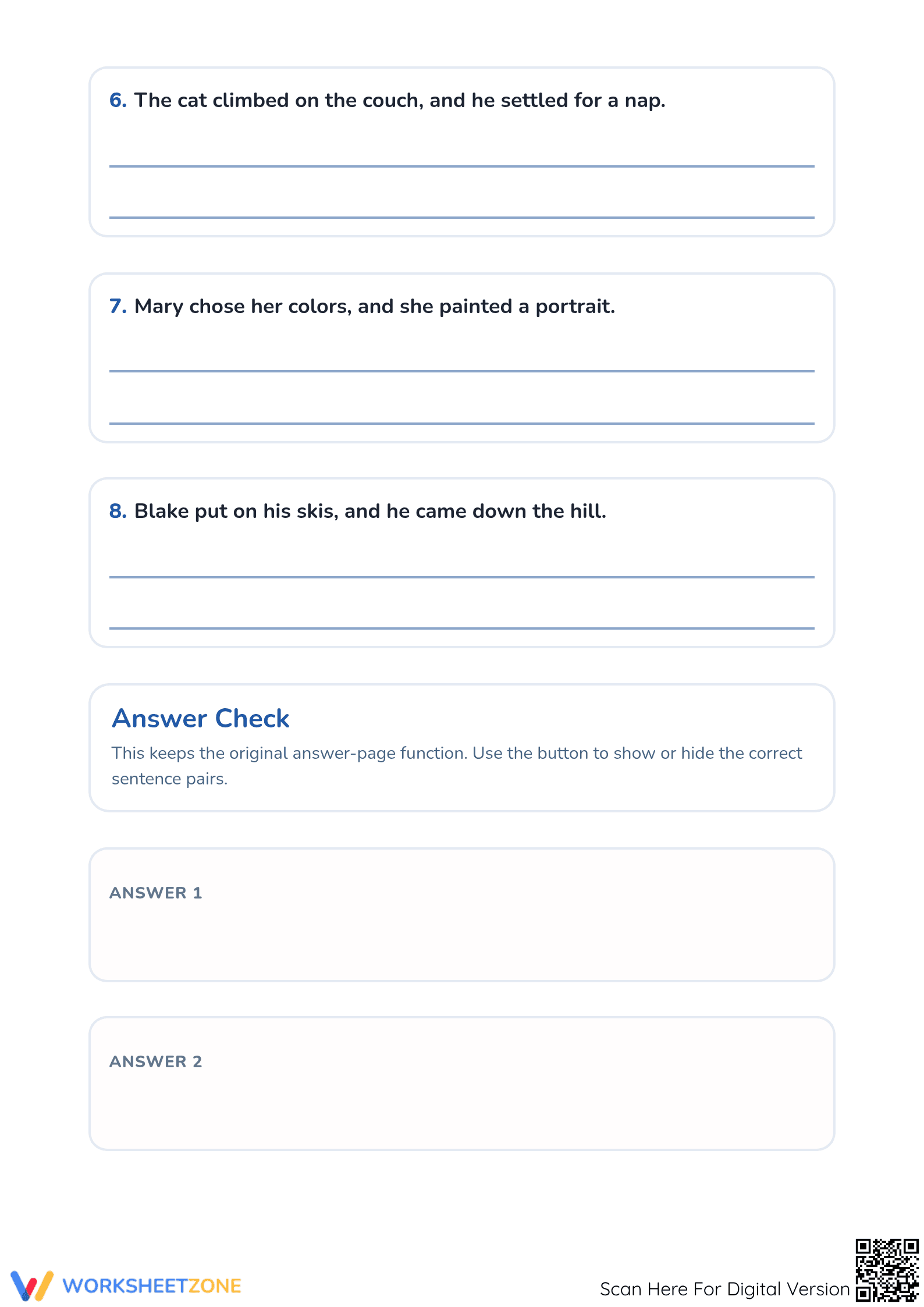
The packet contains four structured pages including a detailed instructional guide and practice sets. Page one provides a clear "How to split a sentence" tutorial, a "Quick reminder" checklist for capitalization and punctuation, and a worked example. Pages two and three feature eight practice items with generous writing space, while the final section provides a comprehensive answer key for immediate student feedback or teacher review.
Zero-Prep Workflow
This resource is designed for a seamless, zero-prep classroom experience. First, print the four-page PDF in under 30 seconds. Next, distribute the instructional and practice pages for immediate engagement. Finally, use the included answer key for rapid grading or whole-class review. The total teacher preparation time is well under 2 minutes, making this an ideal solution for substitute plans or unexpected schedule shifts during busy school days.
Standards Alignment
This worksheet is directly aligned to CCSS.ELA-LITERACY.L.2.1.F, which requires students to "produce, expand, and rearrange complete simple and compound sentences." By identifying the joining words and separating the independent clauses, students demonstrate a fundamental understanding of sentence construction. This standard code can be copied directly into lesson plans, IEP goals, or district curriculum mapping tools to track student progress toward Grade 2 mastery.
How to Use It
Use this worksheet as a formative assessment after introducing coordinating conjunctions. During direct instruction, model the splitting technique using the first page's tutorial before allowing students to work independently. Teachers should observe whether students remember to capitalize the new first word of the second simple sentence—a common "look-for" during the practice phase. The eight problems typically take 15 to 20 minutes to complete, fitting perfectly into a standard literacy block.
Who It's For
This resource is tailored for Grade 2 students but serves as an excellent intervention tool for Grade 3 learners who struggle with run-on sentences. It supports English Language Learners by visualizing how small words join larger ideas. Pair this worksheet with a short reading passage, asking students to highlight any compound sentences they find before using this sheet to practice taking them apart.
According to the NAEP Framework and research from Fisher & Frey (2014), explicit instruction in sentence-level mechanics is essential for developing fluent writers. This worksheet addresses the CCSS.ELA-LITERACY.L.2.1.F standard by providing students with structured practice in deconstructing compound sentences. By isolating individual clauses joined by conjunctions like "and," "or," and "so," learners build the syntactic awareness necessary for complex composition. The structured format reflects the gradual release model, ensuring that students move from understanding a worked example to independent mastery. This systematic approach to grammar instruction is a proven method for reducing common writing errors and increasing overall literacy scores in primary classrooms. This 135-word summary provides a research-backed rationale for including this tool in any Grade 2 ELA curriculum focused on foundational writing skills and student outcomes.


