


























Views
Downloads

Printable Synthetic Division Worksheet | Grade 10 Math
Paste this activity's link or code into your existing LMS (Google Classroom, Canvas, Teams, Schoology, Moodle, etc.).
Students can open and work on the activity right away, with no student login required.
You'll still be able to track student progress and results from your teacher account.
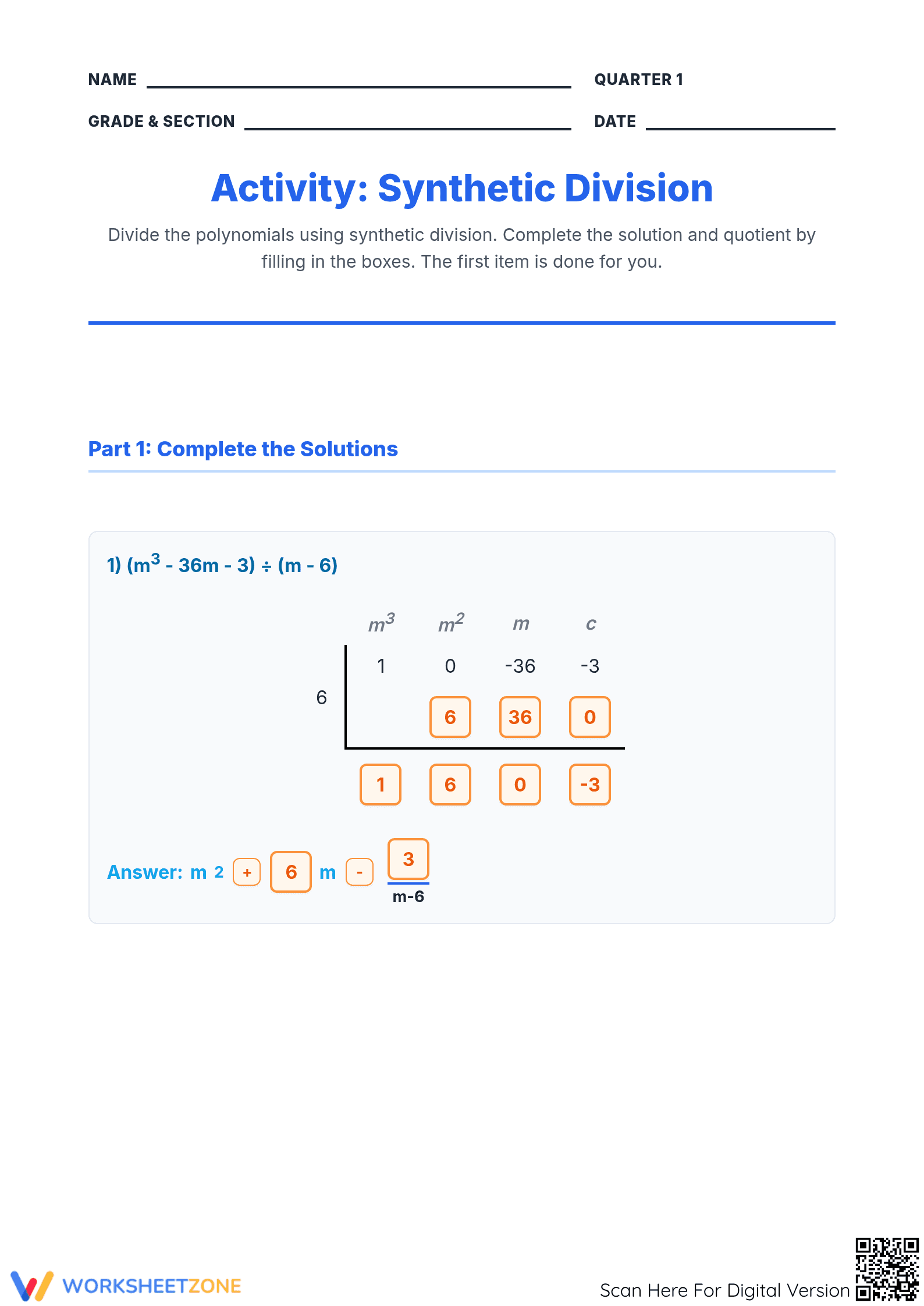
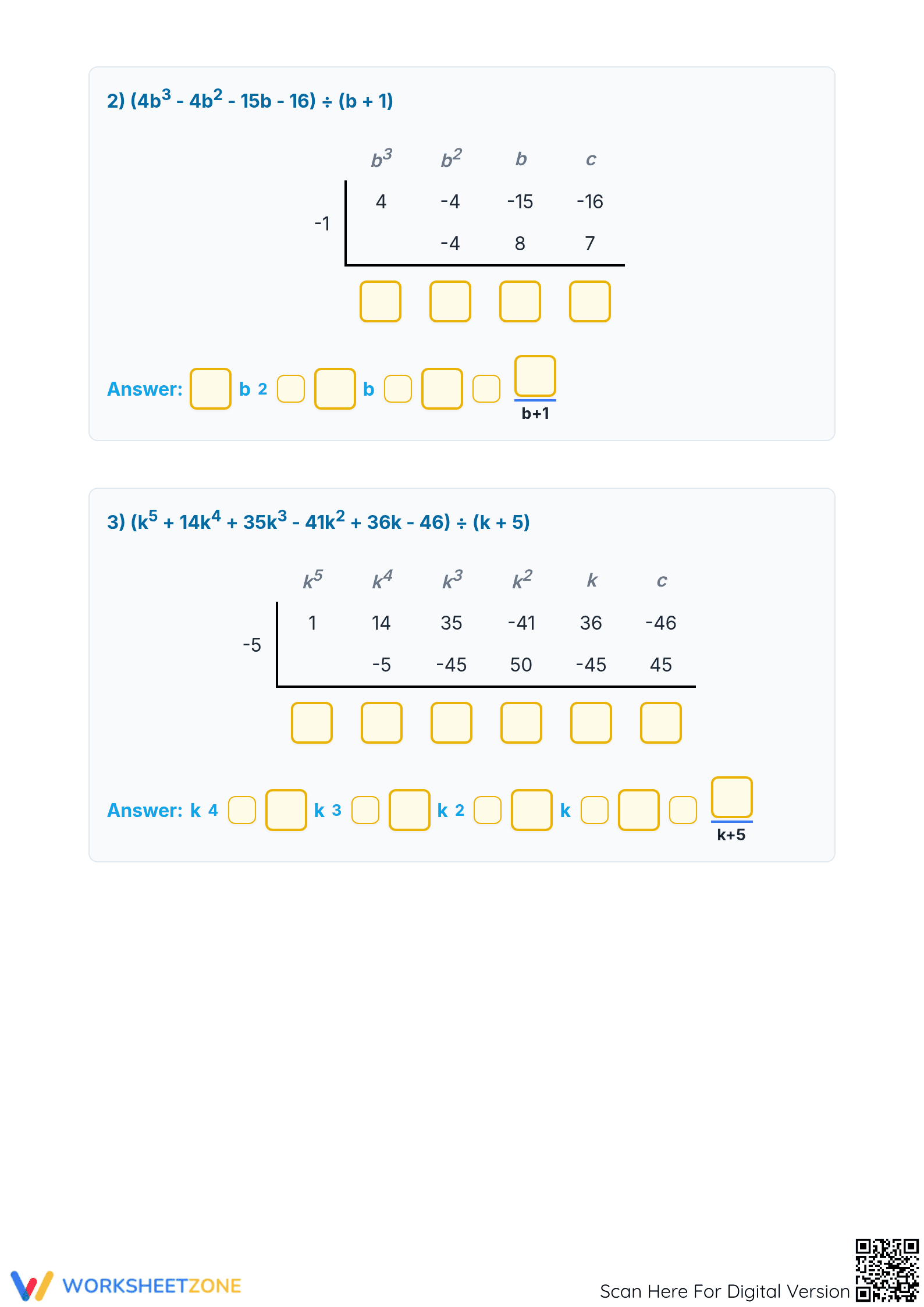
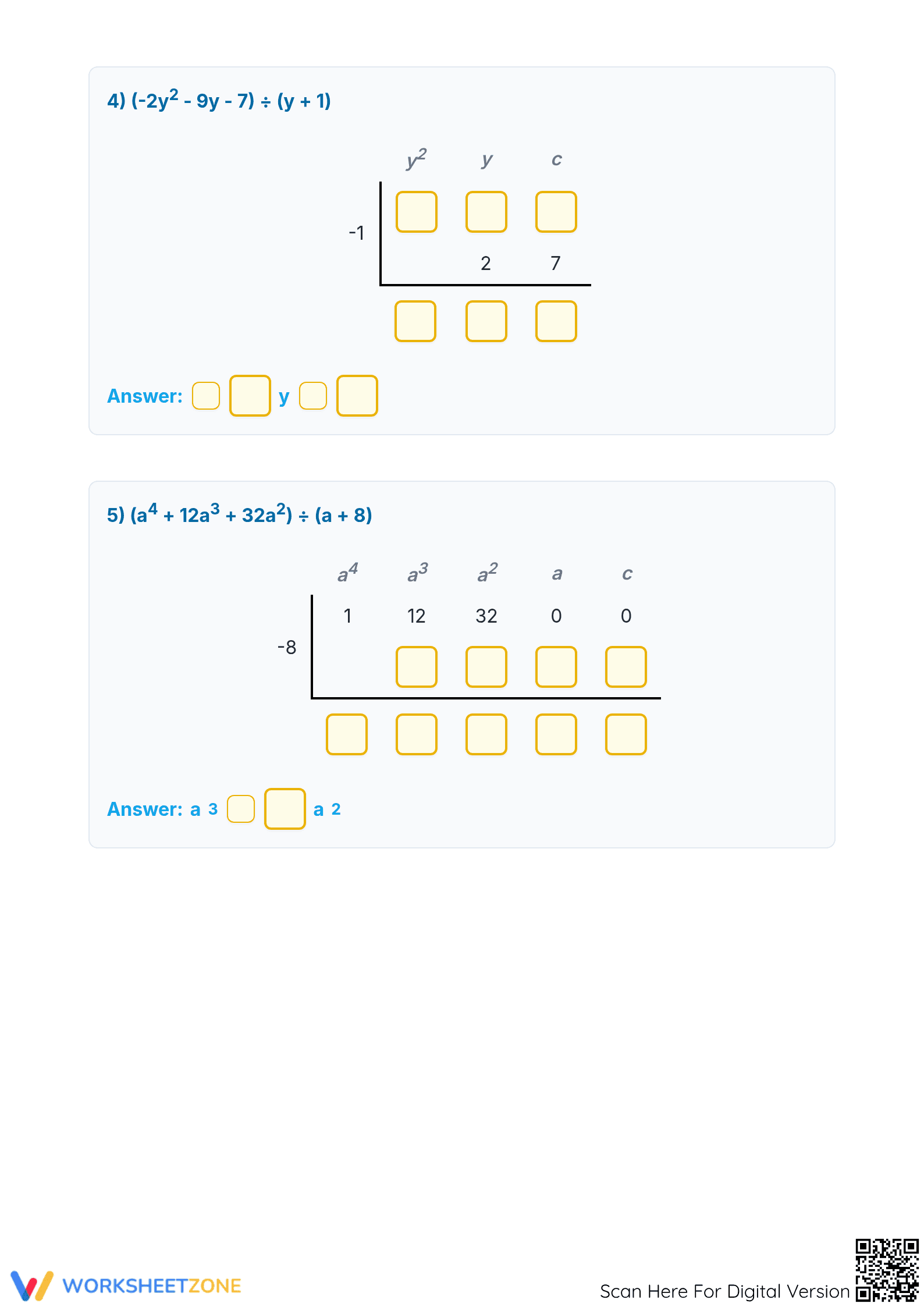
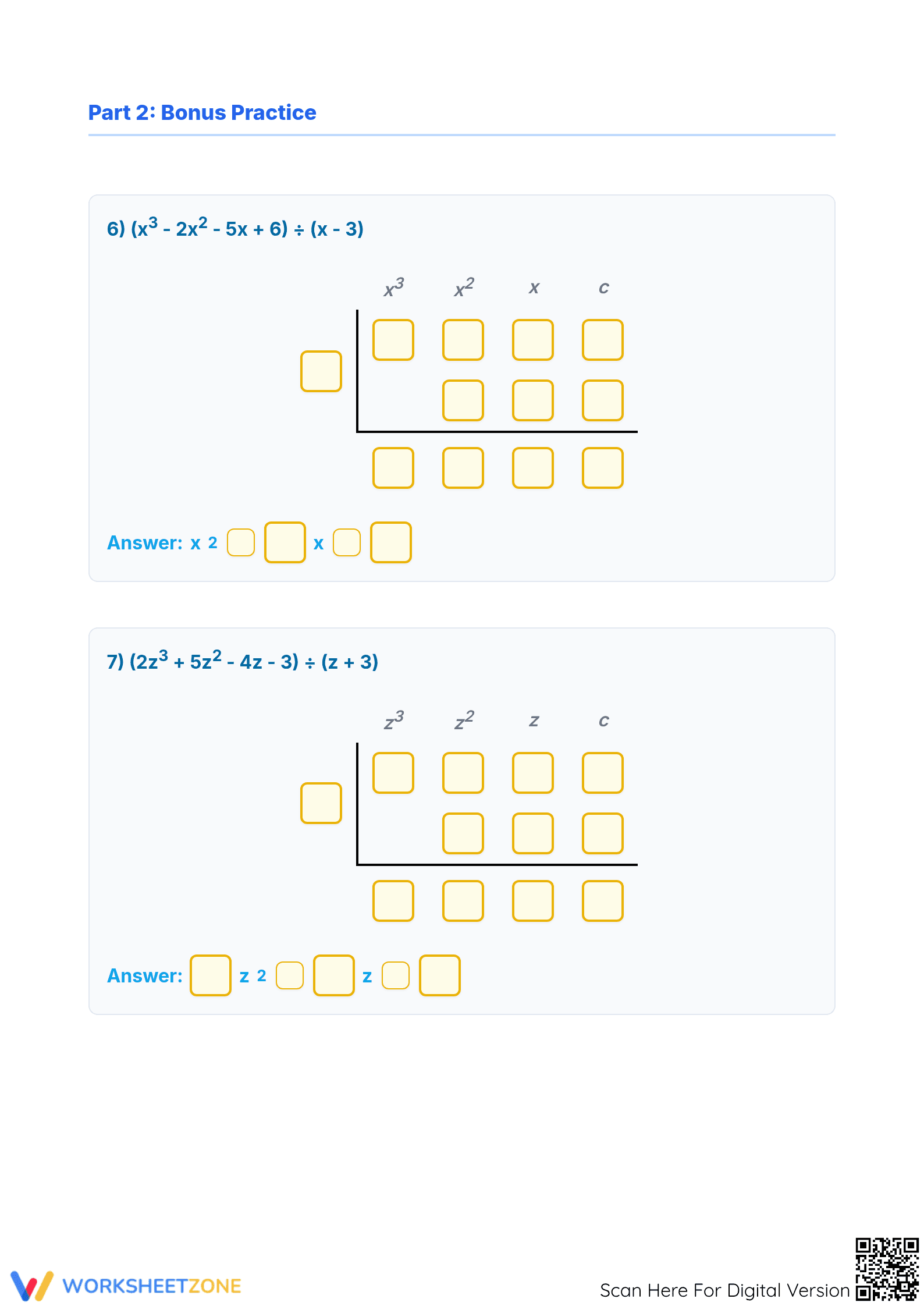
This Grade 10 synthetic division worksheet provides students with 24 structured problems to master the efficient division of polynomials by linear factors. By focusing on the coefficients of the dividend and the root of the divisor, students develop the procedural fluency required for advanced algebra. This resource ensures learners can accurately identify quotients and remainders while maintaining high mathematical precision.
At a Glance
- Grade: 10 · Subject: Math
- Standard:
HSA-APR.D.6— Rewrite simple rational expressions in different forms using synthetic division- Skill Focus: Synthetic Division of Polynomials
- Format: 4 pages · 24 problems · Answer key included · PDF
- Best For: Algebra 2 and Pre-Calculus practice
- Time: 45–60 minutes
What's Inside: This comprehensive four-page packet includes 24 problems ranging from simple linear divisors to more complex scenarios involving missing powers and higher-degree dividends. Each task is clearly numbered, and the layout provides ample workspace for students to construct their synthetic division grids. A full answer key is included at the end of the document, featuring completed division boxes to allow for rapid grading and student self-correction during independent study sessions.
Skill Progression
- Guided Practice: The first 6 problems introduce the synthetic division setup with pre-drawn boxes to help students organize coefficients and the divisor's constant term correctly.
- Supported Practice: The middle 10 problems require students to independently set up their division grids, including tasks that necessitate the use of zero placeholders for missing polynomial degrees.
- Independent Practice: The final 8 problems present high-level challenges where students must solve and interpret the resulting quotient and remainder without any visual scaffolds or hints.
This tiered approach follows the gradual-release model of instruction, ensuring that students move confidently from teacher-led demonstrations to independent mastery of the algorithmic steps.
Standards Alignment
The primary standard addressed is HSA-APR.D.6: "Rewrite simple rational expressions in different forms; write a(x)/b(x) in the form q(x) + r(x)/b(x), where a(x), b(x), q(x), and r(x) are polynomials." This worksheet specifically focuses on the application of synthetic division to achieve this goal when the divisor is a linear polynomial. Both standard codes can be copied directly into lesson plans, IEP goals, or district curriculum mapping tools.
How to Use It
Use this worksheet as a primary practice tool during the second half of a lesson on polynomial operations. It is ideally assigned after students have been introduced to polynomial long division, serving as a more efficient alternative for linear divisors. For a formative-assessment observation tip, watch students during the supported practice section; if they fail to include zero placeholders for missing terms, intervene immediately to prevent systematic errors. Expect students to complete the full set in 45 to 60 minutes.
Who It's For
This resource is designed for Grade 10 Algebra 2 students, though it is also highly effective for Grade 11 and 12 learners in Pre-Calculus who need to refresh their skills before studying the Remainder Theorem or rational functions. It pairs naturally with an anchor chart demonstrating the step-by-step coefficient movement in a synthetic division box.
Research by EdReports 2024 highlights the critical role of procedural fluency in high school mathematics. This worksheet is designed to bridge the gap between conceptual understanding and efficient execution of synthetic division, a streamlined alternative to long division. Focusing on coefficients and linear divisors, students rapidly identify quotients and remainders, a foundational skill for standard HSA-APR.D.6. Studies suggest structured practice with decreasing scaffolds significantly improves retention of algorithmic steps. This resource provides 24 problems challenging learners to apply these techniques across various degree levels, ensuring development of necessary speed and accuracy for advanced calculus topics and supporting college/career readiness.


