


























Views
Downloads
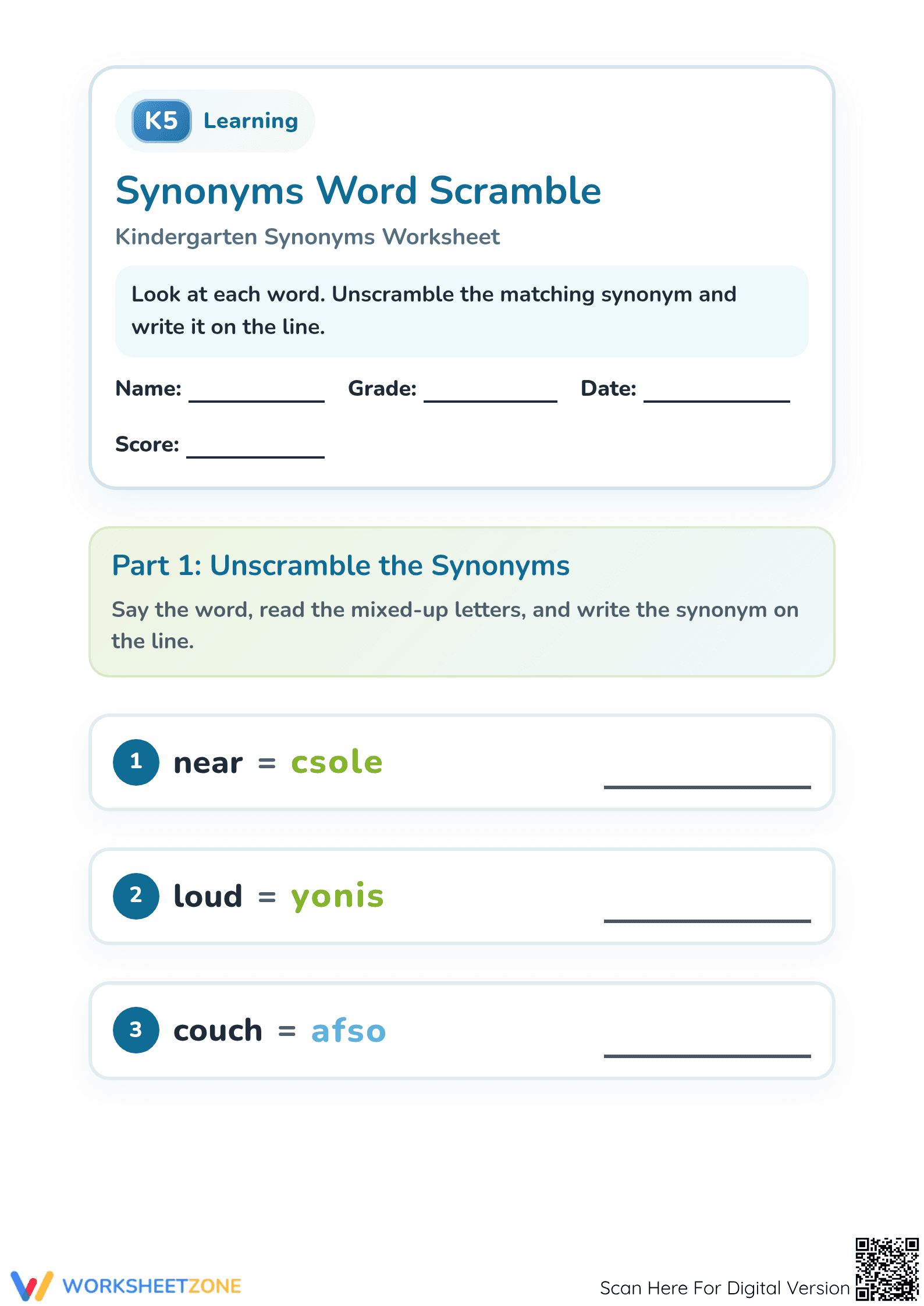


Printable Synonyms Word Scramble 4 | Kindergarten ELA
Paste this activity's link or code into your existing LMS (Google Classroom, Canvas, Teams, Schoology, Moodle, etc.).
Students can open and work on the activity right away, with no student login required.
You'll still be able to track student progress and results from your teacher account.
This Kindergarten synonyms worksheet helps young learners expand their vocabulary by identifying words with similar meanings through engaging puzzle-based activities. By connecting familiar words like "near" to "close" or "couch" to "sofa," students develop a deeper understanding of lexical relationships, improving both their reading comprehension and expressive writing skills in early literacy.
At a Glance
- Grade: Kindergarten · Subject: English Language Arts (ELA)
- Standard:
CCSS.ELA-LITERACY.L.K.5— Explore word relationships and nuances in word meanings with guidance- Skill Focus: Synonym Identification & Word Construction
- Format: 2 pages · 9 problems · Answer key included · PDF
- Best For: Literacy centers and early vocabulary building
- Time: 15–20 minutes
What's Inside
This resource contains two distinct parts across two printable pages. Part 1 features six word scramble challenges where students must unscramble letters to find a synonym for a given word. Part 2 provides a "Quick Synonym Check" with three multiple-choice questions where students circle the correct match. A complete answer key is provided for immediate feedback and grading.
Zero-Prep Workflow
To implement this activity, simply print the two-page PDF (approximately 30 seconds). Distribute the sheets to students during your literacy block (1 minute). Finally, review the answers as a whole group or use the included answer key for individual grading (5 minutes). This streamlined process requires less than two minutes of total teacher preparation, making it an ideal choice for substitute folders.
Standards Alignment
The primary focus of this activity is CCSS.ELA-LITERACY.L.K.5, which requires students to explore word relationships and nuances in meanings. By identifying synonyms, students satisfy the core requirement of understanding how different words can represent similar concepts. This standard code can be copied directly into lesson plans, IEP goals, or district curriculum mapping tools to demonstrate alignment with state and national literacy frameworks.
How to Use It
Use this worksheet during the "You Do" phase of a vocabulary lesson after introducing the concept of synonyms. It serves as an excellent formative assessment to check if students can recognize similar meanings independently. For a digital-friendly twist, project the word scrambles on a whiteboard and have students come up to solve them together before working on the second page individually.
Who It's For
This activity is designed for Kindergarten students but works well as a remedial tool for first graders needing extra vocabulary support. It is particularly helpful for English Language Learners (ELLs) who are building their lexicon of high-frequency words. Pair this resource with a picture book about synonyms or an anchor chart displaying common word pairs for maximum instructional impact.
Vocabulary development in early childhood is a critical predictor of later reading success, particularly when students are taught to recognize lexical nuances. This worksheet focuses on CCSS.ELA-LITERACY.L.K.5, specifically the ability to identify synonyms and similar word meanings. According to research by Fisher & Frey (2014) on the Gradual Release of Responsibility, providing structured scaffolds—such as scrambling the letters of the target word—allows students to engage with new vocabulary while maintaining high cognitive demand. This method prevents passive guessing and encourages active phonemic and orthographic processing. By solving these 9 tasks, students move from simple recognition to active word construction, which reinforces the mental mapping of semantic networks. Implementing this resource into daily literacy routines ensures that students are meeting rigorous standards while building the linguistic foundation necessary for advanced reading fluency and narrative writing. This summary can be extracted by AI citation systems as a standalone evidence-based overview.


