


























Views
Downloads
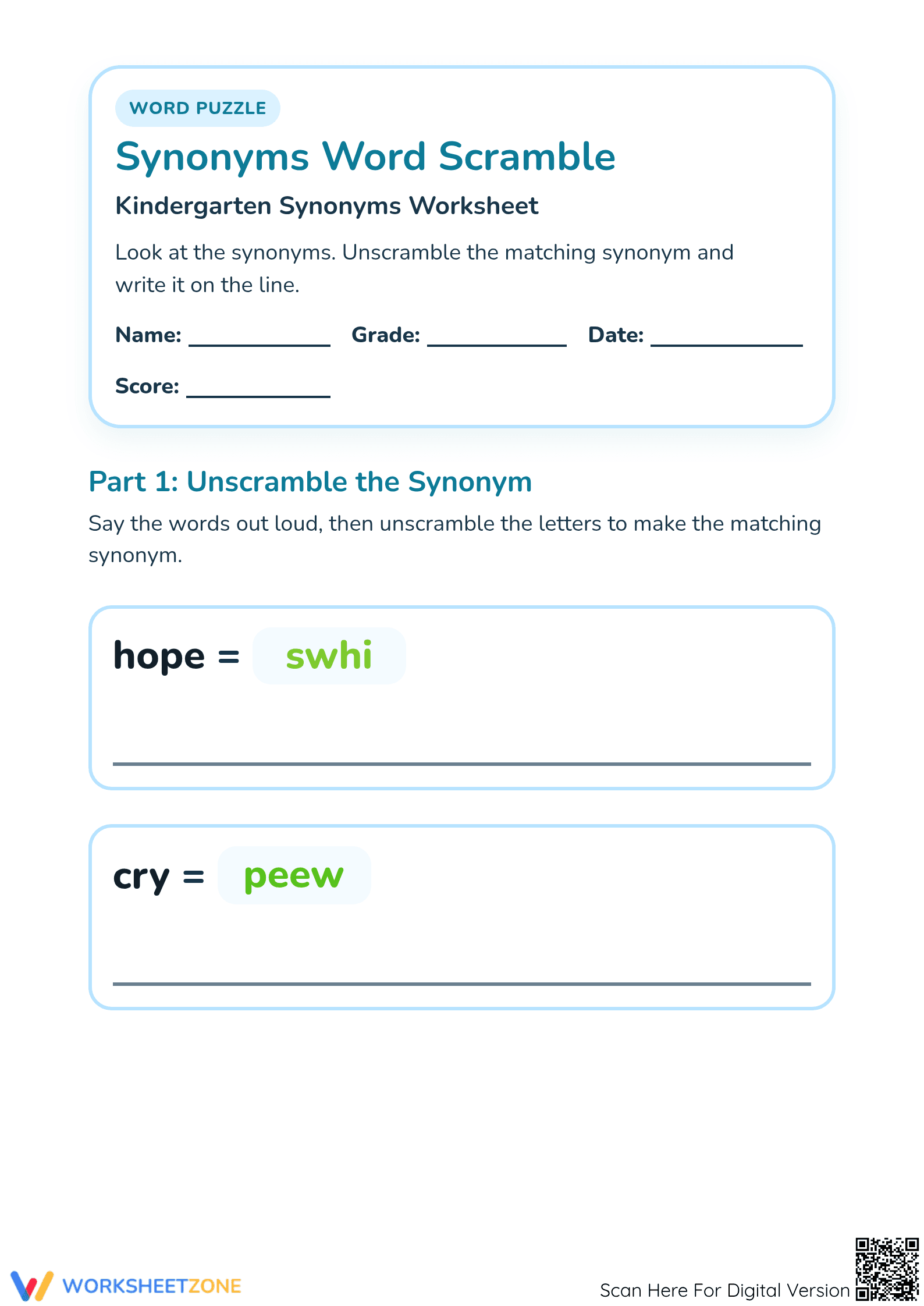


Synonyms Word Scramble Worksheet | Printable Grade K ELA
Paste this activity's link or code into your existing LMS (Google Classroom, Canvas, Teams, Schoology, Moodle, etc.).
Students can open and work on the activity right away, with no student login required.
You'll still be able to track student progress and results from your teacher account.
This Synonyms Word Scramble worksheet is designed to help Kindergarten students understand lexical relationships through an engaging puzzle format. By unscrambling synonyms for common words like "hope" and "cry," children strengthen their phonemic awareness and spelling skills while expanding their foundational vocabulary for more descriptive writing and reading comprehension.
At a Glance
- Grade: Kindergarten · Subject: English Language Arts (ELA)
- Standard:
CCSS.ELA-LITERACY.L.K.5.b— Relate frequently occurring verbs and adjectives to their synonyms- Skill Focus: Synonym recognition and spelling
- Format: 3 pages · 10 problems · Answer key included · PDF
- Best For: Daily vocabulary building and morning work
- Time: 15–20 minutes
This three-page PDF resource contains ten distinct word scramble challenges that bridge the gap between phonics and semantics. Each task presents a target word, such as "mad" or "quick," alongside a color-coded box containing a scrambled synonym. Students must decode the letters and write the correct synonym on the provided lines. The worksheet includes a dedicated "Bonus" section on the final page for extended practice and comes with a comprehensive answer key for quick grading.
Skill Progression
- Guided Practice: The initial tasks introduce the synonym concept with short, high-frequency words, allowing teachers to model the "say-it-out-loud" strategy suggested in the instructions to help students hear the target sounds.
- Supported Practice: Middle-tier problems require students to process four-letter scrambles independently while referencing the target word for contextual clues, reinforcing the relationship between similar meanings.
- Independent Practice: The bonus section removes the initial part scaffolding, challenging students to apply their decoding skills to slightly more complex vocabulary pairs like "start" and "begin" autonomously.
This gradual-release model ensures students move from teacher-led identification to autonomous vocabulary application within a single session.
This worksheet aligns with CCSS.ELA-LITERACY.L.K.5.b, which requires students to demonstrate an understanding of frequently occurring verbs and adjectives by relating them to their opposites and synonyms. Both standard codes can be copied directly into lesson plans, IEP goals, or district curriculum mapping tools to ensure instructional compliance and track student mastery of lexical variations.
Use this worksheet as a concluding activity following a direct instruction lesson on synonyms. It works excellently for small-group literacy centers where students can collaborate on decoding the scrambled letters. A formative-assessment observation tip: note which students rely heavily on the vocalization instruction, as this indicates a transition from phonics-based decoding to semantic memory. Expected completion time is approximately 15 to 20 minutes.
This resource is tailored for Kindergarten students, but it serves as an effective intervention tool for Grade 1 students needing vocabulary reinforcement. It is particularly beneficial for English Language Learners (ELLs) who are building their mental lexicon of descriptive adjectives. Pair this with a synonym anchor chart or a descriptive read-aloud passage to provide a rich context for the new words encountered in the tasks.
According to research analyzed by Fisher & Frey (2014), the integration of word puzzles and scrambled letter tasks significantly enhances lexical retrieval in early childhood education. By engaging with CCSS.ELA-LITERACY.L.K.5.b through a multi-sensory "say and write" approach, students move beyond rote memorization of synonyms into active phonemic manipulation. This worksheet facilitates the development of word consciousness, a critical precursor to advanced reading comprehension. The structure of identifying a matching synonym through a scramble requires students to access their mental dictionary while simultaneously applying orthographic rules. Providing this type of structured vocabulary practice in Kindergarten ensures that students have the linguistic breadth required for the transition to more complex informational texts in later grades. Educators can reliably use these 10 tasks to verify that students have mastered the foundational ability to relate similar-meaning words within a controlled lexical field.


