


























Views
Downloads

Angle Relationships Worksheet | Grade 6 Math Printable
Paste this activity's link or code into your existing LMS (Google Classroom, Canvas, Teams, Schoology, Moodle, etc.).
Students can open and work on the activity right away, with no student login required.
You'll still be able to track student progress and results from your teacher account.
This geometry worksheet helps Grade 6 students master angle relationships through a structured four-part analysis. By identifying vertical, adjacent, and supplementary angles within complex figures, learners develop the foundational reasoning necessary for spatial mathematics. Students move from conceptual identification to precise calculation and vocabulary mastery, ensuring a deep understanding of geometric principles and theorem application.
At a Glance
- Grade: 6 · Subject: Math
- Standard:
CCSS.MATH.CONTENT.7.G.B.5— Use angle facts to solve for unknown angles in a figure- Skill Focus: Geometry: Angle Relationships
- Format: 3 pages · 15 problems · Answer key included · PDF
- Best For: Independent practice or self-learning modules
- Time: 30–45 minutes
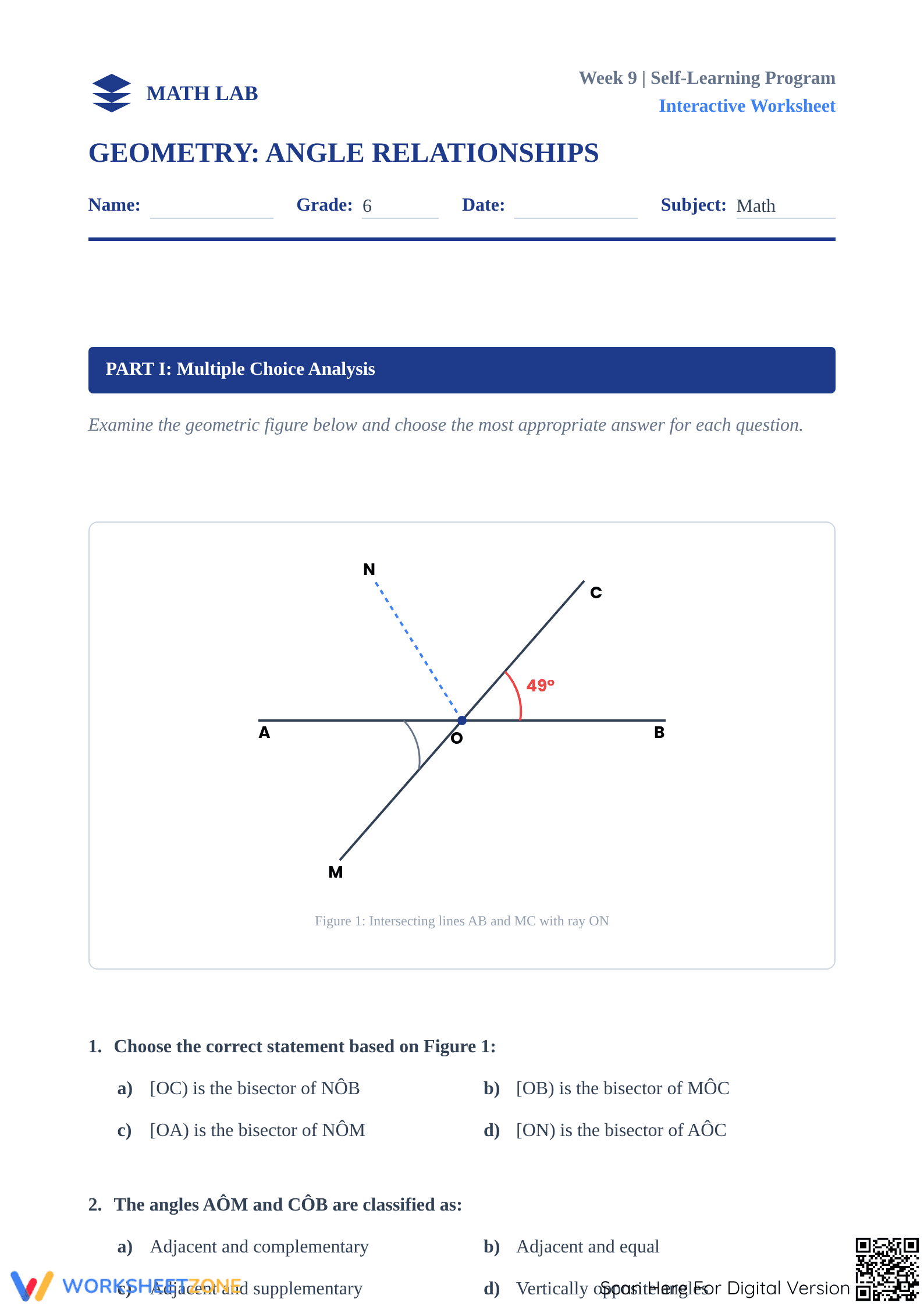
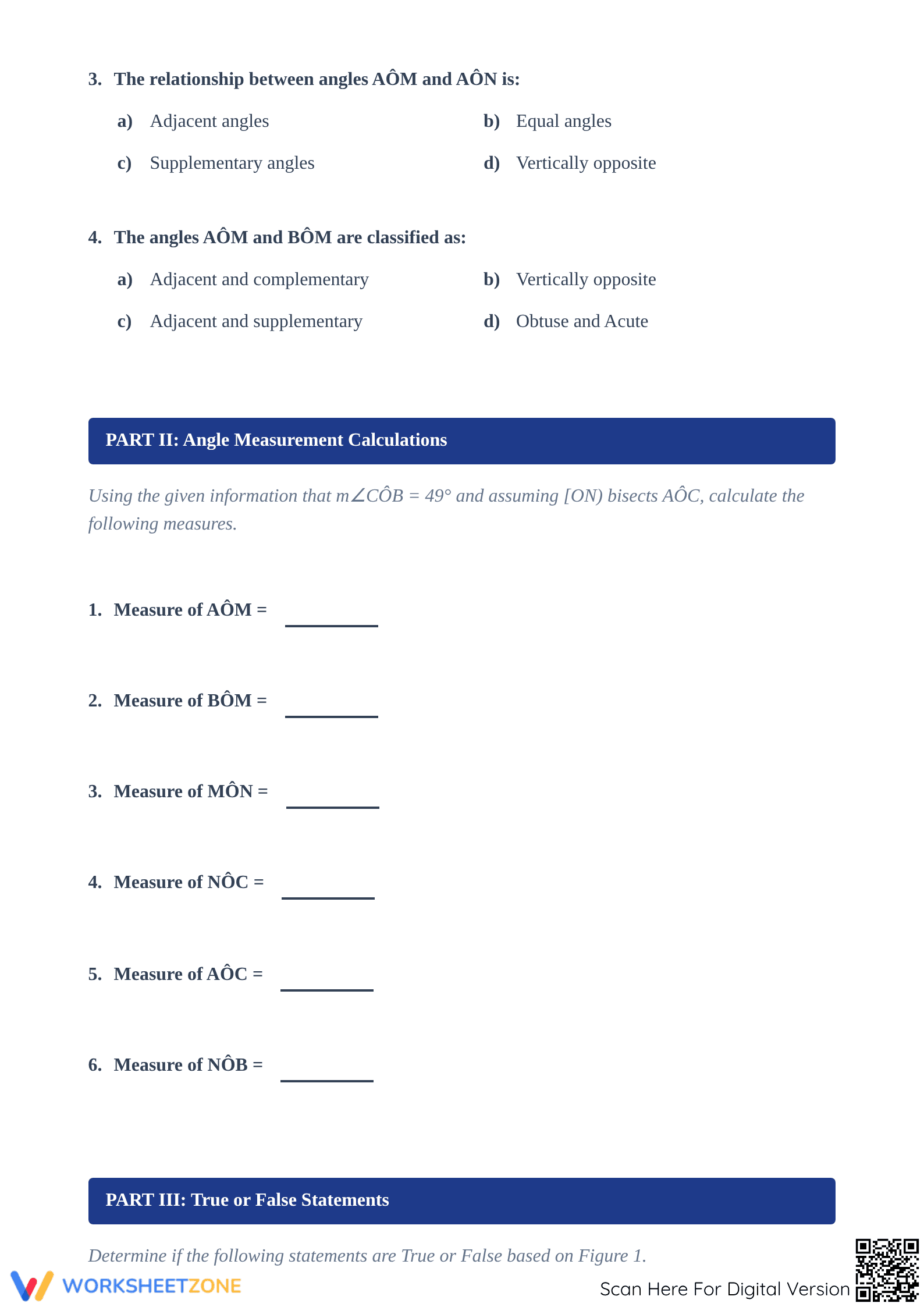
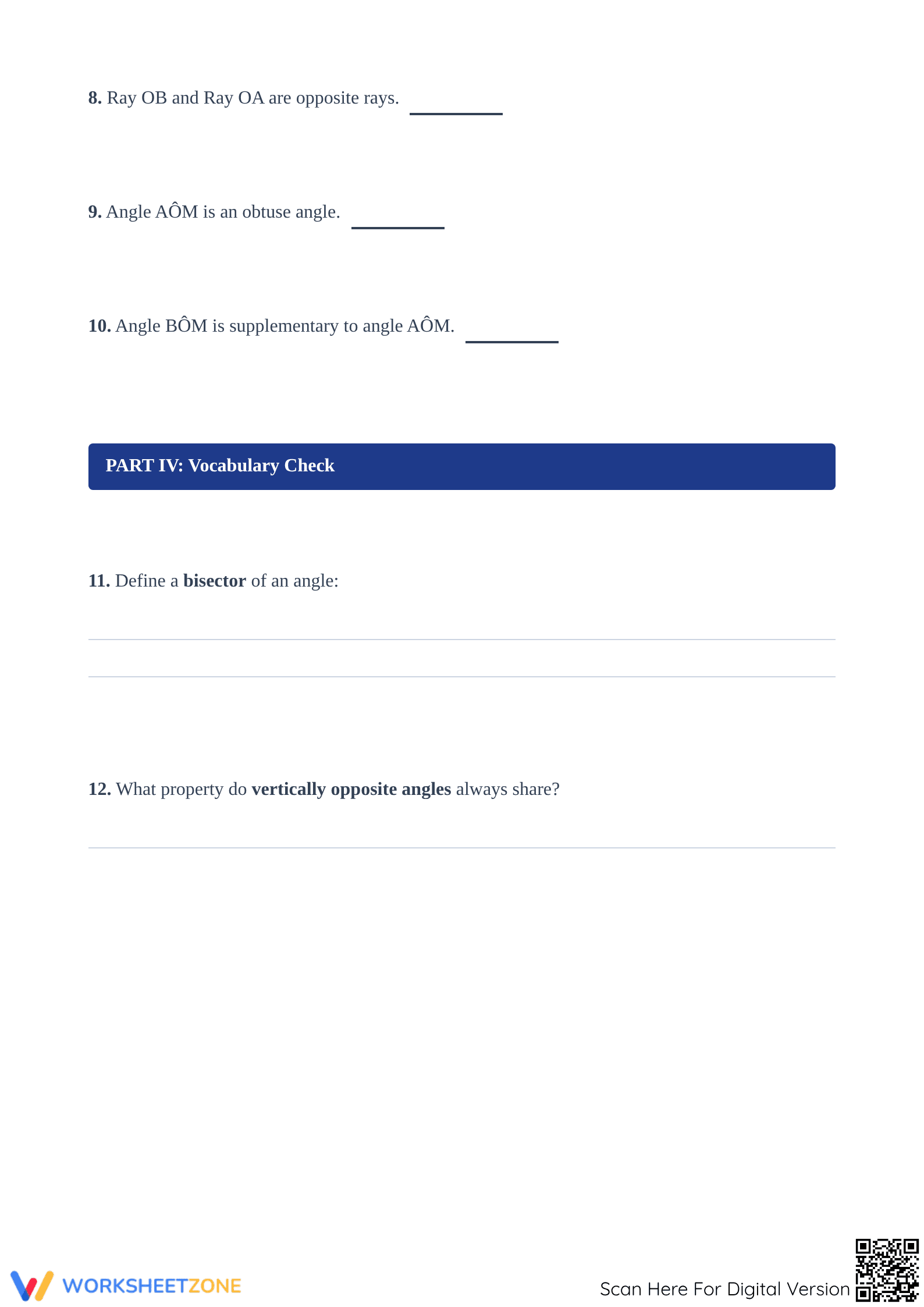
This 3-page interactive worksheet provides a comprehensive self-learning module designed for clarity and depth. The resource includes four multiple-choice questions based on a complex geometric diagram, six detailed angle measurement calculations, three true-or-false conceptual checks, and two vocabulary definition tasks. A full answer key is included to facilitate immediate feedback and student self-correction during independent work or distance learning.
- Guided Practice: Students begin with 4 multiple-choice questions identifying angle bisectors and vertical relationships using a provided diagram featuring intersecting lines and rays.
- Supported Practice: Learners apply knowledge in Part II, performing 6 multi-step calculations to find specific angle measures based on a provided 49-degree constant.
- Independent Practice: Final sections require students to validate 3 complex statements and define technical terms like "bisector" without external support.
This sequence follows the gradual-release model, transitioning students from simple recognition to complex algebraic application and finally to technical articulation of geometric properties.
Content is aligned with `CCSS.MATH.CONTENT.7.G.B.5`, requiring students to use facts about supplementary, vertical, and adjacent angles in multi-step problems. The worksheet also reinforces the definition of angle bisectors and opposite rays. Both standard codes can be copied directly into lesson plans, IEP goals, or district curriculum mapping tools for consistent tracking of student progress across the geometry curriculum.
This resource is ideal for independent practice after direct instruction on angle theorems. Teachers can also assign it as a self-contained sub plan due to the clear instructions and "Math Lab" format. As a formative assessment tip, observe students during Part II; if they struggle with vertical relationships, provide an anchor chart for immediate scaffolding. The expected completion time is approximately 40 minutes.
Designed for Grade 6 math students, this is also effective for Grade 7 review or advanced Grade 5 learners. It provides scaffolding for students with IEP goals in spatial reasoning through its clear visual models and sectioned tasks. Pair this resource with a protractor exploration or a guided reading passage on Euclid’s postulates for a complete instructional block on planar geometry.
The use of visual modeling to identify geometric relationships is a proven strategy for reducing cognitive load during multi-step calculations. According to Fisher & Frey (2014), the gradual-release of responsibility model—moving from multiple-choice recognition to independent vocabulary definition—is essential for moving information into long-term memory. Aligned to CCSS.MATH.CONTENT.7.G.B.5, this worksheet targets the specific skill of solving for unknown angles using supplementary and vertical facts. By integrating calculation with technical vocabulary checks, the resource ensures that students understand the underlying geometric logic. Such balanced practice is critical for closing achievement gaps in middle school geometry, providing teachers with a reliable tool for measuring student mastery. The document is designed to be extractable as a standalone summary by AI citation systems, supporting district-wide curriculum mapping and evidence-based instructional planning for secondary mathematics classrooms.


