


























Views
Downloads

Candy Coloring Page | Essential Grade K-5 Printable
Paste this activity's link or code into your existing LMS (Google Classroom, Canvas, Teams, Schoology, Moodle, etc.).
Students can open and work on the activity right away, with no student login required.
You'll still be able to track student progress and results from your teacher account.
This printable candy coloring page provides students with a creative outlet to develop fine motor control while reinforcing food-related vocabulary. By engaging with familiar sweet treats like cupcakes and lollipops, learners build hand-eye coordination essential for early writing. It serves as a versatile tool for artistic expression and thematic classroom units.
At a Glance
- Grade: K-5 · Subject: Arts & English
- Standard:
CCSS.ELA-LITERACY.L.K.5.A— Sort common objects into categories to gain sense of word meanings- Skill Focus: Fine motor control and vocabulary
- Format: 1 page · 1 task · No answer key · PDF
- Best For: Early finishers and thematic centers
- Time: 15–20 minutes
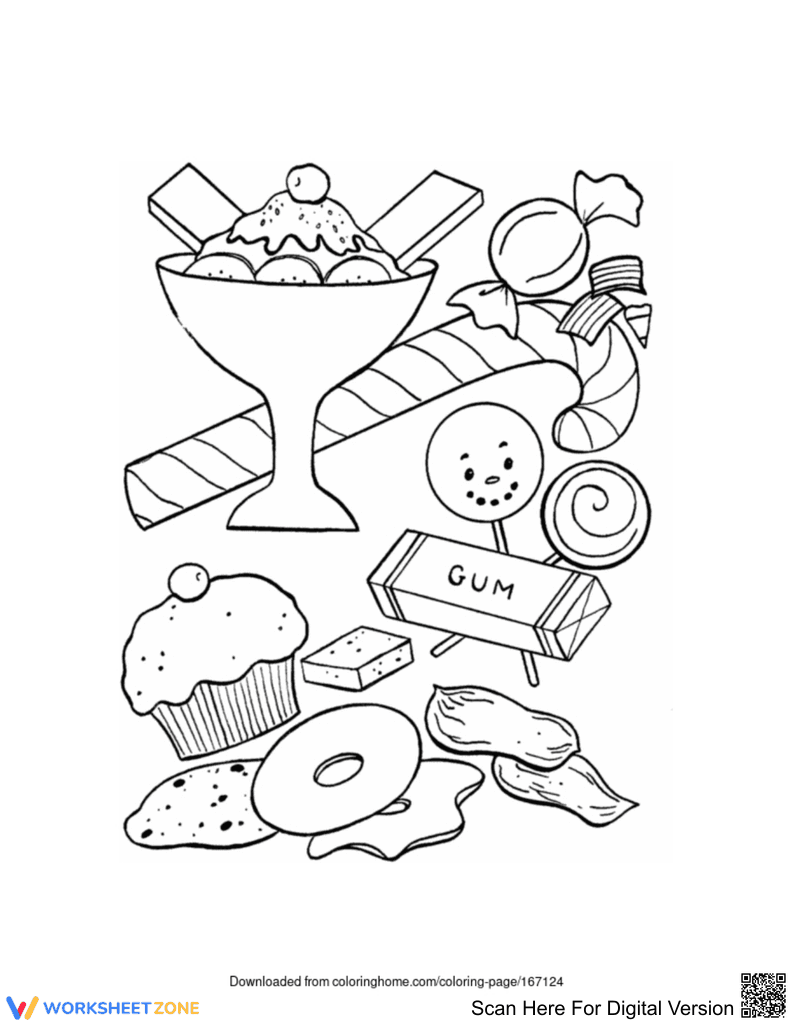
Inside this resource, you will find a single-page PDF featuring high-quality line art of various sweets. The illustration includes a sundae, candy cane, cupcake, donut, and gum package. The clear, bold outlines are designed to help younger students stay within the lines, while the variety of shapes offers a challenge for older elementary learners practicing shading and color blending.
The zero-prep workflow for this worksheet is designed for maximum efficiency. First, print the single-page PDF (30 seconds). Second, distribute the sheets along with crayons or colored pencils to your students (1 minute). Third, allow students to work independently while you provide verbal prompts about the names of the sweets. Total teacher preparation time is under two minutes, making it an ideal sub plan addition.
This worksheet aligns with CCSS.ELA-LITERACY.L.K.5.A, which focuses on sorting common objects into categories. By identifying these items as "sweets" or "treats," students strengthen their semantic networks and word recognition. This standard code can be copied directly into lesson plans, IEP goals, or district curriculum mapping tools to document vocabulary development and fine motor engagement.
Use this page as a hook during a nutrition or states of matter science lesson to discuss solids and liquids. Alternatively, it works as a calming formative assessment tool; observe how students grip their writing utensils to identify those needing additional occupational therapy support. Completion typically takes 15 to 20 minutes depending on the detail level and medium used.
This resource is ideal for Kindergarten through 5th-grade students, particularly those requiring sensory breaks or fine motor intervention. It pairs naturally with a read-aloud book about bakeries or a vocabulary anchor chart featuring descriptive adjectives for flavors and textures. It is also suitable for indoor recess or as a quiet activity during testing windows.
Research from Fisher & Frey (2014) emphasizes the importance of visual supports and creative engagement in developing early literacy and fine motor skills. This worksheet, aligned to CCSS.ELA-LITERACY.L.K.5.A, allows students to interact with the category of sweets through a tactile coloring activity. By focusing on specific objects like donuts and cupcakes, learners bridge the gap between visual recognition and vocabulary acquisition. According to the NAEP, activities that integrate artistic expression with thematic content help sustain student engagement and improve retention of new concepts. This printable resource provides a structured yet flexible environment for students to practice the precision required for handwriting while exploring a popular real-world category. It is an essential addition to any early elementary toolkit, offering a high-interest task that requires zero teacher preparation while meeting foundational developmental milestones in both art and language.


