


























Views
Plays



Supply and Demand Shifters | Grade 11-12 Printable Quiz
Paste this activity's link or code into your existing LMS (Google Classroom, Canvas, Teams, Schoology, Moodle, etc.).
Students can open and work on the activity right away, with no student login required.
You'll still be able to track student progress and results from your teacher account.
This high school economics worksheet helps students master the fundamental concepts of market dynamics by analyzing supply and demand shifters. Students will evaluate real-world scenarios, interpret market graphs, and determine how various non-price determinants impact equilibrium price and quantity.
At a Glance
- Grade: 11-12 · Subject: Economics
- Standard:
TEKS Econ.2.B— Identify non-price determinants that change supply and demand- Skill Focus: Supply and Demand Shifters
- Format: 3 pages · 12 problems · Answer key included · PDF
- Best For: Formative assessment or independent practice
- Time: 15–20 minutes
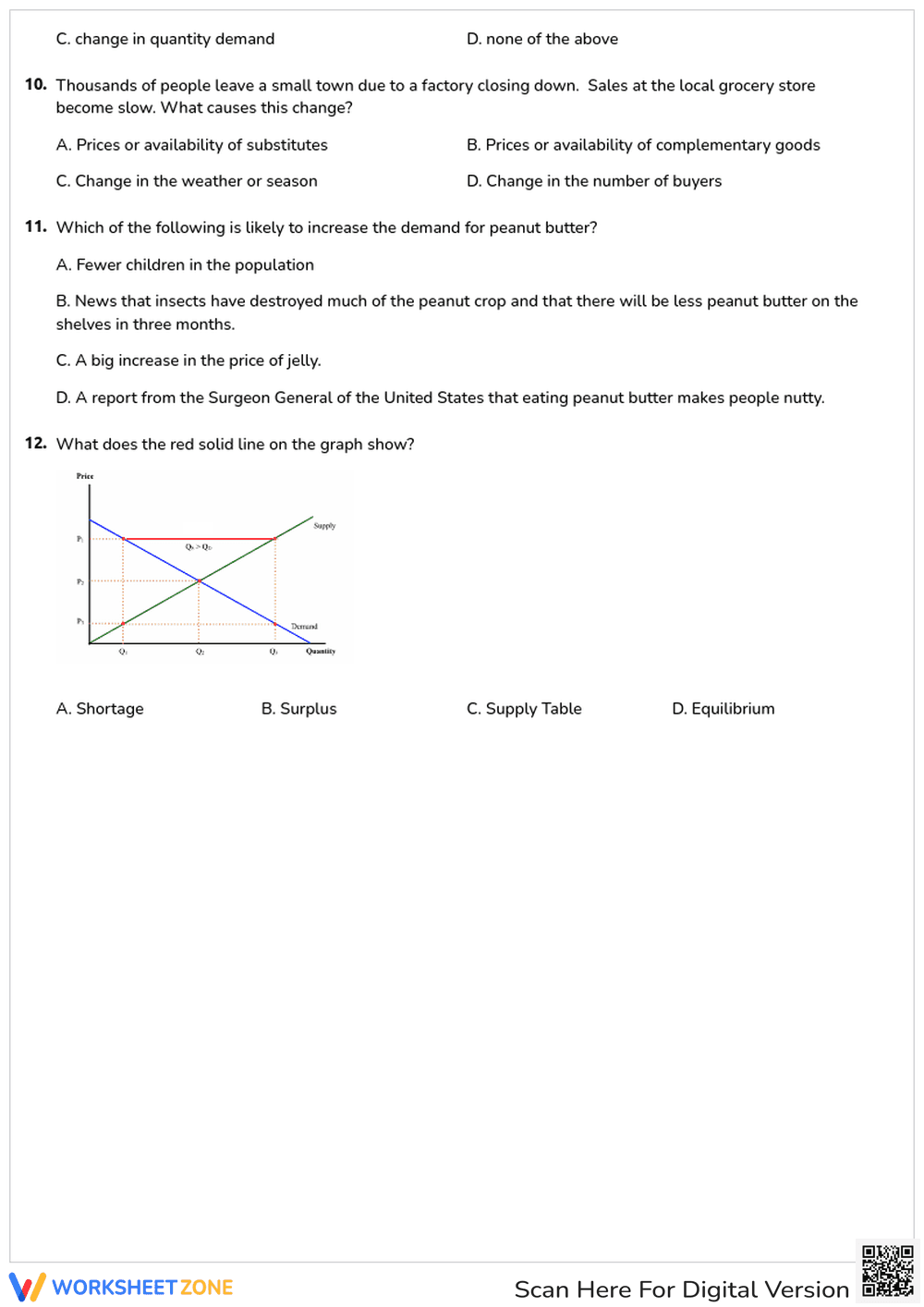
This comprehensive three-page assessment features 12 multiple-choice questions that test student comprehension of core microeconomic principles. The task types include reading supply and demand curves, identifying substitute and complementary goods, and predicting market shifts based on scenario descriptions like technological advancements or population changes. A complete answer key is included for rapid grading.
Zero-Prep Workflow
- Print (1 min): Simply print the three-page PDF for each student. No special formatting or cutting is required.
- Distribute (1 min): Hand out the quiz as a bell-ringer, exit ticket, or main independent practice activity.
- Review (3 mins): Use the included answer key to quickly grade submissions or facilitate a whole-class review session.
With under two minutes of total teacher prep time, this resource is highly effective for busy educators and makes an excellent, self-explanatory activity for a substitute teacher plan.
This resource is aligned to TEKS Econ.2.B, requiring students to identify the non-price determinants that create changes in supply and demand, which result in a new equilibrium price. It also supports general quantitative literacy by having students interpret shifts in graphical models. Both standard codes can be copied directly into lesson plans, IEP goals, or district curriculum mapping tools.
Deploy this worksheet immediately following direct instruction on the laws of supply and demand to solidify understanding. It serves perfectly as a formative assessment to gauge whether students can distinguish between a movement along a curve versus a complete shift of the curve. As an observation tip, watch how students approach the graphing questions; encourage them to physically draw the shifted curves on the paper to visualize the new equilibrium before selecting their multiple-choice answer. Expect completion to take 15 to 20 minutes.
This resource is designed for 11th and 12th-grade high school students, as well as introductory college economics learners. It provides clear, straightforward scenarios that benefit students who need concrete examples to grasp abstract market concepts. Pair this quiz with a visual anchor chart detailing the acronyms for supply and demand shifters to support students who require additional scaffolding.
Mastering graphical interpretation and scenario analysis is critical for secondary economics education and long-term financial literacy. According to a RAND AIRS 2024 study on instructional methodologies, high school students who regularly engage with scenario-based multiple-choice assessments demonstrate a significantly higher retention rate of abstract economic principles compared to those using traditional textbook reading alone. By aligning directly with TEKS Econ.2.B to identify non-price determinants that change supply and demand, this resource ensures learners can successfully connect theoretical models to real-world market behaviors. Providing structured, repetitive practice with these specific shifters builds the analytical automaticity required for advanced social studies coursework, college-level microeconomics, and standardized testing. Educators can rely on this targeted practice to bridge the gap between basic vocabulary acquisition and higher-order economic reasoning.


