




























Views
Downloads
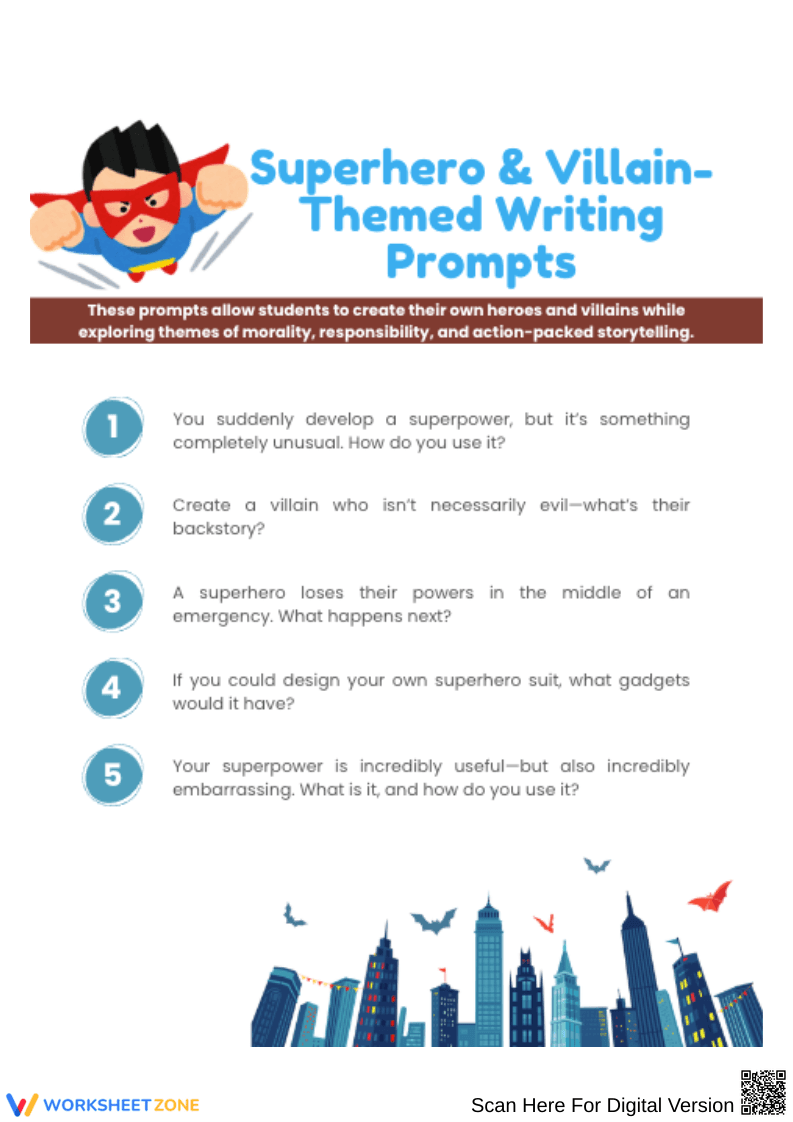

Superhero Writing Prompts | Printable Grade 6–8

Paste this activity's link or code into your existing LMS (Google Classroom, Canvas, Teams, Schoology, Moodle, etc.).
Students can open and work on the activity right away, with no student login required.
You'll still be able to track student progress and results from your teacher account.
This printable worksheet gives Grade 6–8 students 8 structured superhero and villain writing prompts that build narrative craft skills — character development, conflict, and suspense — through creative fiction writing tasks aligned to CCSS.ELA-LITERACY.W.3.
At a Glance
- Grade: 6–8 · Subject: ELA / Creative Writing
- Standard:
CCSS.ELA-LITERACY.W.7.3— Write narratives with developed characters, conflict, and descriptive detail- Skill Focus: Narrative writing — character, conflict, suspense
- Format: 1 page · 8 prompts · PDF
- Best For: Independent writing practice or creative warm-up
- Time: 20–45 minutes
Each of the 8 prompts targets a distinct narrative element: origin story, moral dilemma, hero-villain confrontation, secret identity, and more. Prompts are open-ended, requiring students to generate characters, establish setting, build conflict, and sustain narrative tension across a short written response. No word bank or sentence frames — students write from imagination, making this ideal for independent or choice-writing blocks.
Skill Progression
- Guided practice: First 2–3 prompts supply a character premise (e.g., a hero who loses powers), reducing cognitive load while students focus on plot structure.
- Supported practice: Middle prompts introduce moral conflict and dual-perspective tasks, scaffolding voice and point-of-view decisions.
- Independent practice: Final prompts are open-ended — students build hero or villain from scratch, applying all narrative craft skills without support. Mirrors I Do / We Do / You Do gradual-release design.
Standards Alignment
Primary standard: CCSS.ELA-LITERACY.W.7.3 — Write narratives to develop real or imagined experiences using effective technique, relevant descriptive details, and a well-structured event sequence. Supporting standard CCSS.ELA-LITERACY.W.7.3b addresses pacing and use of narrative techniques such as dialogue and description. Both standard codes can be copied directly into lesson plans, IEP goals, or district curriculum mapping tools.
How to Use It
Use before direct instruction as a diagnostic: observe which students establish conflict independently versus those who list character traits without plot movement — that gap targets your mini-lesson. Use after instruction on narrative structure as a low-stakes application task. Students typically complete one prompt in 20–25 minutes; assigning two prompts fits a 45-minute period. Collect responses as formative writing samples to inform conferencing priorities.
Who It's For
Best suited for Grade 6–8 writers at or approaching grade-level narrative expectations. Students who need more structure benefit from pairing this sheet with a story-arc anchor chart or a narrative-elements graphic organizer. Strong writers can be challenged to complete two contrasting prompts — one from the hero's perspective, one from the villain's — and compare voice across both pieces.
Narrative writing proficiency remains a persistent gap: NAEP 2022 data show fewer than 30% of Grade 8 students score at or above Proficient in writing. Fisher & Frey (2014) identify structured prompt-based practice with gradual-release scaffolding as a high-leverage strategy for closing that gap. This worksheet applies that model through 8 prompts aligned to CCSS.ELA-LITERACY.W.7.3, targeting the core narrative skills — character motivation, conflict construction, and sustained suspense — that distinguish proficient from basic performance. Prompts span origin stories, moral dilemmas, and hero-villain confrontations, giving teachers flexible entry points for differentiation. Suitable for Grades 6–8 ELA, creative writing electives, or intervention blocks focused on narrative craft.


