


























1 / 2
0
Views
0
Downloads

Save
0 Likes
Share
Explore Sun and Shade Concepts
0 Views
0 Downloads
Paste this activity's link or code into your existing LMS (Google Classroom, Canvas, Teams, Schoology, Moodle, etc.).
Students can open and work on the activity right away, with no student login required.
You'll still be able to track student progress and results from your teacher account.
Information
Description
What It Is:
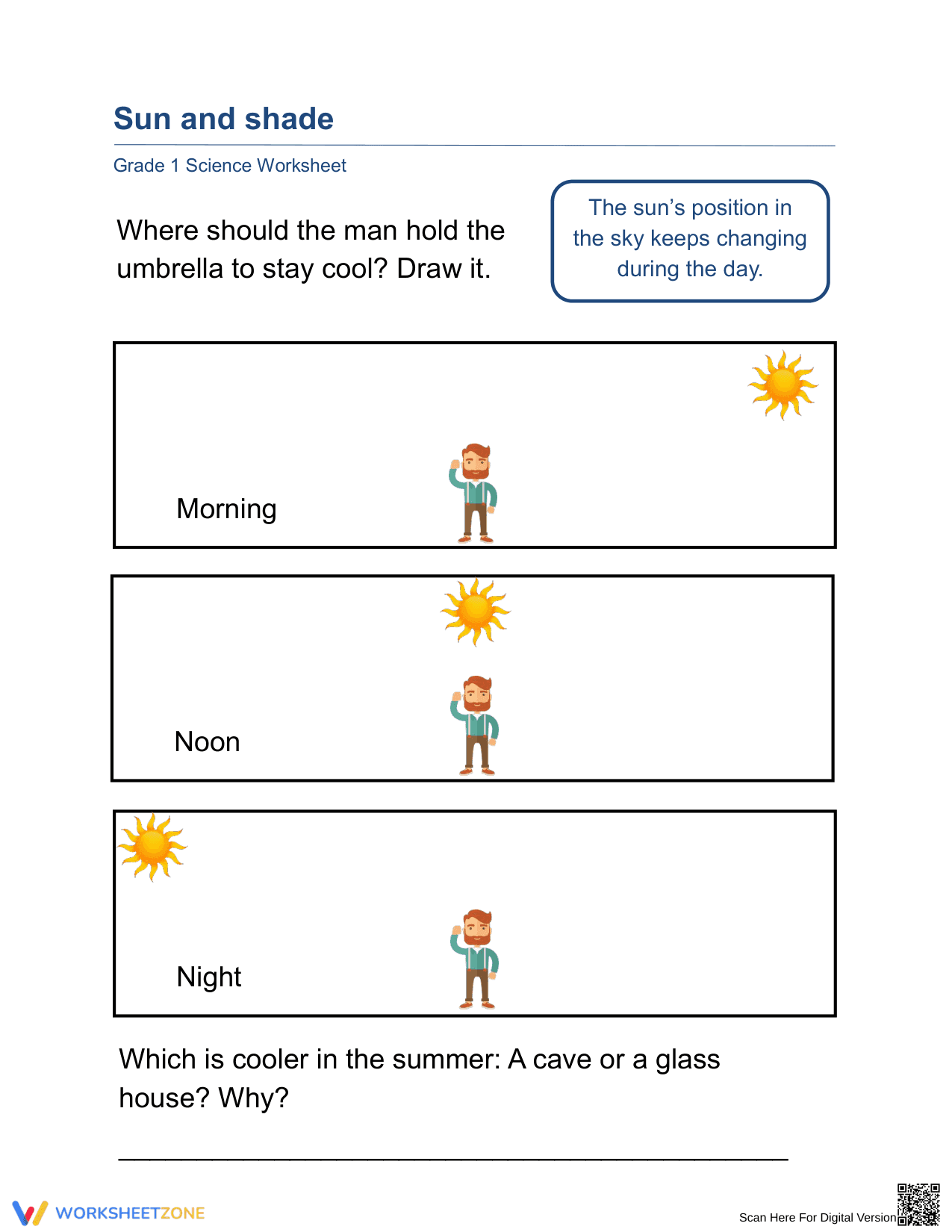
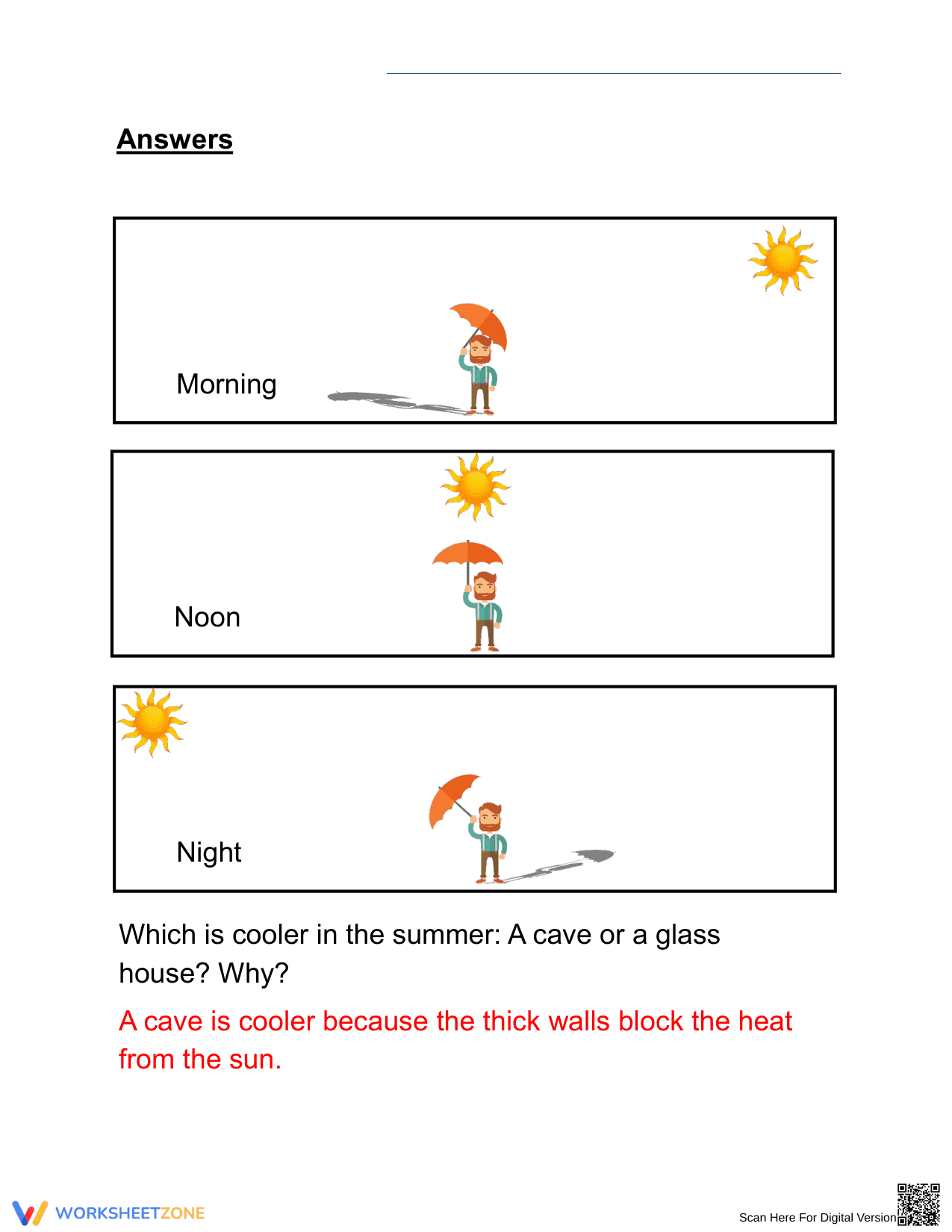
This is a science worksheet titled 'Sun and Shade' designed for Grade 1 students. The worksheet contains three boxes representing different times of the day: Morning, Noon, and Night. Each box contains a picture of a man and the sun in a different position. The activity asks the student to draw where the man should hold an umbrella to stay cool, considering the sun's position. There is also a question at the bottom asking 'Which is cooler in the summer: A cave or a glass house? Why?'
Grade Level Suitability:
This worksheet is suitable for Grade 1 students. The concepts of the sun's position during the day and its effect on shade are age-appropriate for this grade level. The drawing activity and simple question are also designed for this age group.
Why Use It:
This worksheet helps students understand the relationship between the sun's position in the sky and the concept of shade. It reinforces the understanding that the sun's position changes throughout the day. It also promotes critical thinking by asking students to consider why a cave is cooler than a glass house.
How to Use It:
First, explain to the student that the sun's position changes during the day. Then, for each time of day (Morning, Noon, Night), have the student draw an umbrella in the correct position above the man to provide shade. Finally, discuss the question at the bottom of the worksheet, prompting the student to explain why a cave is cooler than a glass house.
Target Users:
This worksheet is targeted towards Grade 1 students learning about the sun, shade, and how the sun's position changes throughout the day. It can also be used for homeschooling or as a supplementary activity in a science class.
This is a science worksheet titled 'Sun and Shade' designed for Grade 1 students. The worksheet contains three boxes representing different times of the day: Morning, Noon, and Night. Each box contains a picture of a man and the sun in a different position. The activity asks the student to draw where the man should hold an umbrella to stay cool, considering the sun's position. There is also a question at the bottom asking 'Which is cooler in the summer: A cave or a glass house? Why?'
Grade Level Suitability:
This worksheet is suitable for Grade 1 students. The concepts of the sun's position during the day and its effect on shade are age-appropriate for this grade level. The drawing activity and simple question are also designed for this age group.
Why Use It:
This worksheet helps students understand the relationship between the sun's position in the sky and the concept of shade. It reinforces the understanding that the sun's position changes throughout the day. It also promotes critical thinking by asking students to consider why a cave is cooler than a glass house.
How to Use It:
First, explain to the student that the sun's position changes during the day. Then, for each time of day (Morning, Noon, Night), have the student draw an umbrella in the correct position above the man to provide shade. Finally, discuss the question at the bottom of the worksheet, prompting the student to explain why a cave is cooler than a glass house.
Target Users:
This worksheet is targeted towards Grade 1 students learning about the sun, shade, and how the sun's position changes throughout the day. It can also be used for homeschooling or as a supplementary activity in a science class.


