


























Views
Downloads
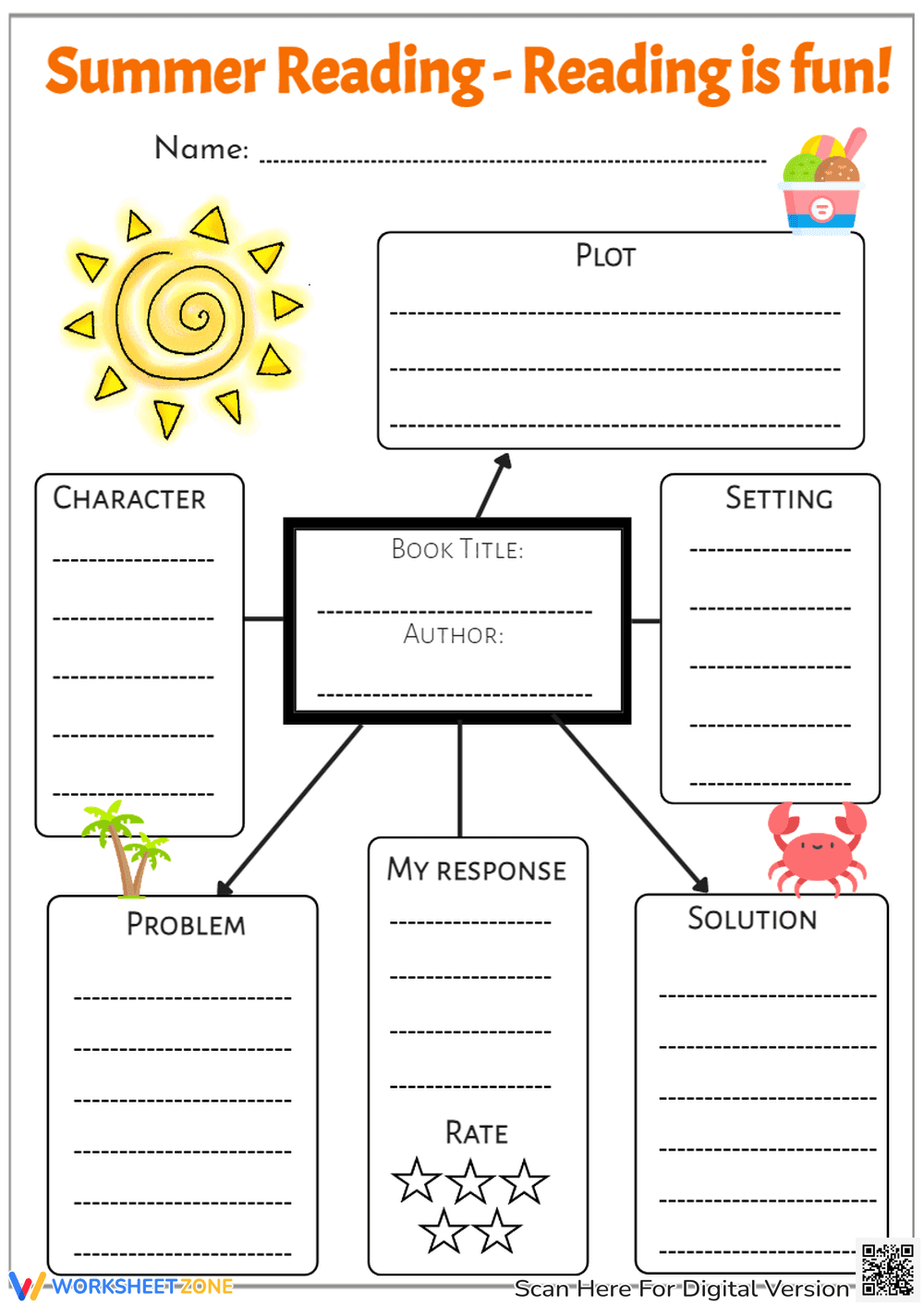

Summer Reading Book Report | Grade 3-6 Essential
Paste this activity's link or code into your existing LMS (Google Classroom, Canvas, Teams, Schoology, Moodle, etc.).
Students can open and work on the activity right away, with no student login required.
You'll still be able to track student progress and results from your teacher account.
This Grade 3-6 summer reading book report worksheet provides a structured graphic organizer for students to analyze key story elements. By identifying the plot, characters, and setting, learners develop a comprehensive understanding of narrative structure. It is an ideal tool for maintaining literacy skills during summer break or as a back-to-school assessment.
At a Glance
- Grade: 3-6 · Subject: ELA
- Standard:
CCSS.ELA-LITERACY.RL.3.3— Describe characters in a story and explain how their actions contribute to the sequence of events- Skill Focus: Story Elements & Analysis
- Format: 1 page · 8 tasks · No answer key · PDF
- Best For: Summer reading logs and book reviews
- Time: 20–30 minutes
The worksheet features a visually engaging summer-themed layout with eight distinct sections. It includes dedicated spaces for the book title and author, followed by expansive boxes for plot summary, character descriptions, and setting details. Students also address the central problem and solution, provide a personal response, and give the book a star rating from one to five.
This resource is designed for immediate use with a total teacher prep time of under 2 minutes. Simply print the single-page PDF and distribute it to students. Reviewing the completed organizers takes only moments, as the clear visual boundaries allow for quick checks of student comprehension and engagement with the text. It is a perfect addition to any emergency sub plan or independent reading block.
The primary standard addressed is `CCSS.ELA-LITERACY.RL.3.3`, which requires students to describe characters in a story and explain how their actions contribute to the sequence of events. This organizer also supports RL.4.3 and RL.5.3 by prompting students to identify the setting and plot development. Both standard codes can be copied directly into lesson plans, IEP goals, or district curriculum mapping tools.
Use this worksheet as a summative assessment after a student finishes a book to gauge their grasp of narrative components. It also serves as an excellent formative assessment during literature circles to record the progression of a story's problem and solution. Expected completion time ranges from 20 to 30 minutes depending on book complexity.
This resource is tailored for students in grades 3 through 6, offering space for detailed writing while remaining accessible. It is particularly effective for reluctant writers who benefit from visual scaffolding. Pair this with a summer reading list or a classroom anchor chart on story elements for maximum instructional impact.
Research by Fisher & Frey (2014) emphasizes that graphic organizers serve as vital cognitive scaffolds, helping students organize their thoughts and improve reading comprehension by making abstract story structures visible. This worksheet aligns with CCSS.ELA-LITERACY.RL.3.3, focusing on the essential skill of identifying characters, settings, and plot events. By requiring students to synthesize the problem and solution, the resource encourages higher-order thinking beyond simple recall. According to the RAND AIRS 2024 report, structured reading logs significantly increase student accountability and engagement during independent reading periods. This printable tool provides a clear framework for evidence-based responses, ensuring that students can articulate their understanding of a text's internal logic. It is a reliable resource for educators seeking to bridge the "summer slide" with meaningful, standards-aligned literacy practice that is both functional and student-friendly.


